

Walk into an old Roman bathhouse or a Lisbon pavement, and you are standing on mosaico. The word is Italian, Spanish, and Portuguese for mosaic, and it covers everything from a museum floor to a kitchen backsplash.
This guide treats the word the way most homeowners search it: small tiles set in sheets or patterns for walls, floors, showers and counters. It covers materials, shapes, grout, slip resistance,e and installation.
Numbers come from named sources, and where they disagree, you will see the disagreement. Anything I worked out myself is labelled as mine.
What the word means in practice
In a tile shop, a mosaic is a group of small tiles pre-set on a sheet. Mir Mosaic defines them as any combination of sizes, shapes, colors, and materials set on a sheet for easier installation.
That lets you lay many pieces at once.
The sheet is the practical point. Setting tiny pieces one by one is artistry. Setting them by the sheet is a weekend project for a careful beginner.
Outside tile shops, mosaico also means hand-set artwork, where pieces are placed individually into a pattern or picture. That is a craft project, and this guide is about the tile sheets you can buy and install.
The search term is ambiguous, so I have assumed home use. If you meant the art form or a brand name, the sections on materials and shapes still apply, but the installation advice will not.
A short glossary before you shop
Thin-set is the cement-based adhesive that holds tile to the wall or floor. Substrate is the surface underneath, such as backer board. An expansion gap is the small space left at edges, later filled with caulk.
Sanded and unsanded describe whether the grout contains sand, which affects the joint width it suits. DCOF is a slip resistance rating. Backer board and waterproofing membranes are the layers that protect walls and floors from water.
Tesserae is the traditional word for the individual pieces in a hand-set mosaic. It is general knowledge rather than something taken from the sources above, but you will see it in art and history writing.
How small is small enough to count
Mir Mosaic says mosaic tiles are typically smaller than 2 by 2 inches. WhyTile points to a facial area of less than 9 square inches.
Those two lines do not match. A 2 by 2 tile has 4 square inches of face, while 9 square inches would allow a 3 by 3. That arithmetic is mine.
The practical answer is that no single standard settles it, so read the product spec for the actual tile size and the sheet size. A 1-inch penny round and a 3-inch hexagon behave very differently on a wall.
WhyTile adds that micro mosaics are measured in millimeters. It also says smaller tiles tend to look better in smaller spaces, a point that suits compact bathrooms.
Materials and what each one does
Mir Mosaic lists seven families. Glass reflects light, can make a space feel larger, and is non-porous, so a bathroom floor will not stain. Natural stone is classic, and natural veining means no two tiles match.
Porcelain and ceramic are durable and lower maintenance, with a wide range of finishes. Marble, stone and wood looks cost less than the real thing.
Shell, or mother of pearl, brings shimmer. Recycled glass is sustainable and comes in many styles. Waterjet mosaics, mostly stone with metal or shell accents, give a sculptural look. Metal adds sparkle in copper, silver,r and gold.
That page lists almost no drawbacks, which tells you it comes from a mosaic seller. I have noted where other sources add cautions.
Roca Tile USA warns that stone is porous and must be sealed before and after grouting, and that glass and metal need special adhesive. Those details change how you install each material, and they come up again below.
My own rule for choosing: porcelain for floors and wet zones where you want low fuss, glass for walls where light matters, stone where you accept maintenance, and metal or shell as accents rather than whole surfaces.
Shapes and patterns
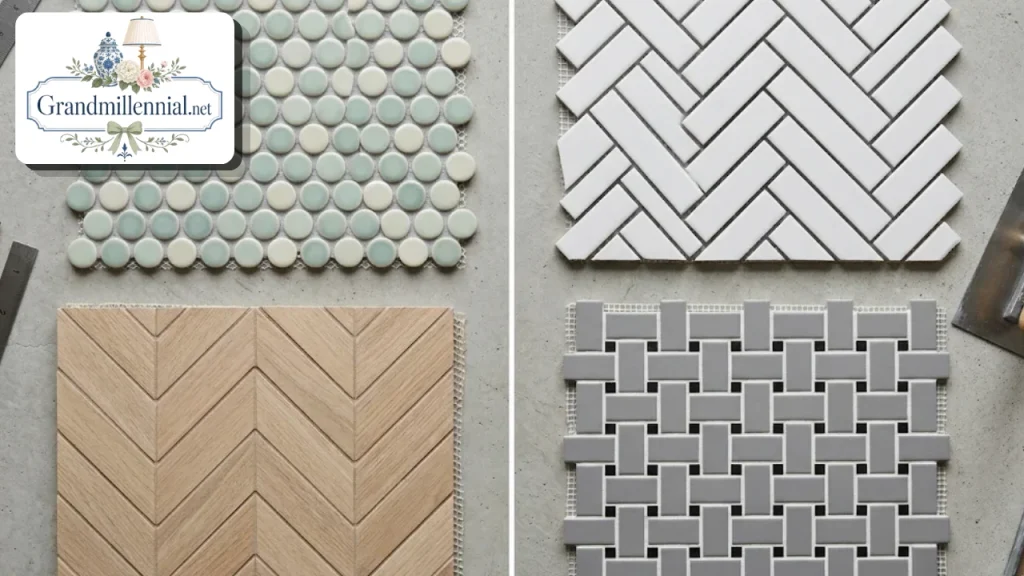
Mir Mosaic names basketweave, chevron, mini brick, arabesque, herringbone, hexagon, square, round, penny round, diamond, floral, geometric, octagon, and subway as common shapes.
Shape does more than style. Small round and hexagonal tiles create many grout joints, and WhyTile notes that on a bathroom floor those lines add traction. More joints also mean more grout to clean.
Straight grid layouts read as calm and modern. Chevron and herringbone add movement, which suits a feature wall or backsplash better than a whole room.
WhyTile describes mosaic feature walls as an alternative to painted accent walls. It also notes you can use as many colors as you want, or one color where the tile shape alone creates texture.
A mix of tile colors in a sheet can look busy in a small room. Test the layout by dry-laying a sheet on the floor and standing back before you commit.
Where mosaics work in the home
Mir Mosaic lists uses by room. In kitchens: backsplashes, floors, and an accent wall above the range. In bathrooms: backsplashes behind vanities, accent walls, shower walls, and glass floors.
It also lists shower pans, living room murals and medallion floors, entryway and hallway floors, fireplace surrounds because the tiles withstand heat, and pool waterlines and patios.
That is a long list from a seller, so check each product’s rating before using it somewhere new. A tile suited to a wall may not be rated for a floor.
If you are weighing a mosaic backsplash against other styles, our kitchen backsplash ideas guide shows how a backsplash sits at eye level between counter and cabinet.
For a calmer, coastal approach, our coastal kitchen ideas list handmade ceramic, pale blue and green tile, and suggests letting a decorative backsplash be the star while the rest stays quiet.
Planning a backsplash
A backsplash is the easiest first project because it is vertical, rarely walked on, and small enough to finish quickly. It also protects the wall from moisture and staining, as WhyTile points out.
Start with the height, the outlets, and the edges. Plan where sheets will end so you do not finish with thin slivers at a corner or beside a window.
Dry-lay sheets on the counter first and look at the seams. Sheets that are pre-spaced usually hide the join, but a different grout width between sheets will show.
Our modern kitchen cabinets guide lists patterned backsplash tile among the ways to give simple cabinets more character, so match the busyness of the tile to the cabinets rather than competing with them.
In a bathroom, a mosaic backsplash behind the vanity is a smaller version of the same idea. Our small bathroom vanity guide helps you size the cabinet beneath it.
Floors and slip resistance
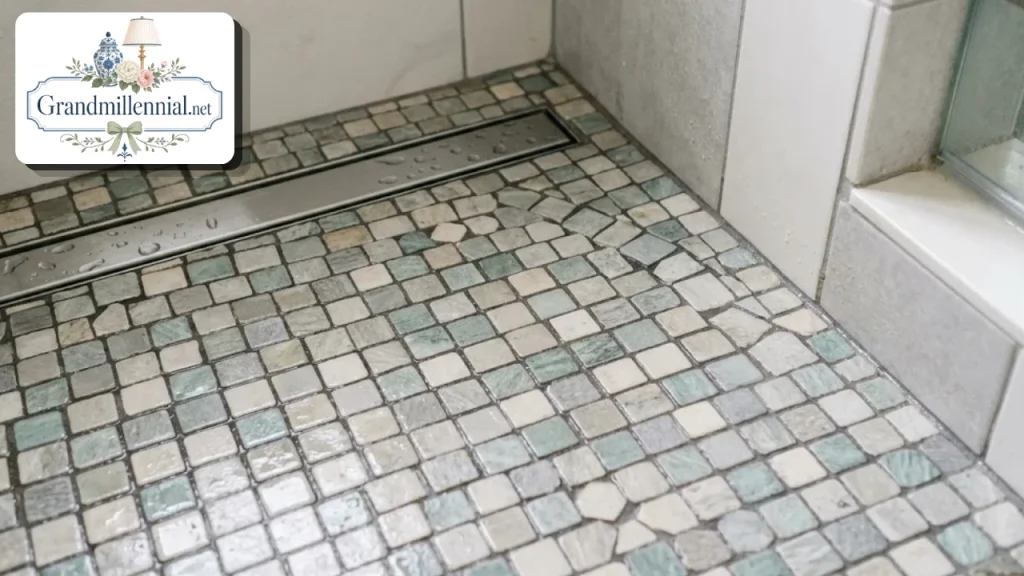
Roca Tile USA sets a baseline of a minimum DCOF value of 0.42 for tile on level interior floors, and calls DCOF critical for any floor application, especially wet areas.
DCOF is the dynamic coefficient of friction, a slip resistance rating. Wall-only products carry a label that reads “NA, WALL ONLY,” so look for it before you buy.
The same page says mosaics of 2 inches or less with a lower DCOF may still suit some uses, because of the added grout joints and surface texture. It gives no shower-specific numbers.
I would treat that as a reason to ask the seller, not a permission slip. For showers and pool decks, Roca points to a separate guide on DCOF for mosaic tile.
On a floor that stays wet, smaller tiles with more joints may grip better, while a polished tile may grip less. Check the rating for the exact product you are buying.
Showers and wet zones
In wet areas, the Tile Shop guide says to use backer board or a waterproofing membrane under the tile. That layer, not the tile, keeps water out of the wall.
For shower floors and other wet spots, Flooring Clarity recommends epoxy grout, which is waterproof and stain-resistant but more expensive and harder to work with.
Flooring Clarity also says persistent mold points to a moisture problem. In that case, check the waterproofing and ventilation, not just the cleaner.
If your bathroom is still at the planning stage, our small 3/4 bath layout and hall bathroom design ideas show where a shower and its tile fit.
Grout choice, joint width, and color
Flooring Clarity splits cement grout into unsanded and sanded. Unsanded suits fine mosaics with joints under 1/8 inch. Sanded suits joints of 1/8 inch or wider, mainly on floors.
Roca Tile USA agrees on the 1/8 inch line. It adds that unsanded grout is needed for delicate materials like some glass or marble, and sanded grout on glass only if the manufacturer approves.
Narrow joints of 1/16 to 1/8 inch, according to Flooring Clarity, are typical for glass and small mosaics, and they accentuate the pattern. Wider joints of 1/8 to 1/4 inch need sanded grout for stability.
Epoxy is the third option: waterproof and stain-resistant, usually needing no sealing. Cement grout is cheaper and easier but must be sealed.
Color matters as much as type. Light grout brightens the mosaic and emphasizes individual tiles. Dark grout blends the joints and highlights the overall pattern.
For multicolored mosaics, Flooring Clarity suggests a grout that complements the dominant hues. Test a small patch, since grout dries lighter or darker than it looks wet.
Hard water leaves limescale on tile and fixtures, which is worth knowing before you choose a pale grout. Our guide to softening water covers that side of upkeep.
The surface underneath
Roca Tile USA says a perfectly flat and level substrate is crucial for mosaics, since small tiles amplify unevenness. Mir Mosaic adds that mosaics are prone to wave formation after laying.
That is why you tap sheets flat into the thinset and check with a level as you go. A wavy wall is hard to hide with tiny tiles because each seam catches the light.
For floors, stiffness matters. Our best flooring for a second floor guide says that tile and stone do not flex, so a bouncy floor leads to cracked grout and loose tiles.
It cites a deflection limit of about L/360 for ceramic and porcelain tile and a stricter L/720 for natural stone, and recommends a contractor or structural engineer check joists beyond a bathroom.
Hairline grout cracks, Flooring Clarity says, are usually caused by substrate movement. If you see them, look at what is moving underneath before you regrout.
Installing sheets step by step
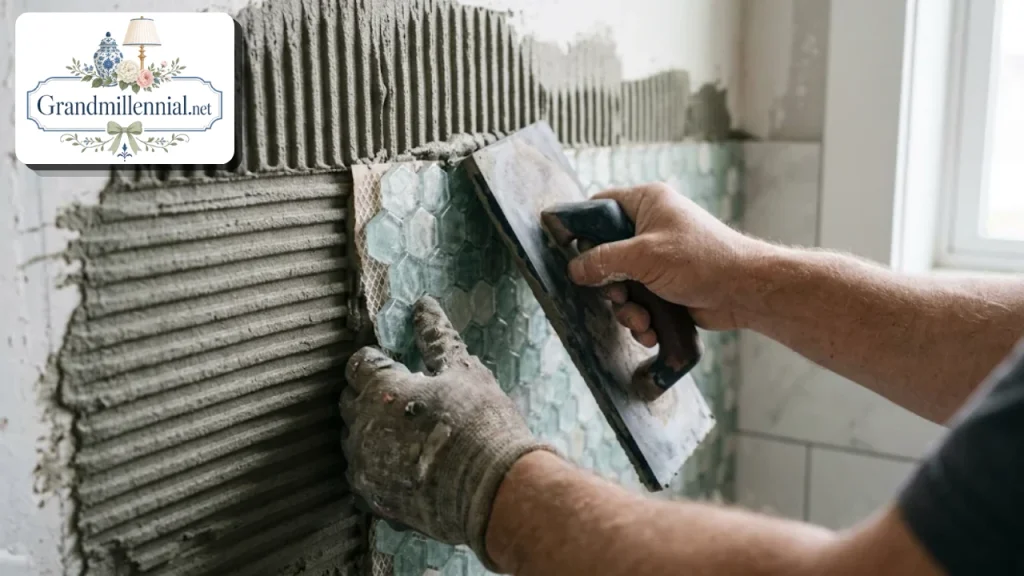
The Tile Shop guide gives a clear order. First, make sure the surface is clean, dry,y and flat, and patch holes or cracks. Second, measure the area, dry-lay the sheets, and mark layout lines with a level.
Third, flip each sheet face down and cut the mesh backing between tiles with a utility knife where you need to trim. Fourth, mix only the thinset you can use in about 20 minutes.
Spread it in small sections, press the sheets in place, tap them with a grout float,t and check with a level. Use spacers if the tiles are not pre-spaced.
Leave a 1/8 inch expansion gap where tile meets countertops or walls, and let the thinset cure fully before grouting. The page names no cure time and defers to the manufacturer.
Mix grout to a peanut-butter consistency and use it within 20 to 30 minutes. On walls, grout from bottom to top.
On floors, start at the point furthest from the door and work backward, working diagonally at about 45 degrees.
After 15 to 30 minutes, shape the joints and remove excess. Let the grout dry 24 to 72 hours per the manufacturer, buff off haze, apply sealer, and caulk the expansion gap after the drying period.
Wear gloves and eye protection while cutting. That advice is mine, not from the guide.
Handling glass and metal
Roca Tile USA gives specific warnings for glass. Use white thinset so the tile’s true color and luminosity come through, because standard cement thinset may show through transparent glass.
It recommends epoxy or urethane adhesive for glass and metal, and a wet saw with a dedicated glass blade. It also says trowel lines can show through highly reflective pieces.
In practice, that means spreading adhesive evenly, since trowel lines can show. Ask the manufacturer for a compatible adhesive, since the wrong one can ruin an entire wall.
Glass and metal also need gentler cleaning. Roca recommends a soft cloth and a pH-neutral cleaner for glass, and non-abrasive cleaners for metal.
Recycled glass can be scratched by abrasive cleaners. Keep scouring pads out of the kit.
Sealing, cleaning and upkeep
Grout is porous, Mir Mosaic notes, so seal it with the sealer the grout manufacturer recommends. Flooring Clarity says to seal cement grout after full cure, usually 48 to 72 hours.
For re-sealing, sources differ. Flooring Clarity says every 1 to 3 years in high-traffic or wet areas.
Roca says maintenance on stone requires sealing every 1 to 2 years. They cover different materials, so follow the product’s own instructions.
For daily cleaning, Flooring Clarity recommends pH-neutral cleaners made for tile and grout. A mild bleach solution can handle biological stains after a test in a hidden spot.
Roca warns that acidic or abrasive products can etch stone. Ventilate bathrooms to cut mold and mildew, and inspect for cracks or loose tiles so you can fix them early.
Haze is common on cement grout, according to Flooring Clarity. Remove it within the manufacturer’s recommended time with a haze remover.
Groutless shell options, such as the Sea and Shell collections, avoid grout lines entirely, Mir Mosaic says. That is a seller’s claim, so ask about the maintenance for any specific product.
A weekend plan for a first backsplash
This plan is mine, built from the Tile Shop steps and timings above. It is meant for a small, flat, dry wall, not a shower. Adjust it to the manufacturer’s instructions for your tile and adhesive.
On Friday evening, clean and patch the wall, mark layout lines, and dry-lay every sheet on the counter. Cut the mesh where you need to trim, and decide where the seams will fall.
On Saturday morning, mix a small batch of thinset and set the first sheets from the bottom center. Tap each flat and check it with a level before the next.
Leave the gap at the counter and walls, then stop and let the thinset cure fully. Do not rush to grout the same afternoon. The Tile Shop page defers to the manufacturer on cure time.
On Sunday, mix a small batch of grout, work it diagonally, and shape the joints after 15 to 30 minutes. Let it dry for the time on the bag, then buff, seal, and caulk.
How to read a product spec
Before you buy, find five things on the spec sheet: the tile size, the sheet size, the material, the slip rating if it is for a floor, and the recommended adhesive and grout.
If the sheet says wall only, keep it off the floor. If it is glass or metal, ask which adhesive and grout the manufacturer approves.
Check whether the sheet is pre-spaced. That affects the grout width you can use, and so the grout type. Look for sealing instructions, especially for stone.
I would also buy a little more than the measured area, since cuts and breakage are normal. That is my advice, not a figure from the sources, and the right amount depends on the pattern.
Picking by room
This table is my own synthesis of the sources above, not a published standard. Always confirm the rating and instructions for the exact product.
| Room | Good starting point | Check first |
|---|---|---|
| Kitchen backsplash | Glass, ceramic or stone sheets | Edges and outlets, sheet ends |
| Bathroom wall | Glass or porcelain | Backer board or membrane behind |
| Shower floor | Small porcelain with epoxy grout | DCOF rating and slope |
| Bathroom floor | Porcelain or stone | DCOF 0.42 minimum, flat substrate |
| Fireplace surround | Stone or porcelain | Manufacturer heat rating |
| Upstairs floor | Porcelain, mind the limits | Floor stiffness, L/360 |
The fireplace row comes from Mir Mosaic’s statement that tiles withstand heat. I would still check the manufacturer’s rating for the specific tile and adhesive.
Five mistakes that cost the most
First, buying without checking the DCOF or wall-only label for floor use. A beautiful tile that is wall-only is a hazard on a wet floor.
Second, using sanded grout in narrow joints or on delicate glass. Roca and Flooring Clarity both flag unsanded grout for joints under 1/8 inch.
Third, skipping the dry layout. Mosaicco wall with one wrong seam is obvious every day.
Fourth, ignoring the substrate. Waves, flex,x and moisture show up in the tile later. Fifth, using the wrong adhesive on glass or metal, which can show through the tile.
Pairing mosaics with the rest of the room
A busy tile needs quiet neighbors. Our bathroom wallpaper ideas suggest tile in areas exposed to more water and wallpaper on drier upper walls, coordinated by undertone or pattern scale.
That same page recommends a finishing profile or narrow painted rail where tile ends at an awkward level. It is a neat trick for a mosaic that stops halfway up a wall.
For other walls in the room, our how-to-decorate-walls guide suggests choosing one dominant wall and keeping the adjacent one simpler. A mosaic feature wall is a strong candidate for the dominant one.
If the bathroom itself is changing, our 6×8 bathroom layout guide and master bath plan show where tile surfaces land.
The short version
Mosaico tile is small pieces on sheets, and the details that matter are the ones under and between the tiles: a flat, waterproofed surface, the right grout for the joint width, and a slip rating that suits the floor.
Choose the material by room, test the layout dry, and follow the manufacturer on adhesive and sealing. Sources disagree on sizes and re-sealing intervals, so the product sheet wins.
FAQs:
What is mosaic tile used for?
Mir Mosaic lists kitchen and bathroom backsplashes, shower walls and pans, floors, fireplace surrounds, pools and patios. Always confirm the rating for each use.
How small is a mosaic tile?
Mir Mosaic says typically smaller than 2 by 2 inches. WhyTile cites a face of less than 9 square inches. Check the product spec.
Which grout is best for mosaic tile?
Unsanded cement grout suits joints under 1/8 inch. Sanded suits 1/8 inch and wider. Epoxy suits showers. Glass needs the manufacturer’s approval for sanded grout.
Can mosaic tile go on a bathroom floor?
Yes, if it is rated for floors. Roca Tile USA sets a minimum DCOF of 0.42 for level interior floors, and wall-only tile is labelled as such.
Do mosaic tiles need sealing?
The grout does, if it is cement-based, and natural stone does too. Epoxy grout typically does not. Follow the manufacturer’s schedule.
How long should grout dry before sealing?
Flooring Clarity says to seal cement grout after full cure, usually 48 to 72 hours. Tile Shop says dry 24 to 72 hours per the manufacturer.
Why do mosaic walls look wavy?
Mir Mosaic says mosaics are prone to wave formation after laying. Tap sheets flat into the thinset and check with a level.
Is mosaic tile hard to install?
It is manageable with careful prep, since sheets speed the work. A flat substrate, correct adhesive, and a dry layout matter most.