

Hard water leaves white crust on kettles, film on shower glass, and a stiff feel on laundry. The cause is dissolved calcium and magnesium, and the fix has a name: water softening.
Softening of water means removing or neutralizing those minerals so soap lathers, scale stays out of pipes,s and appliances last longer. Britannica defines it as removing the dissolved calcium and magnesium salts that cause hardness.
The methods range from a home resin tank to a municipal plant that adds lime by the ton. They solve the same problem in very different ways.
This guide covers the main methods, the hardness numbers that decide whether you need one, and the sodium question people worry about. Where a figure is my own arithmetic, I say so, and where sources disagree, I show both.
What hardness is and where it comes from
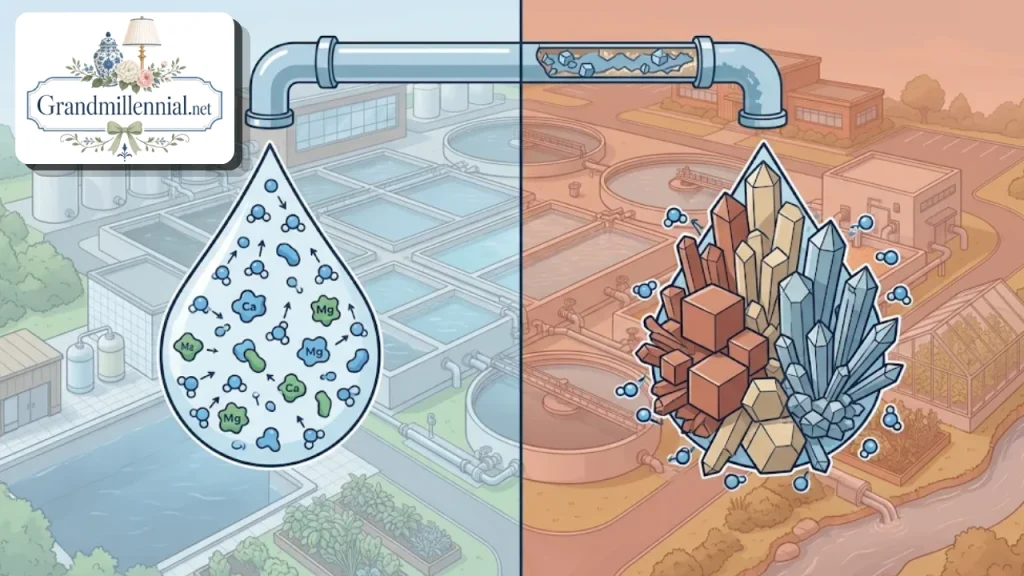
Rain is soft. As water moves through the ground, it dissolves minerals, and in limestone or chalk country it picks up calcium and magnesium. Home Depot’s guide makes the same point: rainwater falls soft, then absorbs minerals as groundwater.
Those two minerals are harmless to drink in normal amounts, but they cause trouble when the water is heated, evaporates,d or is mixed with soap.
Soap reacts with calcium and magnesium to form an insoluble curd instead of lather. Britannica notes that this wastes soap, though it adds that modern detergents do not have this problem.
Heat is the second cause. In boilers and water heaters, hard water leaves scale that slows heat transfer and raises fuel use, according to Britannica. In a kettle, you see it as a white crust.
Hardness is reported as the combined calcium and magnesium, expressed as calcium carbonate. That convention matters later, because every hardness number in this article uses it.
The result is that hardness is a property of where you live and where your water comes from. A town on one aquifer can have soft water while a town a few miles away has very hard water.
Temporary and permanent hardness
Hardness comes in two kinds, and the difference decides which fix works. A civil-engineering lecture handout uploaded to Scribd calls them carbonate and non-carbonate hardness.
Carbonate hardness, also called temporary hardness, comes from calcium and magnesium bicarbonates. Boiling breaks the bicarbonates down, and the minerals settle out as scale, which is why a kettle furs up.
Non-carbonate hardness, called permanent hardness, comes from other calcium and magnesium salts such as sulfates and chlorides. Boiling does not remove it, according to the same handout.
This is why boiling water at home is not a general answer. It helps only if your hardness is mostly the temporary kind, and it does nothing at the tap for washing or showering.
It also explains why the lime-soda process uses two chemicals. The same handout says lime treatment alone targets carbonate hardness, while lime plus soda ash removes both kinds.
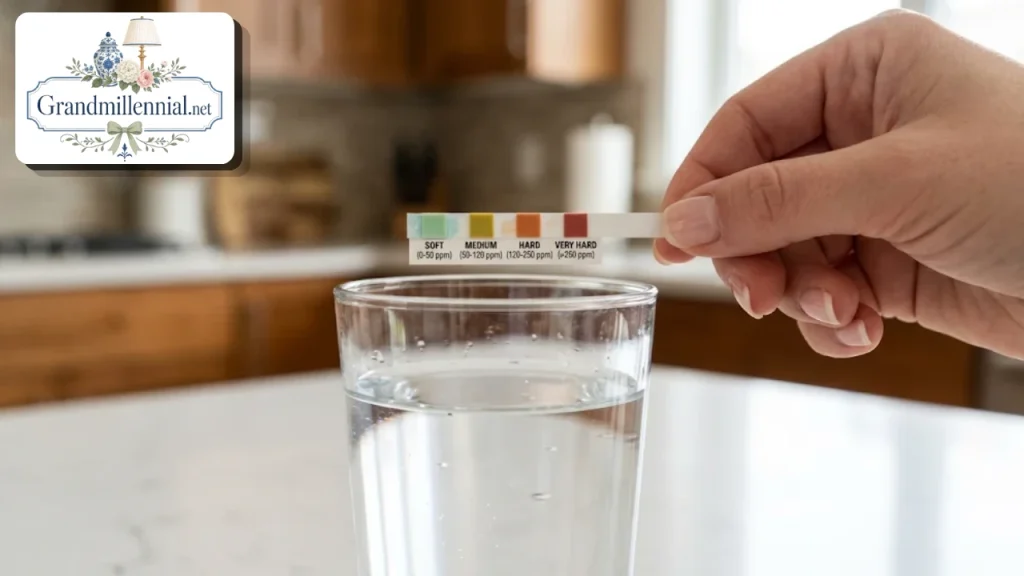
You can find out which type you have from a full water analysis. A home test strip reports total hardness only, so a lab report or your utility’s quality report is the place to look for the split.
How hard is hard? The numbers in two units
Search results quote hardness in two units, and that is the source of a lot of confusion. Grains per gallon (gpg) are common in the home market. Milligrams per liter (mg/L, the same as parts per million) are used by scientists and agencies.
The conversion is one grain per gallon to 17.1 mg/L, which several sources give. The US Geological Survey (USGS) classifies hardness as calcium carbonate in four bands.
| USGS class | mg/L as calcium carbonate | Grains per gallon (my conversion) |
|---|---|---|
| Soft | 0 to 60 | 0 to 3.5 |
| Moderately hard | 61 to 120 | 3.5 to 7.0 |
| Hard | 121 to 180 | 7.0 to 10.5 |
| Very hard | More than 180 | More than 10.5 |
The gpg column is my own division by 17.1, though several sites print the same bands. For example, 120 divided by 17.1 is about 7.0, and 180 divided by 17.1 is about 10.5.
Two retailers use a rule of thumb that lines up with those bands. Lowe’s says a test of seven grains per gallon or higher makes a softener a good option, and Home Depot says seven often indicates one may be needed.
Seven grains per gallon is about 120 mg/L (my arithmetic), which is the top of the moderately hard band. That is the point where the softening of water starts to pay off for most households.
TapWaterData, an aggregator, reports a median of about 100 mg/L across the 7,614 US cities it indexes, which is moderately hard. Treat that as a rough guide, because it is a website and not a government survey.
Ion exchange: how a home softener works
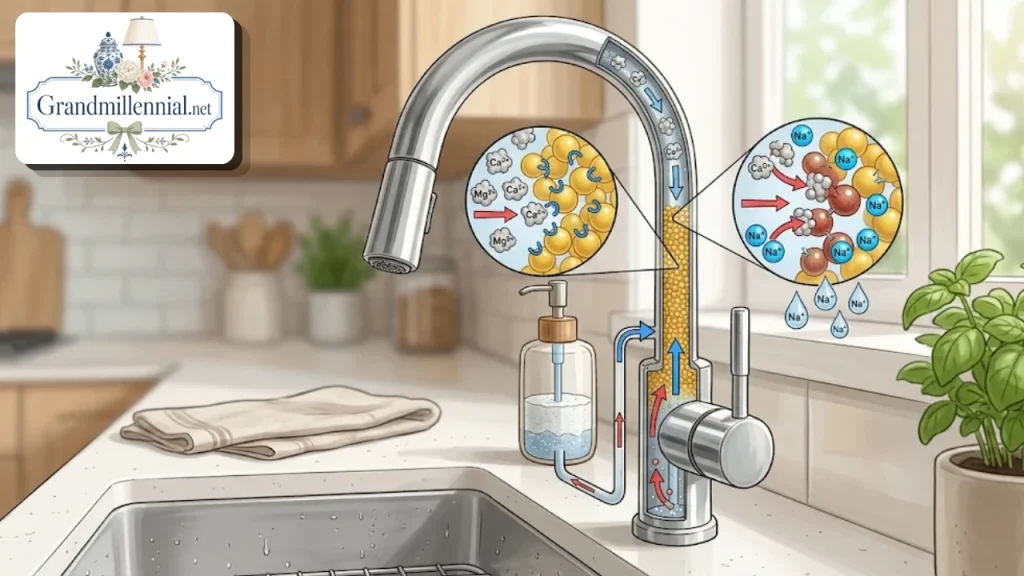
Almost every household softener works by ion exchange. Britannica describes passing water through a resin that trades sodium ions for calcium and magnesium ions.
Lowe’s breaks the process into four steps. Water enters a tank of resin beads coated with sodium. The beads attract the mineral ions, the water picks up sodium in exchange, and the softened water flows into the plumbing.
The fourth step is regeneration. Eventually, the beads are full of calcium and magnesium, so the system washes them with brine to flush out the minerals and restore the sodium.
A typical unit has three main parts, per Lowe’s: a resin tank, a brine tank that holds the salt, and a control valve that monitors use and triggers regeneration.
The resin is made of beads of a synthetic polymer. Wikipedia describes them as organic polymers with sites that hold calcium more strongly than sodium, which is why the exchange runs in one direction.
Ion exchange is the most thorough route to softening of water in homes. The trade site waterandwastewater.com says it can reduce hardness to near zero, which fits how the process works.
One thing it does not do is remove other contaminants such as bacteria, chemicals, or most metals. It is a softener, not a purifier, so a separate filter is needed if you have other concerns.
Regeneration, salt and water use
Regeneration is the part of a softener that costs money. Home Depot says the cycle runs on a preprogrammed schedule, such as every 10,000 gallons, and at least weekly in most homes.
It also says a regeneration cycle can use about 50 gallons of water on average, though use varies by system. That water, now full of minerals, goes down the drain.
Salt is the running cost. Home Depot says many residential models use about 10 pounds of salt per week, or 40 to 50 pounds per month. Neither retailer gives a price, so I cannot cost it.
Harder water and more use mean more frequent cycles. That is why the hardness test comes first. The same unit costs far more to run on very hard water than on moderately hard water.
A single-tank softener cannot soften water while it regenerates, according to both Lowe’s and Home Depot. Many systems are set to run at night, and dual-tank units avoid the gap.
Brine discharge is an environmental concern. A vendor site, waterandwastewater.com, lists brine discharge that can affect local water sources as a downside of salt-based systems, though it is a vendor and gives no figures.
Some local authorities restrict or ban salt-based softeners for this reason. I did not find a source for which places do, so check your local rules before you install one.
Lime-soda and other chemical methods
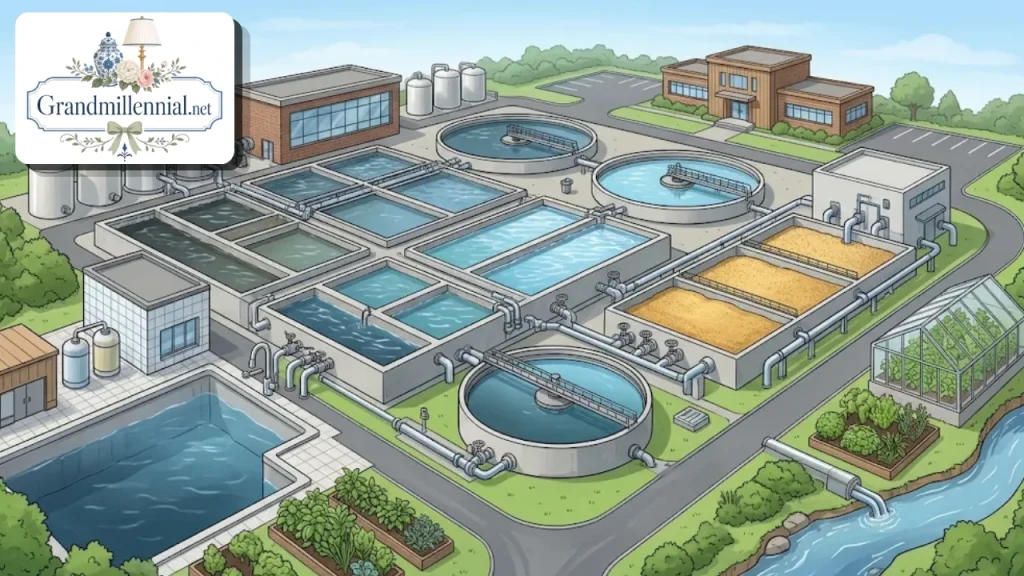
Ion exchange is the home method. At the municipal scale, the older approach is chemical precipitation. Britannica describes adding chemicals that form insoluble precipitates, which are then removed.
In the lime-soda process, lime (calcium hydroxide) precipitates calcium as carbonate and magnesium as hydroxide. Soda ash (sodium carbonate) then removes the remaining calcium. Britannica says sedimentation and filtration must follow.
One course page says the process is simple and suits extremely hard water. The same page lists the downsides: a large quantity of sludge to dispose of, and a need for skilled supervision.
Another set of student slides says lime-soda cannot take hardness to zero, because calcium carbonate and magnesium hydroxide are slightly soluble. I found that claim on slides, not in a textbook, so treat the specific figure with caution.
Sources disagree on how current the method is. OER Commons calls it obsolete but useful for large volumes, while Britannica describes it as a large-scale method. My reading is that both are true: it is a plant-scale method, not a home one.
Other chemical agents exist at small scale. Britannica lists ammonia, borax, slaked lime,e and trisodium phosphate, usually with soda ash. These are old-fashioned laundry-room methods, not a modern household solution.
Chelating agents are a related idea. Wikipedia mentions sequestration, where an additive ties up the minerals so they do not form scale, but the water itself is not softened.
Reverse osmosis and distillation
Two non-chemical methods also remove hardness. Wikipedia says distillation and reverse osmosis are the two most widely used non-chemical methods of water softening.
Distillation boils water and condenses the steam, leaving the minerals behind. Wikipedia calls it expensive and energy-inefficient compared with other methods. Rainwater is soft because nature distills it.
Reverse osmosis forces water through a semipermeable membrane. Home Depot says it removes minerals and contaminants. That makes it more of a purification method than a softener.
Membranes need regular cleaning or replacement, according to Wikipedia. That is a running cost, and the pages I read do not give figures for it.
In practice, home reverse osmosis units are usually fitted at one tap for drinking water, because treating a whole house this way would be costly. That is my general understanding, not a claim from the sources.
If your goal is scale-free pipes and soft showers, reverse osmosis is the wrong tool. If your goal is clean, low-mineral drinking water, it fits well and pairs with a softener.
A softener and a reverse osmosis unit can work together. The softener protects the membrane from scale, and the membrane polishes the drinking water, including the sodium the softener adds.
Salt-free conditioners: softening or not?
Salt-free systems are sold as softeners, and that is where most of the argument begins. Lowe’s says salt-free devices are conditioners and descalers, not softeners, because the minerals stay in the water.
Instead of removing hardness, these devices change how the minerals behave. The most common type, called template-assisted crystallization, turns dissolved minerals into tiny crystals that are less likely to stick.
A test strip would show the same hardness before and after, which is the key point. One vendor, SoftPro, says treated water measures the same in grains per gallon, and it sells salt-based units, so weigh that.
Another vendor, US Water Systems, says salt-free systems are not softeners and calls its own product a conditioner. It also sells water treatment equipment, so read the argument as sales talk with some truth in it.
There is some evidence for the scale claim. A table on Wikipedia, citing tests on hard water from Tempe, Arizona, shows scale formation at 0.04 with crystallization and 0.06 with ion exchange, against 1.00 with no treatment.
I only saw that table in a search snippet, and it is a single test on one water supply. It suggests conditioners can reduce scale, not that they soften.
Home Depot describes salt-free softeners as using potassium chloride in place of sodium. That is a different thing: potassium chloride is itself a salt, and those units still use ion exchange. It is a potassium softener, not a salt-free one.
Sodium: how much it adds
Ion exchange swaps hardness for sodium, so softened water contains more sodium than the source water. The amount depends on how hard the water was.
Sources give slightly different rates. An extension publication on core.ac.uk says about 8 mg per liter for each grain per gallon removed. A vendor page (CrystalQuest) cites 7.5 as a Water Quality Association rule of thumb. TapWaterData gives 7.9.
The 7.9 figure matches 30 mg per gallon divided by 3.785 liters, which is my own check. The range is narrow, so the choice among them hardly changes the result.
Here is a worked example, using 8 mg/L per grain (my arithmetic). Water at 10 grains per gallon gains about 80 mg/L of sodium, and an 8-ounce glass, about 0.237 liters, would hold about 19 mg.
The Environmental Protection Agency (EPA) has a drinking-water advisory of 20 mg/L of sodium for people on a very restricted diet of 500 mg per day, according to University of Arizona Extension and a Louisiana health department report. It is not an enforceable standard.
The same publication gives 30 to 60 mg/L as the EPA taste range. Softened water at 80 mg/L is above both, which is why people on restricted diets should talk to a doctor.
For most people, water is a small part of sodium intake. The University of Arizona publication says there is no health-related standard for sodium in drinking water. If you are restricted, ask your doctor and test your softened water.
One practical fix is to leave one tap, such as the kitchen cold tap, on unsoftened water. A reverse osmosis unit at the drinking tap is another, since it generally removes much of the sodium.
I saw one vendor page quote 750 mg of sodium per gallon for softened water, which does not match the per-grain figures above. I did not use it.
Which method for which job
The methods are not rivals so much as tools for different scales and goals. This table is my own summary of the sources above.
| Goal | Method | Strength | Limit |
|---|---|---|---|
| Whole-house hard water | Ion exchange softener | Reduces hardness to near zero | Adds sodium, uses salt and water |
| Large-scale municipal or industrial | Lime-soda | Suits very hard water | Sludge, skilled operation |
| Drinking water at one tap | Reverse osmosis | Removes minerals and more | Membrane upkeep, not for whole house |
| Scale control without brine | Salt-free conditioner | No sodium, no brine | Hardness unchanged |
| Small, occasional use | Boiling | Cheap | Temporary hardness only |
| Specialty lab use | Distillation | Very pure | Energy-intensive |
Use the table as a start, not a verdict. A household on very hard water and a household on moderately hard water have different best answers.
For true softening of water, meaning soap that lathers and no film on glass, ion exchange is the method that does it. If you only want to protect a tankless heater from scale, a conditioner may be enough.
For whole-house use, the main question is whether you can accept the salt and wastewater. If not, a conditioner or a potassium-based unit is the compromise.
Do you need to treat your water?
Start with a test. Lowe’s and Home Depot both point to about seven grains per gallon as the level where a softener becomes worth considering.
Below that, moderately hard water causes minor scaling and many homes simply live with it. Above it, the symptoms are hard to ignore: scale on fixtures, spotted dishes, and poor lather.
The softening of water is an optional upgrade, not a safety need. Hard water is not a health risk in the way a contaminant is, so the decision is about comfort, appliances, and cost.
The Scribd lecture handout suggests treatment is needed above about 150 to 200 mg/L, which is higher than the retail thresholds. That reflects engineering practice for supplies, not a home preference.
Think about the household too. Hard water costs more where hot water use is heavy, where a tankless heater is installed, or where people have sensitive skin, so those homes may act at a lower reading.
Check your utility’s annual water quality report first, since it often lists hardness. If you use a private well or borehole, test it yourself, because no utility does it for you.
A test also tells you about other problems. Iron, for example, can foul a softener resin, though I did not find a source in this research, so ask the equipment maker about limits.
If your result is in the moderately hard band, try simple steps first, such as a descaling product for the kettle. Move to treatment only if the symptoms persist.
Common mistakes
The first mistake is buying before testing. A system sized for very hard water is wasteful on moderately hard water, and one sized too small will regenerate constantly.
The second is mixing up softening and conditioning. If a product does not remove hardness, a test will show the same number, so do not expect soap to lather any better.
The third is ignoring sodium. If anyone in the home is on a sodium-restricted diet, plan an unsoftened drinking tap or a reverse osmosis unit from the start.
Another is forgetting the salt. A softener with an empty brine tank stops softening, and many homes do not notice for weeks. Check the level monthly.
People also mistake units. A report in mg/L read as gpg makes the water look seventeen times harder than it is. Convert with the 17.1 figure before comparing numbers.
Finally, do not trust one page. The retail and vendor pages I read contradict each other on potassium, sodium, and salt-free systems. Cross-check with a utility, an extension service or a water professional.
Before you buy or build
A sensible path to softening of water starts with a number and ends with a quote. Work through these steps in order.
First, get your hardness in both units. Use the utility report or a test, and convert with 17.1 so you can compare any source.
Second, decide your goal. Soft showers and clean glass need a softener, while scale protection for a heater alone may need only a conditioner.
Third, check sodium needs. If anyone is restricted, plan a separate drinking tap. Fourth, ask local plumbers about brine discharge rules and installation needs, and get written quotes.
Fifth, ask for the maker’s sizing method and the expected salt use. Home Depot’s 40 to 50 pounds per month is a retailer’s typical figure, not a promise for your home.
Finally, plan upkeep. Salt refills, a yearly check of the valve and resin, and a test after installation tell you whether the system is working.
Water softening is a practical fix for a common problem. Test first, pick the method that fits your goal, and you can enjoy soft water without paying for more than you need.
FAQs:
What is water softening?
It is the removal of the dissolved calcium and magnesium that make water hard. Britannica describes it as removing those salts, usually by adding chemicals or using ion exchange.
How does a home softener work?
Hard water passes through resin beads coated with sodium. The beads hold calcium and magnesium and release sodium. The beads are washed with brine when full, as Lowe’s explains.
At what hardness do I need a softener?
Lowe’s and Home Depot point to about seven grains per gallon, roughly 120 mg/L by my conversion. Test first, since the right level depends on your symptoms and budget.
Is softened water safe to drink?
For most people, yes, but it contains added sodium. The EPA advises 20 mg/L only for people on very restricted diets. Ask your doctor if you are restricted.
Do salt-free softeners really soften water?
Lowe’s says they are conditioners, not softeners, because the minerals stay in the water. They may reduce scale, but a hardness test will read the same.
Does boiling soften water?
Only temporary (carbonate) hardness. A civil-engineering lecture handout says boiling does not remove non-carbonate hardness.
How much salt does a softener use?
Home Depot says many residential models use about 10 pounds per week, or 40 to 50 pounds per month. Use depends on tank size and hardness.
What is the difference between ion exchange and lime-soda?
Ion exchange swaps minerals for sodium on resin and suits homes. Lime-soda precipitates minerals with chemicals and suits large plants, according to Britannica.