

Bathrooms are often designed around hard surfaces. Tile covers the floor, ceramic surrounds the sink, glass encloses the shower, and stone or quartz finishes the vanity. All of these materials make sense from a practical standpoint, but together they can leave a room feeling cold or overly functional.
Wallpaper changes that balance. It introduces softness, color, rhythm, artwork, and personality without asking you to replace plumbing or rebuild the room. In the right setting, wallpaper can make a modest bathroom feel more thoughtfully designed than one filled with expensive finishes.
The challenge is choosing a design that belongs in the space rather than simply choosing a pattern you like on a sample card. The most successful bathroom wallpaper ideas consider the entire room: its size, natural light, tile color, vanity style, moisture levels, ceiling height, architectural details.
And the way the bathroom is actually used. This guide approaches bathroom wallpaper from that perspective. Instead of treating wallpaper as decoration added at the end, think of it as one of the materials that shapes the room.
Start With the Mood, Not the Wallpaper Pattern
Before looking at wallpaper collections, decide how you want the bathroom to feel. That sounds simple, but it eliminates many poor choices. A bathroom can feel:
- calm and restorative
- dramatic and intimate
- playful and unexpected
- classic and traditional
- light and coastal
- artistic and contemporary
- warm and rustic
- tailored and luxurious
Those moods require very different wallpaper choices. A small leafy print in faded sage may suit a calm guest bathroom, while a black-background floral could completely transform a powder room into something theatrical.
If you begin by browsing hundreds of patterns without defining the mood, everything starts to look appealing. Start with atmosphere first. Pattern comes second.
Create a Garden-Like Bathroom With Leafy Wallpaper
Botanical designs remain one of the easiest wallpaper styles to use successfully in bathrooms. There is a natural connection between plants, water, freshness, and restorative spaces, which explains why leafy designs feel comfortable rather than forced. You do not need an obvious tropical print. Consider:
- delicate fern illustrations
- climbing vines
- eucalyptus leaves
- woodland foliage
- palm silhouettes
- watercolor branches
- stylized botanical drawings
For a softer bathroom, choose greenery against cream, warm white, or pale beige. For more drama, look for foliage printed against charcoal, dark green, navy, or deep blue.
A botanical pattern also works well when the bathroom has real plants. The repetition between wallpaper and living greenery can make a small room feel surprisingly layered.
Use Wallpaper to Introduce Color Without Replacing Tile
Many homeowners inherit bathrooms dominated by beige, gray, or white tile. Replacing perfectly usable tile simply because the room lacks character can be expensive.
Wallpaper gives you another route. Instead of fighting the existing tile, look closely at its undertones. Gray tile may contain blue, brown, green, or violet undertones. Beige tile may lean toward:
- cream
- sand
- peach
- yellow
- taupe
Choose wallpaper containing one of those underlying colors. You do not need an exact match. A loose visual connection is enough. For example, warm beige floor tile can work beautifully with wallpaper containing olive leaves, rust-colored flowers, and a soft cream ground. The room immediately looks more intentional.
Make a Powder Room Feel Like a Destination
Powder rooms are unusual spaces because people spend very little time in them. That permits you to make stronger decorative decisions. A wallpaper that might feel overwhelming across a large bedroom can feel perfectly balanced in a room measuring only a few square meters. Try:
- dark florals
- abstract patterns
- birds
- dramatic landscapes
- richly colored geometric designs
- illustrated animals
- oversized leaves
The goal does not have to be making the room appear larger. Sometimes a small room becomes more interesting when its scale is embraced rather than disguised. Think of the powder room almost like a decorative box. A concentrated dose of pattern can make it memorable.
Let a Soft Pattern Calm a Busy Bathroom
Not every bathroom needs a statement wall. If the room already includes patterned flooring, colorful cabinetry, visible shelving, or highly veined stone, another powerful visual element can make the space feel restless. This is where quiet wallpaper works well. Look for:
- pale stripes
- tone-on-tone leaves
- small dots
- faded block prints
- subtle linen effects
- watercolor washes
- tiny repeating motifs
From a distance, these designs often read as texture rather than obvious pattern. Up close, they add the detail that plain paint cannot provide. This can be especially effective in larger bathrooms where expanses of empty painted wall otherwise look unfinished.
Use Wallpaper Above the Vanity as Artwork
One of the smartest ways to use wallpaper is to treat the wall behind the vanity as a composition. The mirror becomes part of the artwork.
Before installing anything, study where the pattern will fall. If your wallpaper contains large flowers, birds, faces, architecture, or other recognizable motifs, avoid placing the mirror directly over the strongest part of the design. Ideally, the pattern should frame the mirror rather than disappear behind it.
This requires more planning than simply beginning in a corner and working around the room. For expensive wallpaper, dry-positioning the first few drops can be worth the effort.
Combine Wallpaper With a Strong Vanity Color
A painted vanity gives you a convenient bridge between wallpaper and the rest of the room. Instead of defaulting to white cabinetry, choose one color from the wallpaper and use it on the vanity. The color does not need to be dominant. In fact, secondary colors are often more interesting.
Imagine wallpaper with a cream background, dark green leaves, dusty blue berries, and occasional brown stems. Most people would choose green cabinetry. A dusty blue vanity might produce a more subtle and original result. This approach creates coordination without making the room feel overly matched.
Bring Personality Into a Rental Bathroom
Rental bathrooms are often difficult because permanent changes may not be allowed. Removable wallpaper can provide considerable visual impact without replacing fixed finishes. Good places to consider temporary wallpaper include:
- the wall behind the toilet
- an upper wall above existing tile
- the vanity wall
- a small powder room
- a drywall opposite the shower
However, temporary does not automatically mean suitable for every surface. Before applying removable wallpaper, check:
- manufacturer moisture guidance
- required paint cure time
- wall texture
- surface cleanliness
- adhesive compatibility
Always test a sample first if removal matters. A temporary product that performs perfectly on smooth satin paint may behave very differently on textured or chalky walls.
Try a Fine Stripe for a Tailored Look
Striped wallpaper gives a bathroom structure without making it feel overly decorated. Vertical lines work especially well in bathrooms with relatively low ceilings because they naturally draw attention upward. Fine stripes create a traditional or tailored effect.
Broad stripes feel more graphic. Uneven hand-drawn stripes can feel relaxed and contemporary. A stripe is also useful when the bathroom contains many small visual elements such as taps, towel bars, shelves, mirror frames, and lighting.
The regular rhythm of the pattern helps organize the visual noise. Pair a stripe with relatively simple tile to keep the overall scheme balanced.
Introduce a Vintage Mood Without Building a Period Bathroom
Wallpaper is one of the easiest ways to reference the past without making the bathroom feel like a museum. Consider designs inspired by:
- Victorian botanicals
- Art Nouveau
- 1930s geometrics
- mid-century graphics
- traditional English florals
- old-fashioned toile
- hand-blocked motifs
Then combine them with contemporary fixtures. A vintage-inspired wallpaper beside a simple modern basin often looks more sophisticated than using reproduction fixtures everywhere. The tension between old and new gives the room personality.
This works particularly well in renovated older homes where completely contemporary decoration can sometimes feel disconnected from the architecture.
Make White Bathroom Fixtures Feel Less Clinical
White sinks, toilets, bathtubs, and shower trays are practical and widely available. The problem is that when they are combined with white tile and white walls, the room can start to feel sterile.
Wallpaper introduces warmth without interfering with the practicality of the fixtures. Warm colors that work particularly well alongside white sanitaryware include:
- ochre
- terracotta
- olive
- muted pink
- tobacco brown
- rust
- dusty red
- warm blue
Cream-background wallpaper often works better than bright white wallpaper because it softens the contrast between decorative walls and stark ceramic surfaces.
Use Black Wallpaper in a Room With Good Lighting
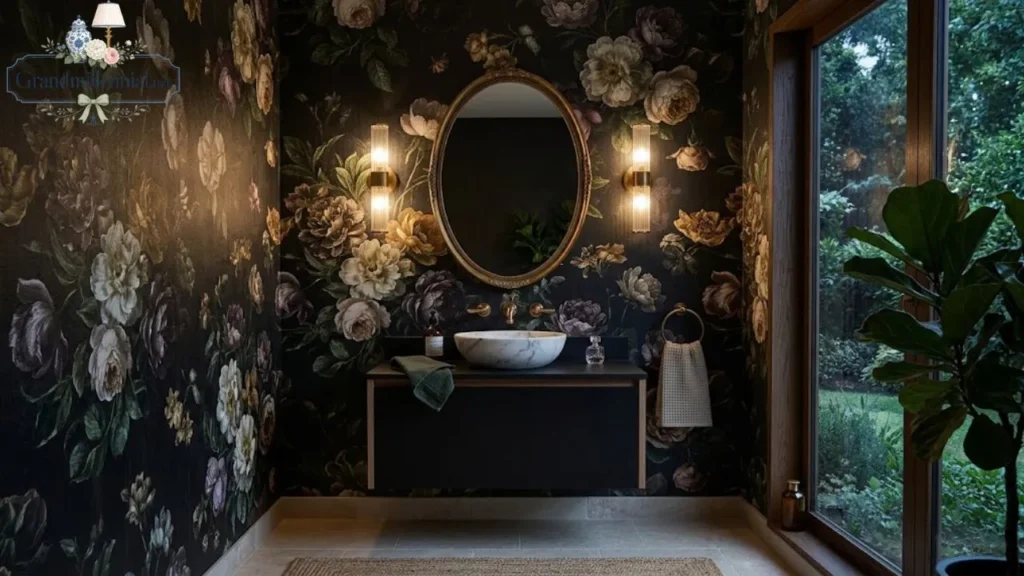
Dark wallpaper does not automatically make a bathroom unsuccessful. The key question is whether the darkness feels deliberate. Black or charcoal backgrounds can create an elegant setting for:
- brass fittings
- white basins
- marble countertops
- warm wood
- antique mirrors
- soft lighting
A black-ground wallpaper containing flowers, stars, leaves, or geometric forms can create depth that flat black paint cannot. Lighting becomes particularly important. Wall sconces positioned at face level, warm ceiling lights, and reflective mirrors prevent the room from feeling gloomy.
Dark bathroom wallpaper ideas are especially effective in powder rooms where atmosphere often matters more than maximum brightness.
Add Warmth to a Minimalist Bathroom With Texture
Minimalist bathrooms can sometimes feel visually unfinished because so many surfaces are smooth. Glass, stone, ceramic, mirrors, and chrome reflect light but provide little softness. Wallpaper with visual texture helps. Look for designs resembling:
- woven fibers
- linen
- plaster
- grasscloth
- handmade paper
- fine brushwork
If the room experiences regular humidity, select a wallcovering appropriate for those conditions rather than assuming a natural fiber material will perform well. A textured-effect wallcovering can maintain a minimalist palette while preventing the space from feeling flat.
Use a Mural to Change the Sense of Space
Murals behave differently from repeating wallpaper. Instead of creating rhythm across a wall, they create a scene. This makes them useful in bathrooms where one uninterrupted wall deserves attention. Ideas include:
- misty forests
- abstract watercolor
- mountains
- oversized flowers
- coastal landscapes
- clouds
- architectural drawings
Murals work particularly well opposite the entrance because the full image can be appreciated immediately. Avoid placing the strongest visual element directly behind a large mirror, cabinet, or towel warmer. Before ordering, measure the usable wall area carefully and consider how doors, windows, and fixtures interrupt the scene.
Use Wallpaper to Make a Narrow Bathroom More Interesting
Long, narrow bathrooms can feel corridor-like. Wallpaper can correct that impression by shifting attention away from the room’s proportions. A stronger pattern on the short wall at the end of the room can visually bring that wall forward.
Alternatively, using the same moderate-scale pattern on all drywall can reduce the sense that the room is a tunnel. Horizontal motifs can emphasize width, although they need to be used carefully when ceilings are low.
Mirrors can amplify both light and pattern, so check reflections before committing to a highly repetitive design. Sometimes the most visible wallpaper in a narrow bathroom is not directly in front of you but reflected behind you.
Pair Floral Wallpaper With Modern Shapes
Floral wallpaper does not require traditional furniture. In fact, it often looks strongest beside clean geometry. Try pairing expressive floral wallpaper with:
- rectangular floating vanity
- circular mirror
- cylindrical wall lights
- simple slab-front drawers
- frameless glass
- minimal taps
The wallpaper provides movement. The furniture provides structure. That contrast keeps the room from becoming overly decorative. If both the wallpaper and fittings are ornate, there is no visual resting point.
Let Blue Do More Than Create a Coastal Theme
Blue wallpaper is often associated with seaside bathrooms, but it can create very different moods depending on shade. Pale blue can feel airy. Navy feels tailored. Teal can become luxurious. Dusty blue brings softness. Cobalt feels energetic.
Instead of automatically pairing blue wallpaper with white cabinetry, consider walnut, oak, black, burgundy, or muted green. Unexpected combinations can make blue feel less predictable. A bathroom does not need seashells or nautical objects simply because the wall contains blue.
Use Wallpaper Above Half-Height Tile
Many bathrooms already have tile covering the lower half of the walls. Rather than removing it, use the upper wall as a decorative zone.
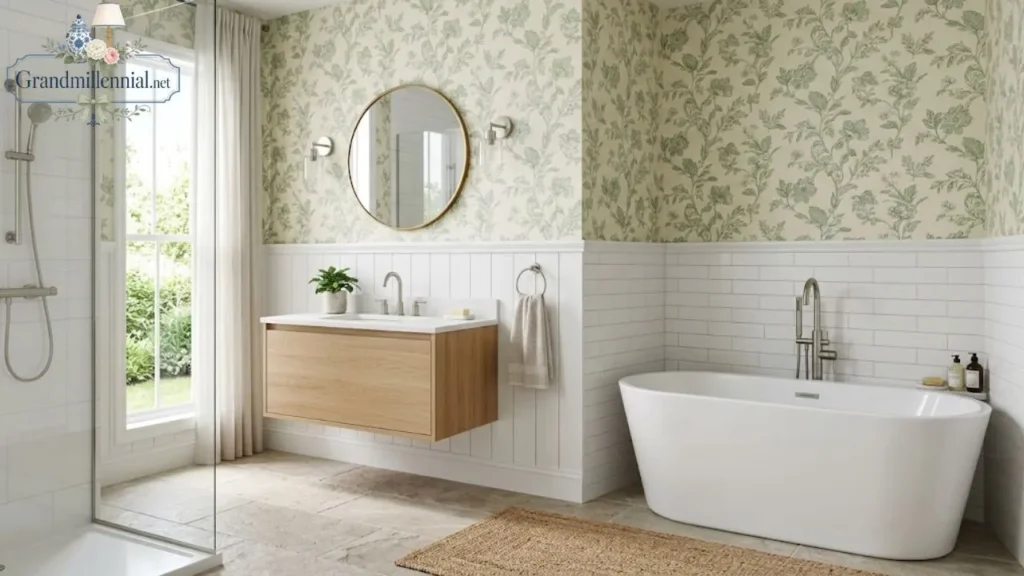
This arrangement is particularly practical because the more vulnerable lower surfaces remain protected. The relationship between tile height and wallpaper is important. If tile ends at an awkward level, consider adding:
- trim
- a narrow painted rail
- decorative molding
- a finishing profile
A clear visual boundary makes the transition look intentional. When choosing the wallpaper, repeat either the tile color or grout color somewhere in the pattern. That small connection helps unify the two materials.
Bring Character to a Neutral Bathroom With Illustration
Illustrated wallpaper has become much more sophisticated than novelty wallpaper once associated with children’s rooms. Look for patterns containing:
- birds
- insects
- trees
- shells
- architecture
- animals
- hand-drawn objects
- botanical sketches
These designs reward close viewing, which makes them especially suitable for small bathrooms. The pattern becomes something visitors actually notice. Keep accessories restrained.
When a wallpaper already tells a visual story, adding decorative signs, themed artwork, and multiple accessories usually weakens the effect.
Use Green Wallpaper With Wood for a Natural Palette
Green and wood are an easy combination because both reference natural materials. Sage wallpaper with pale oak creates a calm Scandinavian feel. Forest green with walnut feels richer. Olive with medium oak can feel warm and earthy.
If your bathroom includes wood-effect tile rather than real wood, the same principle applies. Choose a wallpaper green that relates to the warmth or coolness of the floor. Then use white, cream, stone, or black to prevent the palette from becoming overly earthy.
Turn the Ceiling Into the Feature
The ceiling is often the least considered surface in bathroom design. In a compact room, it can become the most interesting one. Wallpaper on the ceiling works best when there is a clear reason for it. For example:
- the walls are paneled
- the room has a decorative cornice
- the ceiling is low enough to notice
- the wallpaper contains a sky or botanical motif
- the bathroom is intentionally immersive
A patterned ceiling over quiet walls can create surprise without overwhelming the room. Alternatively, continuing wallpaper from wall to ceiling creates a cocoon-like effect. This technique is particularly effective in powder rooms and guest bathrooms.
Use Small Repeating Motifs for a Collected Look
Tiny repeating motifs can make a newly renovated bathroom feel less new. Small stars, flowers, dots, leaves, diamonds, and block-print marks introduce subtle irregularity. This works well with:
- pedestal sinks
- framed mirrors
- traditional taps
- wall-mounted lighting
- painted woodwork
Choose a print that feels interesting from close range but relatively quiet from the doorway. That gives the wall more than one visual reading. From a distance, it appears textured. Up close, the pattern becomes visible.
Try Warm Neutrals Instead of Gray
Neutral bathroom wallpaper does not have to mean gray. Warm neutral palettes are often easier to live with because they complement both natural materials and warm lighting. Useful colors include:
- mushroom
- oat
- sand
- stone
- flax
- taupe
- warm ivory
- camel
A wallpaper combining several warm neutrals can make inexpensive white fixtures feel more considered. Add wood, brushed metal, or woven accessories to reinforce the warmth.
This is one of the safer bathroom wallpaper ideas for homeowners who want something more interesting than paint without committing to a colorful pattern
Build Contrast Around a Statement Mirror
Sometimes the mirror should determine the wallpaper rather than the other way around. If you already own a decorative mirror, examine its:
- shape
- frame color
- visual weight
- period style
A heavily carved vintage mirror may need a quieter background. A simple frameless mirror can sit comfortably against a complex floral or geometric print. Contrast is often more effective than matching. A round mirror against angular wallpaper creates tension.
A black mirror frame against pale botanical wallpaper creates definition. Think about the mirror and wallpaper as a pair. They occupy the same visual space.
Use Wallpaper to Connect an Ensuite to the Bedroom
An ensuite should feel related to the adjoining bedroom without looking identical. Wallpaper can provide that connection. Repeat a bedroom color inside the bathroom but change the pattern.
For example, if the bedroom contains dusty green textiles, choose bathroom wallpaper with a small amount of the same green rather than covering the ensuite in the identical shade. Another option is repeating a motif.
A botanical bedroom can connect to a more abstract leaf pattern in the bathroom. This creates continuity while allowing each room to maintain its own character.
Mix Wallpaper With Stone Carefully
Stone already contains natural movement. Marble may have dramatic veins. Travertine contains bands and variation. Terrazzo contains many small fragments. Adding wallpaper on top of these patterns requires restraint. One useful principle is contrast of scale.
If the stone contains large dramatic veining, use wallpaper with a smaller or quieter repeat. If the stone is relatively uniform, you have more freedom to introduce a larger print.
Color connection also matters. Choose one shade present in the stone and find it again in the wallpaper. This creates cohesion without forcing the materials to match exactly.
Use Red or Burgundy in a Small Bathroom
Red is rarely the first color people consider for bathrooms, which is precisely why it can feel distinctive. Muted red, brick, berry, wine, and burgundy work especially well in:
- traditional powder rooms
- vintage-inspired bathrooms
- dark wood interiors
- bathrooms with brass fittings
- rooms with warm stone
If covering every wall feels too intense, use the wallpaper above paneling. Avoid pairing strong red wallpaper with several equally strong accent colors. Let the wallpaper dominate and keep the remaining finishes comparatively quiet.
Consider Wallpaper When the Bathroom Has No Window
A windowless bathroom does not need to imitate a bright outdoor space. Trying to force it into an all-white palette can sometimes make the lack of daylight more obvious. Instead, create atmosphere. Good options include:
- deep botanical patterns
- soft abstract murals
- jewel tones
- dark blue
- green
- rich warm neutrals
Use layered artificial lighting so the pattern remains visible. Wall lights around the mirror, ceiling illumination, and discreet ambient lighting can make a dark patterned room feel intentional rather than underlit.
Use Playful Wallpaper Without Making the Room Juvenile
Bathrooms are one of the few spaces where slightly humorous or unexpected wallpaper can work beautifully. The difference between playful and childish usually comes down to execution.
Choose sophisticated illustration, restricted color palettes, or unusual subject matter rather than overt novelty graphics. Interesting possibilities include:
- stylized fish
- tiny animals
- abstract faces
- fruit
- clouds
- hand-drawn stars
- imaginative landscapes
Then keep the vanity, mirror, and lighting simple. The room feels witty rather than themed.
Make a Large Bathroom Feel More Intimate
Large bathrooms can occasionally feel less comfortable than small ones because hard surfaces create empty visual space. Wallpaper helps reduce that sense of emptiness. Consider wrapping several drywall surfaces in a medium-scale design rather than creating only one accent wall.
Pattern makes the room feel furnished even where there is no furniture. This is particularly helpful in bathrooms with:
- freestanding tubs
- tall ceilings
- long vanity walls
- large areas of painted drywall
Choose a print that can be viewed from several distances. Tiny patterns may disappear across a large room, while very dense prints can become tiring. Medium-scale organic designs often strike the right balance.
Use Wallpaper as the Starting Point for the Entire Design
When designing a bathroom from scratch, wallpaper can become the first decision rather than the last. Choose the paper before selecting:
- vanity color
- paint
- lighting
- metal finishes
- towels
- accessories
Pull a palette directly from the print. For example, a wallpaper might contain:
- warm cream background
- muted green foliage
- dusty pink flowers
- dark brown branches
That gives you four useful design colors without inventing a separate palette. You might choose:
- cream wall trim
- green vanity
- warm brass hardware
- brown timber mirror
- neutral stone floor
The room becomes layered without looking random. This approach is especially effective when using bold bathroom wallpaper ideas, because everything else can be designed to support the pattern.
How Much Wallpaper Should You Use?
There is no rule requiring wallpaper on every wall. The amount should depend on the architecture and the visual effect you want.
One feature wall
Best when there is an obvious focal point such as the vanity or freestanding bathtub.
Upper half of the room
Useful when lower walls contain tile, paneling, or another moisture-resistant finish.
Every drywall
Works well with subtle patterns or intentionally immersive powder rooms.
Ceiling only
Suitable when you want visual surprise without covering the walls.
Small architectural areas
Wallpaper can also highlight:
- alcoves
- niches
- recessed vanity areas
- sections above built-in storage
Avoid creating too many isolated wallpaper fragments. Pattern usually looks stronger when the starting and stopping points follow the architecture.
How to Choose Wallpaper for a Small Bathroom
Small bathrooms require planning, not necessarily restraint. Instead of asking whether a pattern is “too big,” consider how the design behaves.
Look at pattern density
Large motifs surrounded by open background may feel calmer than tightly packed micro-patterns.
Look at contrast
Navy and white will feel more graphic than sage and cream, even if both wallpapers use the same repeat.
Look at the mirror
Mirrors double whatever sits opposite them. A strong wallpaper can therefore appear much more prominent than expected.
Look at the doorway
Step outside the bathroom and study what portion of the wall is visible. That view often matters more than the one you see while standing directly beside the wallpaper.
Order a meaningful sample
Tiny online swatches are useful for color but poor for understanding scale. Whenever possible, obtain a sample large enough to show at least one full repeat. Tape it to the wall vertically and leave it there for a few days.
How to Coordinate Wallpaper With Fixtures
Wallpaper rarely exists alone. A bathroom also contains several fixed colors and materials.
Chrome
Chrome is visually cool and reflective. It works well with blues, greens, gray-based designs, crisp black-and-white patterns, and many contemporary wallpapers.
Brass
Warm brass pairs naturally with cream, burgundy, olive, navy, brown, dark green, and warm floral designs.
Black fixtures
Black creates a strong outline and can stabilize colorful wallpaper. Repeat black in at least one other element, such as the mirror frame or light fitting.
Nickel
Nickel is softer than chrome and works well in traditional or transitional bathrooms. It sits comfortably beside muted greens, blues, warm whites, and heritage prints. Avoid choosing wallpaper based purely on metal finish, though. The vanity, countertop, tile, lighting, and overall room palette matter more than any single fitting.
Wallpaper Mistakes That Are Easy to Avoid
Choosing wallpaper before checking the bathroom conditions
A beautiful print is irrelevant if the material is unsuitable for the location.
Ignoring existing undertones
A wallpaper can technically contain the same color as your tile and still clash because one is warm while the other is cool.
Using too many statement surfaces
A patterned floor, strongly veined countertop, colorful wallpaper, unusual sink, decorative mirror, and elaborate lighting can all be beautiful individually. Together, they may compete. Decide what should lead.
Hanging wallpaper without considering the mirror
Large mirrors can hide key motifs or reflect awkward sections of the pattern.
Treating every small bathroom as a pale bathroom
Small spaces can carry dark and saturated colors extremely well.
Forgetting that wallpaper is viewed from outside the room
Open the door and study the sight line from the hallway or bedroom.
Selecting from a phone screen alone
Screen colors vary considerably. Physical samples are essential when coordinating with stone, tile, wood, and paint.
A Simple Way to Build a Bathroom Color Scheme Around Wallpaper
If color selection feels complicated, use this three-color method.
background color
Use it for trim, surrounding paint, or the quieter surfaces.
Dominant motif color
Use it on the vanity, towels, or a larger accessory.
accent color
Repeat it sparingly through lighting, artwork, accessories, or flowers. Then introduce your metal finish separately. You do not need to repeat every wallpaper color throughout the bathroom. Trying to match everything usually makes the scheme feel overly planned. Selective repetition feels more natural.
When Wallpaper May Not Be the Right Choice
Wallpaper can transform a bathroom, but it is not suitable for every situation. Consider another wall finish when:
- the wall receives constant direct water
- there is unresolved condensation
- mold keeps returning
- the wall surface is badly damaged
- ventilation is inadequate
- the manufacturer’s instructions exclude bathroom use
- regular heavy scrubbing is required
Tile, waterproof wall panels, microcement, washable paint, or other moisture-tolerant finishes may be more appropriate in those areas. Good design includes knowing when not to use a material.
Bathroom Wallpaper Planning Checklist
Before ordering, confirm:
- the room’s moisture level
- wallpaper suitability
- wall condition
- tile undertones
- vanity color
- metal finish
- natural and artificial lighting
- pattern scale
- repeat size
- mirror placement
- doorway sight line
- required number of rolls
- batch or dye-lot information
- installation method
Taking twenty minutes to work through those details can prevent a very expensive decorative mistake.
Frequently Asked Questions
Is wallpaper a good idea in a bathroom?
Wallpaper can work very well in bathrooms when the wallcovering is suitable for the room’s moisture conditions and is installed on properly prepared walls. Powder rooms generally provide greater flexibility than bathrooms experiencing frequent shower steam and splashing.
What wallpaper looks best in a small bathroom?
There is no single best pattern. Large botanicals can create drama, microprints can add subtle texture, vertical stripes can emphasize height, and low-contrast designs can create a quieter appearance. Choose according to the mood you want rather than relying only on room size.
Should bathroom wallpaper be light or dark?
Either can work. Light wallpaper creates an airy atmosphere, while dark wallpaper can make a compact bathroom feel intimate and sophisticated. Lighting, pattern density, and surrounding finishes influence the result more than color depth alone.
Can you wallpaper only one wall?
Yes. A single feature wall works especially well behind a vanity, freestanding bath, or another natural focal point. Avoid choosing a random wall with no architectural reason for becoming the feature.
Is peel-and-stick wallpaper good for bathrooms?
Some removable wallpapers are suitable for bathroom environments, while others are not. Check the manufacturer’s humidity and surface guidelines rather than assuming all peel-and-stick products perform the same way.
Does wallpaper make a small bathroom look smaller?
Not necessarily. Pattern can actually distract from the physical boundaries of a small room. Low-contrast designs feel quieter, while large patterns can make the room more immersive and visually interesting.
Can you mix wallpaper and bathroom tile?
Yes. This is often one of the most practical combinations. Use tile in areas exposed to more water and wallpaper on drier upper walls. Coordinate the two materials through undertone, pattern scale, or a shared color.
Should wallpaper match the bathroom vanity?
It does not need to match exactly. A stronger approach is to repeat one secondary wallpaper color on the vanity or choose a cabinet color with a compatible undertone.