

Most homeowners pay somewhere between 600 and 1,700 dollars to install gutters, with a national average near 1,135 dollars, according to Bob Vila. Larger or two-story homes, metal upgrades, and gutter guards push the total well above that. The six steps below turn your own measurements into a number you can check against a contractor’s quote.
Gutters are one of those jobs where the quotes look random until you see the arithmetic behind them. One contractor says 900 dollars, another says 3,200, and both are describing the same house.
The gap is almost never a trick. It comes from length, material, height, downspouts, and a handful of extras that each get priced separately.
This guide works as a gutter installation cost calculator you can run with a tape measure and a notepad. Every range comes from a named source, and where those sources disagree, I say so.
How the gutter installation cost calculator works
The whole estimate rests on one idea. Gutters are sold and installed by the linear foot, so your total is your gutter length multiplied by a per-foot price, plus a few add-ons.
Here is the formula in plain language:
- Measure the total length of gutter you need.
- Multiply by the per-foot price of your chosen material.
- Add labor per foot, plus a height adjustment for tall homes.
- Add downspouts.
- Add gutter guards and accessories.
- Add removal of the old system and any repairs.
Keep the low and high ends of each range separate. Add the lows together and the highs together, and you get an honest range instead of one falsely precise figure.
A quick word about the numbers. They are US prices; they come from published cost guides rather than my own quotes, and they will not match your town exactly. Treat the result as a budgeting range, not a bid.
Measure your gutter length
Everything else multiplies against this number, so it is worth getting right. A 20 percent error here becomes a 20 percent error in the total.
Gutters run along the eaves, which are the lower edges of the roof. Walk around the house and measure each edge that has roof above it. A long tape or a measuring wheel works well.
If you cannot measure from the ground, a satellite map with a ruler tool gives a decent first pass. Check it against the real house before you order anything.
Add about 5 to 10 percent for corners, end caps, and waste. Many homes land between 100 and 200 feet in total.
Bob Vila’s size table gives a useful sanity check. Fifty feet of gutter runs roughly 250 to 750 dollars, 100 feet roughly 500 to 1,500, and 200 feet roughly 1,000 to 3,000.
Choose a gutter material
Material is the biggest single lever in a gutter installation cost calculator. The spread between vinyl and copper is enormous.
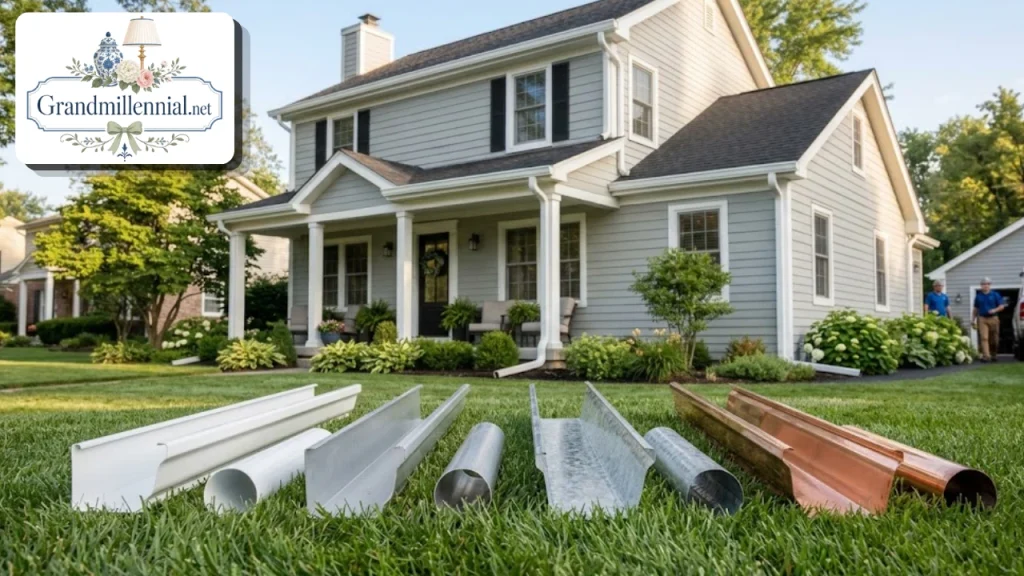
Here are the per-foot ranges for the materials alone, as reported by Bob Vila.
| Material | Cost per linear foot (material) |
|---|---|
| Vinyl | $3 to $6 |
| Aluminum | $4 to $14 |
| Galvanized steel | $6 to $14 |
| Stainless steel | $9 to $20 |
| Zinc | $10 to $29 |
| Copper | $25 to $40 |
Pro Tool Reviews publishes installed prices instead, which already include labor. It lists vinyl at 7 to 8 dollars per foot, aluminum at 8 to 10, galvanized steel at 9 to 12, zinc at 12 to 3,0 and copper at 16 to 32.
For most houses, aluminum is the sensible middle. It does not rust, it is light enough to install cleanly,y and it comes in many colors.
Vinyl is the cheapest, but it can crack in hard cold and fade in strong sun. Copper and zinc are premium choices that last for decades and are priced accordingly.
Add labor and the height adjustment
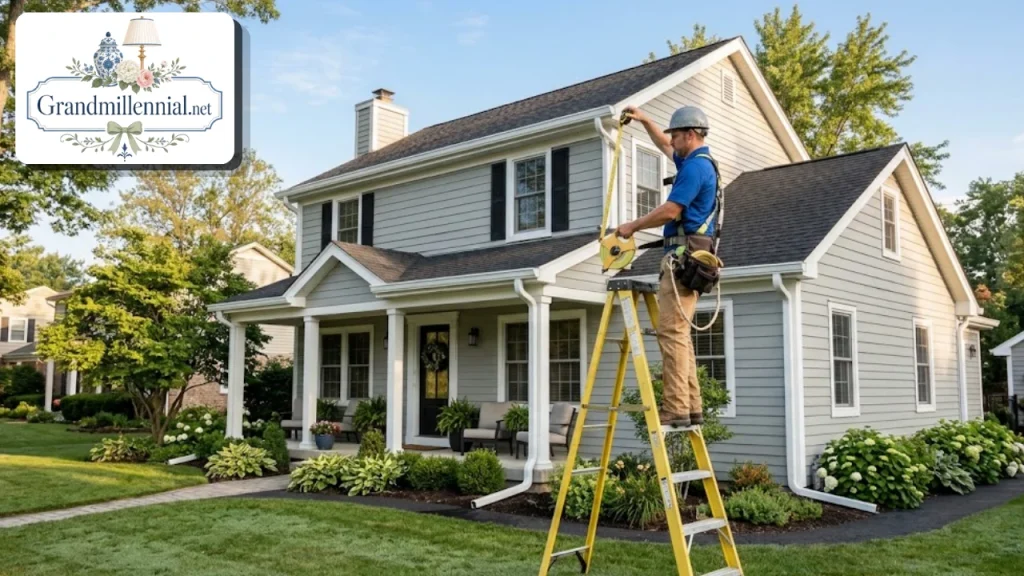
Labor depends on how the gutters are made and how high they go. Bob Vila lists sectional gutters at 2 to 6 dollars per foot for labor and seamless at 3 to 10.
Pro Tool Reviews gives a broader figure of 6 to 9 dollars per foot for labor. Some of that gap comes from region and some from what each source counts as labor.
Height matters too. Each additional story adds roughly 1 to 3 dollars per linear foot, because the crew needs taller ladders or scaffolding and works more slowly.
RoofCalc adds another note. It says steep roofs or complex rooflines can add 15 to 25 percent, though it does not publish how it reaches that figure.
If your house has many corners, dormers, or a steep pitch, push your estimate toward the high end of every range.
Add the downspouts
A gutter without enough downspouts overflows in the middle. Most homes need one downspout for every 30 to 40 feet of gutter, plus one at each low corner.
I could not find a firm, sourced rule for this spacing, so treat it as a common installer guideline and confirm it with your contractor.
Bob Vila prices downspouts per foot. Vinyl runs 5 to 8 dollars, aluminum 9 to 12, and copper 17 dollars and up.
A two-story house usually needs downspouts of about 20 feet each. Four of them are 80 feet, which is a real line item.
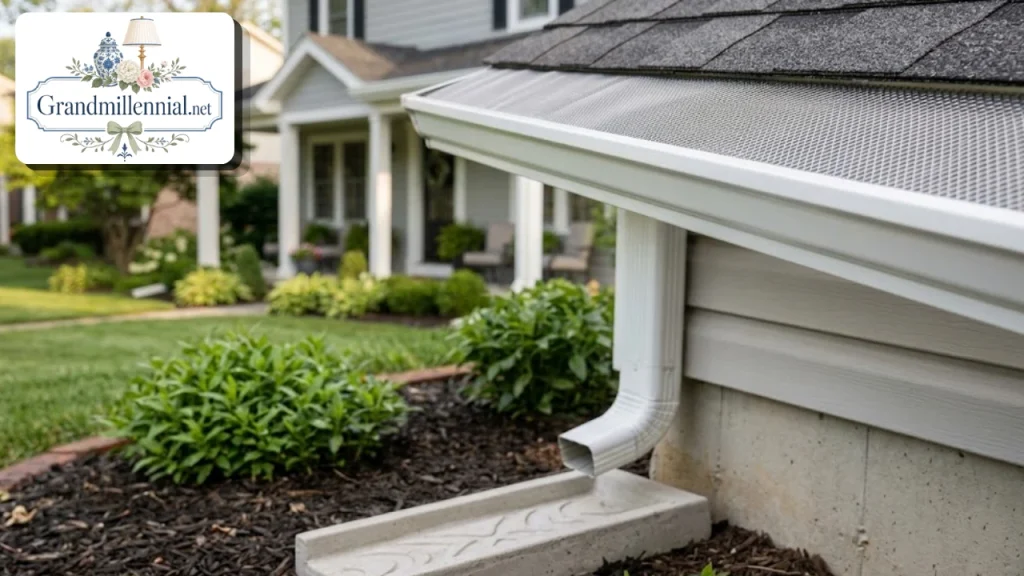
Do not forget what happens at the bottom. Bob Vila lists extensions at 10 to 50 dollars each, with 30 to 100 more for installation, and Pro Tool Reviews lists splash blocks at 10 to 15 dollars each.
Water that lands at your foundation is the problem gutters exist to solve, so this is not the place to skimp.
Gutter guards and accessories
Guards keep leaves out and reduce how often you climb a ladder. They also add a meaningful amount to the price.
Bob Vila puts professionally installed guards at 7 to 12 dollars per linear foot. Pro Tool Reviews gives 5 to 10.
Cheaper options exist. Wire mesh screens run about 1 dollar per foot and foam inserts about 1.50, though both tend to clog sooner than a quality guard.
Heat tape, which helps prevent ice dams in cold climates, runs 1 to 6 dollars per foot according to Bob Vila and 1 to 10 according to Pro Tool Reviews.
Other small items add up as well. Downspout screens run about 8 dollars each and rodent guards about 5, according to Bob Vila, and rain chains cost 50 to 250 dollars each.
Add only what your property needs. A house under pine trees may justify guards, while one in an open field may not.
Removal, repairs and extras
If you have old gutters, they have to come down. Bob Vila puts removal and disposal at 0.65 to 0.85 dollars per linear foot, while Pro Tool Reviews gives a flat 40 to 200 dollars.
Behind the old gutters is where surprises hide. Rotted fascia boards, damaged soffits and wet roof edges need fixing before new gutters go on.
Bob Vila notes that necessary roof repairs can add 360 to 1,550 dollars. That is not a gutter cost in the strict sense, but it lands on your bill all the same.
I would not run the numbers without a contingency line. Setting aside 10 to 15 percent of the estimate is a sensible habit for any work that opens up part of the house.
A worked example: 150 feet, two stories, aluminum
Let me run the gutter installation cost calculator on a realistic house so the steps feel concrete.
The house has 150 feet of eave, two stories, aluminum gutters, four 20-foot downspouts, no guards, and old gutters to remove.
| Line item | Calculation | Low | High |
|---|---|---|---|
| Aluminum gutter, installed | 150 ft x $8 to $10 | $1,200 | $1,500 |
| Second-story adjustment | 150 ft x $1 to $3 | $150 | $450 |
| Downspouts, aluminum | 80 ft x $9 to $12 | $720 | $960 |
| Removal of old gutters | 150 ft x $0.65 to $0.85 | $98 | $128 |
| Total | $2,168 | $3,038 |
So the budget is roughly 2,200 to 3,000 dollars. Adding a 10 to 15 percent contingency gives a planning ceiling near 3,500.
Notice that the installed per-foot price may already cover some downspout work in a few quotes. That is why the high end here is deliberately cautious.
As a cross-check, Bob Vila’s average for a two-story home is about 2,000 dollars. My example lands higher because it includes downspouts and removal as separate lines.
Cost by house size
If you only want a quick ballpark, house size gets you most of the way. These figures are Bob Vila’s averages by home type.
| Home | Typical gutter length | Average total |
|---|---|---|
| One-story home | Around 100 to 150 ft | About $1,200 |
| Two-story home | Around 150 to 250 ft | About $2,000 |
Bob Vila also shows ranges by length. At 150 feet the range is roughly 750 to 2,300 dollars, at 250 feet roughly 1,250 to 3,800, and at 300 feet roughly 1,500 to 4,500.
Those ranges are wide because they span vinyl through premium metals. Your material choice decides where in the band you fall.
The length column in my table is a rough guide only, not a sourced figure. Measure your own house, because footprint shape matters more than square footage.
Why published numbers disagree
Anyone who researches this for more than ten minutes notices the confusion. The same material gets very different prices in different guides.
Bob Vila lists aluminum at 4 to 14 dollars per foot. Pro Tool Reviews lists it at 8 to 10. RoofCalc says aluminum runs 5 to 15 and that a basic installed project costs 10 to 12 per foot.
Part of the explanation is what is being counted. Some figures are material only, others are installed, and some blend the two without saying so.
Region plays a role as well. RoofCalc says prices vary by about 15 to 20 percent by region, and that big metro areas can run 5 to 10 percent higher, though it gives no basis for those numbers.
The honest takeaway is to use ranges, add the lows and highs separately, and trust a written local quote over any national average.
Seamless or sectional gutters
Sectional gutters come in short pieces joined along the run. Seamless gutters are formed on site from a single roll of metal, so they have joints only at corners.
Fewer joints mean fewer places to leak. That is the main reason many installers prefer seamless.
Bob Vila prices seamless labor at 3 to 10 dollars per foot, against 2 to 6 for sectional. It also reports seamless systems totaling 800 to 5,000 dollars overall.
Seamless usually costs a little more up front. For most homeowners, the lower leak risk is worth it, especially with aluminum.
Sectional vinyl is the usual choice for DIY installs because it needs no special forming machine. That is a fair reason to pick it.
K-style, half-round and gutter size
Shape and size change the price a little and the performance a lot. K-style is the most common profile, with a flat back and an ornamental front.
Half-round gutters look classic and suit older homes. They tend to hold less water and often cost more.
Size matters in rainy areas. Pro Tool Reviews says 6-inch gutters cost about 0.50 to 1 dollar more per foot than 5-inch gutters.
If your roof is large or your area gets heavy storms, the extra capacity of 6-inch gutters is usually money well spent. Bob Vila also mentions high-capacity systems for heavy rain.
DIY or hire a pro
Doing it yourself removes the labor line, which is a big share of the total. In the examples above, labor and height adjustments can account for a third or more of the price.
The catch is that gutters need the right slope, secure hangers and watertight joints. A small mistake sends water behind the fascia instead of away from the house.
DIY makes the most sense for a one-story house with vinyl or simple sectional aluminum. The work is repetitive, and a helper makes it much easier.
Hire a professional for two stories, seamless gutters, copper, or anything that needs you on a tall ladder. A fall costs far more than the labor you would save.
Some home improvement stores and gutter suppliers will sell materials and installation together. Ask whether you can buy materials only if you plan to install them yourself.
How to read a gutter quote
A good quote lists the same lines this calculator uses. If yours does not, ask for it to be broken out.
Here is what to check:
- Total linear feet, and whether it matches your own measurement
- Material, gauge, and size, such as 0.027 aluminum or 6-inch K-style
- Number and length of downspouts
- Whether old gutter removal and disposal are included
- Whether guards, extensions and splash blocks are included
- Any fascia or roof repairs, priced as separate lines
- Warranty terms for both materials and workmanship
Compare at least three written quotes. Throw out neither the cheapest nor the dearest without asking why it differs.
RoofCalc warns that a quote near 18 dollars per foot for basic aluminum deserves questions. I could not verify that threshold independently, so treat it as a prompt to ask for detail rather than a hard rule.
Ways to lower the cost
You do not have to accept the first number. A few choices reduce the bill without hurting performance.
Choose aluminum over copper, unless the look matters more than the budget. Skip guards on the sides of the house with no trees.
Ask whether the crew can reuse existing downspouts in good condition. Sometimes only the gutters need replacing.
Schedule the work in a slow season. Contractors are often quieter in late fall or winter in mild climates, and you may get a better price.
Bundle gutters with other exterior work. If you are already replacing the roof or siding, doing the gutters at the same time saves a second setup and sometimes a second trip charge.
If the house is part of a bigger refresh, our renovation tips guide helps you sequence projects so you are not paying twice for ladders and access.
Common mistakes
The first is measuring only the front of the house. Roof edges on side wings and garages count too.
The second is ignoring the slope. Gutters should drop about a quarter inch for every ten feet, so water moves toward the downspout. Check this with your installer, since it varies with the system.
The third is putting downspouts where water lands on a path or against the foundation. Plan where the water goes before you choose positions.
The fourth is buying on the per-foot price alone. A cheap rate with removal, extensions,s and repairs billed separately can end up costing more than an all-in quote.
The fifth is skipping a contingency. Rotten fascia is common behind old gutters, and finding it mid-job is far easier to absorb when the money is already set aside.
Climate, region, and roof shape
Where you live changes the answer more than most people expect. Labor rates differ between a small town and a big city, and rainfall decides how much capacity you need.
In snowy regions, heat tape and sturdier hangers are common extras, because ice and snow load put real strain on the gutter. In dry regions,ons you may get away with a smaller system.
A gutter installation cost calculator cannot see your roof, so adjust by hand for complexity. A simple gabled roof with two long edges is cheap to gutter, while a roof full of valleys, dormers,mers and short runs needs more corners, more outlets,tlets and more labor.
Bob Vila also mentions that local permit rules can apply in some areas. A quick call to your city office takes five minutes and avoids a surprise later.
When a calculator is not enough
Online tools are good for budgeting and bad for final decisions. They cannot see rotted fascia, a sagging roof edge, or a drainage problem at the foundation.
Use the gutter installation cost calculator above to set your range, then have a contractor walk the property. Ask them to point out anything that would change the scope.
If the on-site quote lands inside your range, you can sign with confidence. If it lands far outside, the contractor should be able to name the specific lines that explain the gap.
What about big projects like additions?
If you are building out your house, gutter costs scale with the new roofline. Every new edge of roof needs its own gutter and downspout plan.
For homeowners considering that kind of project, our overview of home additions explains what to budget for. Add the gutter line to that estimate early rather than late.
Also think about how drainage affects your landscaping. If you have pets that dig near the foundation, our guide to keeping your yard looking good with dogs has ideas that work alongside good water management.
FAQs:
How much does it cost to install gutters on a house?
Most homeowners pay about 600 to 1,700 dollars, with a national average near 1,135 dollars, according to Bob Vila. Pro Tool Reviews reports a wider spread, from about 1,000 to 6,600 dollars. Material, height, and house size explain the difference.
How much does gutter installation cost per linear foot?
Bob Vila lists materials from 3 to 6 dollars per foot for vinyl up to 25 to 40 for copper, before labor. Installed prices from Pro Tool Reviews run from 7 to 8 dollars for vinyl up to 16 to 32 for copper. Check whether any figure includes labor.
How many feet of gutter do I need?
Measure every roof edge that sheds water and add 5 to 10 percent for corners and waste. Many homes need between 100 and 200 feet. A tape, a measuring wheel, or a satellite map can all do the job.
Is a gutter installation cost calculator accurate?
A gutter installation cost calculator is accurate to the extent that your measurements and chosen ranges are. It gives a budgeting range rather than a bid. Contractors adjust for access, repairs, and local labor, so always confirm with written quotes.
Are seamless gutters worth the extra cost?
For most houses, yes. Fewer joints mean fewer leaks, and seamless aluminum is a common choice. Bob Vila lists seamless labor at 3 to 10 dollars per foot compared with 2 to 6 for sectional.
How much do gutter guards add?
Professionally installed guards add roughly 5 to 12 dollars per linear foot, depending on the source. Cheap mesh or foam options cost about 1 to 1.50 per foot but often clog sooner.
Can I install gutters myself?
On a single-story home with vinyl or sectional aluminum, many capable DIYers can. Two-story work, seamless systems, and metals like copper are better left to professionals for safety and watertightness.
How much does it cost to remove old gutters?
Bob Vila lists 0.65 to 0.85 dollars per linear foot, while Pro Tool Reviews gives a flat 40 to 200 dollars. Ask whether removal and disposal are included in your quote.