

Quick answer: For Fujitsu mini split repair, start safely. Switch the unit off, then check the remote, the breaker, the filters, and the drain. Note any blinking lights or codes, try one proper power reset, and call a licensed technician for anything involving refrigerant, circuit boards, the compressor,r or burning smells. Most callouts are avoidable with clean filters and clear drains.
[IMAGE 1 goes here: hero. A white wall-mounted ductless indoor unit above a sofa, with a homeowner holding the remote and looking up at it]
A ductless unit usually fails at the worst moment. It’s the hottest week of the year, or the first freezing night, and a light on the front starts blinking at you like a tiny alarm.
Take a breath. GooFujitsusu mini split repair starts with calm observation. Many faults are simple, a few are serious, and learning to tell them apart saves money. This guide explains how to read the signs, what you can safely check, and when to hand the job to a professional.
We are an independent home site. We are not affiliated with Fujitsu or any repair company, and we have nothing to sell you.
Start here: stay safe
A mini split connects to your home’s electrical system and holds pressurized refrigerant. Any Fujitsu mini-split repair plan has to respect both.
Always switch the unit off at the remote and then at the breaker before you touch anything beyond the front grille and filters. Never remove panels or touch wires while the power is on.
Refrigerant work is not a homeowner job. In the United States, handling refrigerant requires certification, and the same is true in many other places. If a guide tells you to “top up the gas,” close the tab.
Stop and call a professional if you smell burning, see scorch marks, hear buzzing or arcing from the outdoor unit, or find water near electrical connections. Those are signs to step back, not investigate.
This article is general information, not a substitute for your unit’s manual or a qualified technician.
What the blinking lights and codes mean
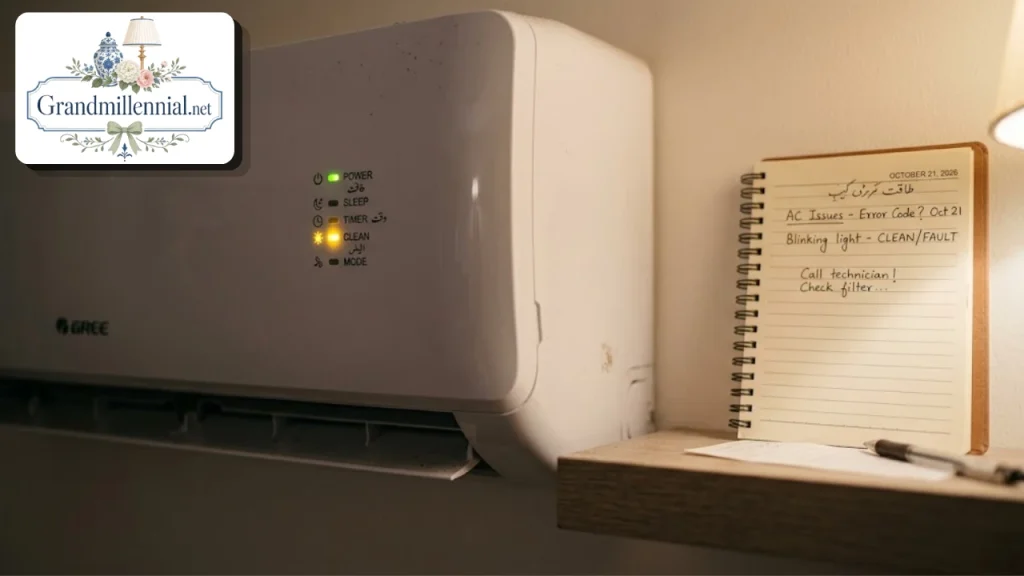
Most owners don’t see a code number. They see lights on the indoor unit flashing in a pattern. On many Fujitsu indoor units, these include an operation light, a timer light,t and an economy light, though the layout differs between models.
Each model uses its own pattern of flashes to point to a fault. The number of times a light blinks, and which lights blink together, maps to a code in your installation or service manual. That is why generic lists can mislead you.
The practical step is to write down exactly what you see. Note which lights blink, how many times, and whether the pattern repeats. Then match it to your model’s manual. The model number is on a label on the indoor unit, and manuals are available from Fujitsu’s support pages.
Some units show a code number on the remote or a display. Reference sites such as PickHVAC publish long code lists based on an older Fujitsu troubleshooting guide, and they are useful for understanding categories. They are not a replacement for your model’s manual.
Common code families
Here is how some commonly listed Fujitsu codes group together, based on the PickHVAC list. Treat this as orientation, not a diagnosis.
| Code family | Examples | Usually points to |
|---|---|---|
| Communication | 11, 12, 18, 3A | Indoor and outdoor units not talking; wiring, power or board trouble |
| Indoor sensors | 41, 42 | Room or coil thermistor problems |
| Indoor fan and drain | 33, 39, 51, 53 | Fan motor faults, drain pump or float switch |
| Outdoor electronics | 62, 63, 64, 65 | Main board, inverter or power module faults |
| Outdoor sensors | 71, 72, 73, 74 | Temperature sensor faults on the outdoor unit |
| Compressor and pressure | 86, 94, 95, A1, A3, A5 | Pressure, current or temperature faults; technician territory |
| Outdoor fan and valve | 97, 98, 99 | Outdoor fan motor or reversing valve problems |
A drain-related code is often the easiest to understand: water isn’t leaving the unit. A pressure or compressor code almost always needs a technician.
Symptom guide: match what you see
Sometimes there is no code at all, only a problem. This table helps you triage before you book any Fujitsu mini-split repair.
| Symptom | Common causes | What you can safely try |
|---|---|---|
| Won’t turn on | Dead remote batteries, tripped breaker, power fault | Replace batteries, check the breaker, try the manual button |
| Runs but doesn’t cool | Dirty filter, blocked airflow, wrong mode, low refrigerant | Clean filters, check mode and set point, clear obstructions |
| Not heating well | Dirty filter, outdoor unit frosted, defrost cycle | Clean filters, clear snow and leaves, wait out the defrost |
| Water dripping inside | Clogged drain, unit not level, heavy condensation | Clean filters, call a pro if it continues |
| Ice on the indoor unit | Poor airflow, low refrigerant, very low set point | Switch off, let it thaw, clean filters |
| Loud or rattling noise | Loose panel, debris in outdoor fan, mounting issue | Check for debris and loose covers with the power off |
| Remote doesn’t respond | Batteries, wrong remote, signal blocked | New batteries, point at the receiver, try the manual button |
| Smells musty | Dirty filter or coil, damp drain | Clean filters; professional coil cleaning if it persists |
If the symptom matches the “call a pro” column, don’t keep running the unit. A system that runs with a fault can turn a small repair into a big one.
Five checks you can do yourself
Most homeowners can handle these without tools. Do them in order.
The remote and settings
It sounds basic, but a surprising share of “broken” units are simply in the wrong mode or have a flat remote. Check that the mode is set to cool or heat, the temperature target makes sense, and the batteries are fresh.
If the unit responds to the manual button but not the remote, the remote is the problem. If you use a wall controller or app, make sure it is connected. Our smart home guide covers how connected devices fit into a calm, well-planned home.
The breaker and power
Look at the breaker for the indoor and outdoor units. Many systems have a separate breaker or disconnect near the outdoor unit. If it has tripped, reset it once. If it trips again, stop and call an electrician or HVAC technician.
The filters
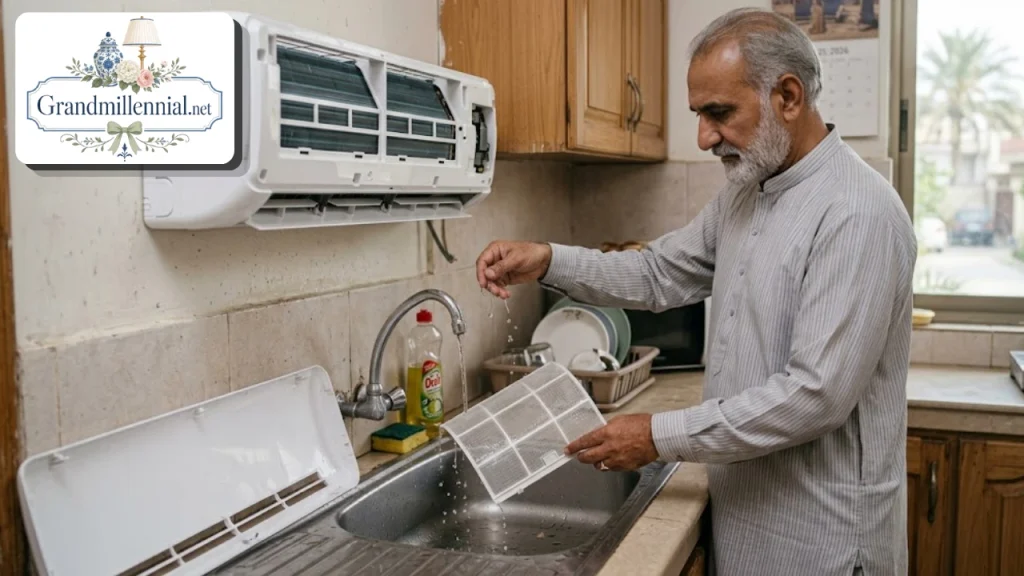
A clogged filter is the most common cause of weak airflow, poor cooling, ice, and smells. Switch the unit off, open the front panel, slide out the filters and rinse them gently with lukewarm water. Let them dry fully before putting them back.
Follow your manual for the cleaning schedule. Competitor guides give different intervals, from monthly in heavy use to every few months, so use your manual and your home as the guide. Homes with pets or dust need more frequent cleaning.
The drain
If water drips from the indoor unit, a blocked drain is a likely cause. Check that the unit is level and that the drain line outside is not kinked, frozen,n or blocked by debris. Don’t push objects into the line. If water keeps coming, call a technician, since leaks near electrical parts are risky.
Dripping water can also damage floors quickly. If it has already reached your boards, our guide on cleaning hardwood floors safely can help with the aftermath, though you should dry the area promptly.
The outdoor unit
Make sure the outdoor unit has clear space around it. Remove leaves, snow, weeds, and anything stacked against it. Follow the clearances in your installation manual rather than a number from the internet.
Rinse the outside gently with a hose if it is dusty, with the power off. Don’t use a pressure washer, since it can bend the delicate fins.
The power reset
A proper reset can clear a minor glitch, though it won’t fix a real fault. Do it once and only once.
Turn the unit off with the remote. Switch off its breaker. Wait about five minutes, since waiting lets the control boards discharge and reset. Then switch the breaker back on and restart the unit.
If the same lights return, the fault is real. Write down what you see and stop resetting. Repeatedly cycling power on a faulty system can stress parts.
What needs a licensed technician
Some jobs are not for homeowners, however handy. Call a professional for refrigerant leaks or low charge, compressor or inverter faults, circuit board replacement, outdoor fan motor problems, reversing valve faults, and any repeated tripping of the breaker.
A technician should also handle sealed-system work, brazing, evacuating the lines, and weighing in refrigerant. Those steps need specialist tools and certification.
Ice that keeps returning after you have cleaned the filters points toward low refrigerant or an airflow problem inside the coil. Don’t keep chipping it off.
How to describe the problem
You will get a faster, cheaper visit if you can describe the issue clearly. Have these ready: the model and serial number from the label, what the lights do, when the problem started, what you have already tried, and photos or a short video of the blinking pattern.
A technician can often tell a lot from that and arrive with the right parts.
Finding a repair company
For a local service, start with the manufacturer. Fujitsu’s support pages can point you to authorized dealers and service providers. If your unit is under warranty, using an authorized provider can protect your coverage.
Ask neighbors who have ductless systems, and check recent reviews that mention specific repairs rather than generic praise. Look for a company that is licensed and insured, and that works on your brand.
Be careful with websites that look local but are really lead-generation pages. The phone number may route to a call center that sells your details. A real company will give you a name, a licence number,r and a physical address.
Be wary of anyone who pushes a full replacement before even opening the unit.
Questions to ask before you book
A few direct questions protect you.
Ask whether there is a diagnostic fee and whether it is applied to the repair. Ask how they price parts and labour, and whether they quote before starting work. Ask whether the repair is warrantied, and for how long.
Ask what certification the technician holds for handling refrigerant. Ask whether they will leave the old parts with you if you want to see them.
If a quote seems high, get a second one. Compare like with like, including the part, the labor,ur and any refrigerant charge.
What drives the cost
When people ask what Fujitsu mini split repair costs, we won’t invent numbers, because prices vary widely by region, model, and the part that failed. None of the top pages we reviewed give a sourced price either, so treat any exact figure online with caution.
What matters is knowing what moves the price. Simple jobs such as cleaning a drain or replacing a sensor cost less than replacing a circuit board, a fan motor, or a compressor.
Refrigerant leaks add cost because the technician must find and fix the leak, not just refill. Access also matters: a hard-to-reach outdoor unit takes longer.
Labour, travel, diagnostic fees, and the age of the unit all play a part. Older units may need parts that are harder to find.
Repair or replace?
This is the question most owners avoid asking. Use a simple framework instead of guessing.
| Question | Leans toward repair | Leans toward replace |
|---|---|---|
| How old is the unit? | Fairly new, within warranty | Well into its second decade |
| What failed? | A sensor, fan, drain or board | Compressor or a major leak |
| Has it failed before? | First problem | Repeated breakdowns |
| How does the quote compare? | A modest fraction of a new unit | A large share of a new unit |
| Is it efficient? | Still performs well | Struggles to keep up |
As a rough rule, a repair that costs a large share of a new system on an old unit often makes less sense. Ask your technician for an honest opinion and a written estimate for both options.
Check for rebates and incentives on new high-efficiency systems in your area. They can change the math. If you are planning wider changes to your home, our notes on renovation tips and home additions may help you plan heating and cooling alongside them.
Warranty and paperwork
Before you pay for anything, check your warranty. Many manufacturers register products and cover parts for a set period, and some installers add their own labour coverage. Terms differ by region and by model.
Find your purchase date, installation invoice and model and serial numbers. Registering the product when it was installed usually makes claims easier.
Ask the installer who handles warranty work. Using an unauthorized repair provider or skipping required maintenance can affect coverage, so read the terms.
Keep every receipt and service report. They help with future repairs, warranty claims, and resale.
Preventing the next breakdown
Prevention is dull, which is why it works.
Clean the filters on the schedule in your manual and more often in dusty homes. Keep the area around the indoor unit clear so air can move. Keep the outdoor unit clear of leaves, snow, mulch, and storage.
Have a professional service the system on a regular schedule. Annual service is a common recommendation, and your installer can advise on the right rhythm for your climate and use.
Pay attention to small changes: a new noise, a weaker airflow, a musty smell. Early attention is cheaper than a breakdown.
Before a heavy season, test the unit on a mild day. Finding a problem in spring costs less than finding it in a heat wave.
A simple seasonal checklist
Spring: Clean the filters, clear winter debris from the outdoor unit, and run the unit in cool mode for a few minutes on a mild day. Listen for new noises and look for drips.
Summer: Check the filters more often, since the unit works hardest now. Keep plants and fences clear of the outdoor unit, and watch for water at the indoor unit.
Autumn: Clean the filters again and sweep leaves away from the outdoor unit. Test heat mode before the first cold snap, not during it.
Winter: Clear snow from around the outdoor unit and keep it off the ground if your installer raised it on a stand. Expect short defrost cycles in heat mode, and call a pro if frost builds up and never clears.
Write the date of each check on a sticky note inside a cabinet door, or in your phone. Records help your technician and your warranty.
Living with the unit at home
A mini split is part of your room, so it helps to treat it that way. Keep curtains and furniture clear of the airflow so the unit can do its work.
Hot sun through a big window makes any cooling system work harder. Sheer or lined window treatments can reduce the load. See our custom curtains guide for ideas that suit your room.
Don’t hang art or shelves where they block the indoor unit, and don’t cover it with anything that restricts airflow. For wall layout ideas that work around a unit, see how to decorate walls.
If the white plastic clashes with your style, choose calm surrounding colors and keep the wall simple. A cozy seating area below the unit, like those in our cozy living room guide, keeps the room balanced.
Avoid placing a sofa directly under the airflow if cold drafts bother you. Adjust the louvers to point air along the ceiling rather than at people.

Mistakes that make repairs worse
The first mistake is ignoring the early signs. A weak flow or a small leak can grow into a bigger failure.
The second is repeated power cycling. Turning the breaker on and off ten times does not fix a faulty part and can add stress.
The third is washing parts with the power on, or using a pressure washer on the outdoor coil.
The fourth is topping up refrigerant without finding the leak. A system that is low has a leak somewhere, and a refill is only a temporary patch.
The fifth is hiring the first number that shows up in search. Check licensing, ask questions and compare quotes.
Anyone searching for Fujitsu mini split repair is better off spending thirty careful minutes on checks and notes than an hour on hold with the wrong company.
FAQs:
Why is my Fujitsu mini split blinking?
The blinking lights are a fault signal. The pattern maps to a code in your model’s manual. Write down which lights flash and how many times, then look it up or give it to a technician.
How do I reset a Fujitsu mini split?
Turn it off with the remote, switch off the breaker, wait about five minutes, then switch the breaker on and restart. If the fault returns, stop resetting and call a professional.
Why is my Fujitsu mini split leaking water?
Common causes include a clogged or kinked drain, a dirty filter, or a unit that is not level. Clean the filters and check the drain. If it keeps leaking, call a technician.
Why is my mini split not cooling?
Check the mode, set point, remote batteries, and filters first. If those are fine, low refrigerant or a faulty part may be to blame, which needs a technician.
Can I repair a mini split myself?
You can do basic checks such as the remote, breaker, filters, and clearances. Refrigerant, electrical,l and sealed-system repairs belong to licensed professionals.
How much does Fujitsu mini split repair cost?
It depends on the part, your region, and the technician. Simple fixes cost less than board, motor,tor or compressor replacements. Get a written quote and, for big repairs, a second opinion.
How long does a Fujitsu mini split last?
Many ductless systems can last a decade or more with proper care, though this varies by use, climate and maintenance. Regular filter cleaning and annual service help.
Is it worth repairing an old mini split?
Often yes for a cheap fix on a fairly new unit. For an older unit with a major failure, compare the repair quote against a new system and consider any rebates.