

Custom curtains typically run somewhere between $250 and $2,500 per window, depending heavily on fabric, lining, and hardware, with luxury or motorized setups climbing well beyond that.
That range is wide enough to be almost useless on its own, which is exactly why most existing guides fail here. The real question isn’t “What do custom curtains cost?” It’s “What’s actually driving your specific number up or down?”
This guide breaks that down honestly, walks through a real fabric yardage calculation, and covers the one factor, the fullness ratio that determines whether an expensive custom job actually looks expensive once it’s hanging.
What “Custom Curtains” Actually Means
“Custom,” “made-to-measure,” and “bespoke” get used almost interchangeably online, but they describe genuinely different processes.
True bespoke curtains involve a workroom or designer measuring your specific windows, selecting fabric with you, and constructing panels built only for that opening the traditional, highest-cost path.
Made-to-measure, especially through newer online services, follows a similar principle but with a more standardized process: you submit measurements yourself, choose from a curated fabric and header selection, and the panels are cut and sewn to your numbers.
Custom curtains in the broadest sense cover both paths what unites them is that the finished panels are built for your exact window, not pulled from a fixed-size rack.
That distinction matters for budget. A full-service workroom experience typically costs more than an online made-to-measure order for a comparable fabric, mainly due to consultation time and overhead rather than construction quality.
What Custom Curtains Really Cost (An Honest Range)
Pricing guides across the category disagree wildly some cite $250–$2,500 per window, others $300–$4,000, and per-room estimates as low as $500–$2,500 total also show up regularly.
That spread isn’t a sign that no one knows the real number it reflects how many genuinely different variables stack together in a single order.
Fabric is usually the largest line item. Lightweight options like cotton, linen, and sheers commonly run $20–$50 per yard, while silk and velvet climb meaningfully higher due to weight and material cost.
Lining adds a modest but real cost often in the $10–$40 range with blackout lining typically costing more than standard lining due to its multi-layer construction and light-blocking performance.
Hardware varies enormously by finish and mechanism, from simple tension rods under $20 to decorative double rods or motorized tracks running into the hundreds per window.
Installation, when professionally done, commonly adds $100–$300 per window, a cost some DIY-comfortable homeowners skip entirely.
Add these together and the wide published ranges start making sense: a simple cotton panel on a basic rod sits at the low end, while a lined silk panel on a motorized track sits at the very high end of every range cited above. If curtains are one piece of a larger project, it’s worth budgeting this alongside a full room renovation rather than pricing them in isolation.
The Fullness Ratio Almost No One Explains Properly
If there’s one number that determines whether custom curtains look luxurious or thin and cheap, it’s fullness ratio and it’s the factor competitors mention least clearly.
The fullness ratio is the relationship between your finished curtain width and your actual window width. Most designers recommend 1.5x to 2.5x the window width in fabric to create a full, gathered look rather than a flat, stretched-tight panel.
A 60-inch-wide window at 1.5x fullness needs 90 inches of finished fabric width; the same window at 2.5x fullness needs 150 inches, nearly double the material and nearly double the visible richness when the curtains are closed.
This is precisely where a tight budget quietly sabotages an otherwise expensive-looking order: choosing a beautiful, costly fabric but skimping on fullness to save yardage produces a flat, underwhelming result despite the high price tag.
If you have to choose between a premium fabric at low fullness and a mid-range fabric at generous fullness, the generous fullness option almost always reads as more expensive in the finished room.
A Real-World Example: Calculating Your Fabric Yardage
Say you have a living room window that’s 50 inches wide and 84 inches tall, and you want a classic pinch-pleat panel at 2x fullness with an 8-inch header allowance and a 4-inch bottom hem.
Step one: multiply width by fullness. 50 inches x 2 = 100 inches of finished fabric width needed.
Step two: divide by your fabric’s usable width (typically 54 inches for decorator fabric) to find how many fabric widths you need. 100 ÷ 54 rounds up to 2 full widths.
Step three: add your header and hem allowances to the curtain length: 84 inches + 8 inches + 4 inches = 96 inches of fabric length needed per width.
Step four: multiply fabric length by the number of widths, then convert to yards. 96 inches x 2 widths = 192 inches, or roughly 5.5 yards of fabric for one panel.
Double that for a pair of panels, and you’re looking at roughly 11 yards total. Multiply by your fabric’s per-yard price to get a real, specific fabric cost before lining, hardware, or labor.
Running this math yourself before requesting quotes means you’ll immediately recognize whether a workroom’s estimate is reasonable or inflated.
Header Styles, Explained by How They Actually Look in a Room
A pinch pleat gathers fabric into crisp, defined folds at the top of the panel, the most traditional, tailored-looking option, and a strong match for formal or classic rooms.
The grommet top uses metal rings the rod passes through, creating soft, even waves and a cleaner, more casual look suited to modern and transitional spaces.
A rod pocket is the simplest and least structured, gathering loosely along a rod sewn directly into the fabric, informal, and budget-friendly, but the least tailored-looking of the common options.
The tab top uses fabric loops along the top edge, creating a relaxed, slightly rustic look that suits cottage and farmhouse-leaning rooms particularly well.
Choosing a header style isn’t purely aesthetic pinch pleat and other structured headers generally require more fabric to achieve proper fullness than rod pocket styles do, which feeds directly back into your total yardage and cost.
Matching Curtain Style to Your Home’s Character
This is the piece almost every competing guide skips entirely, and it’s arguably more important than the price breakdown for anyone renovating with intention rather than just budget in mind.
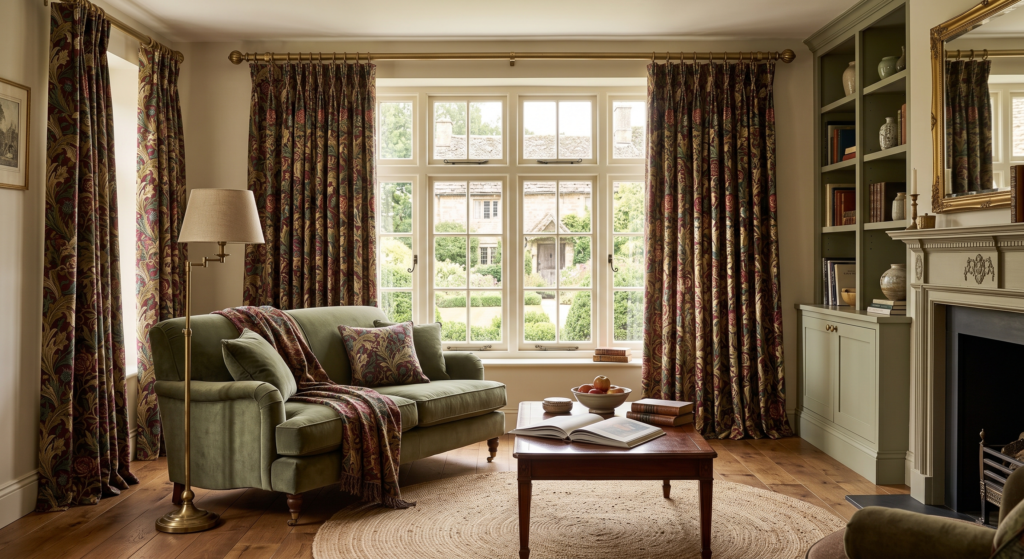
In a grandmillennial-style room think vintage floral or striped fabrics, brass hardware, and layered pattern pinch pleat headers in a mid-weight cotton or linen blend read as authentically traditional without tipping into overly formal or stiff. See our guide to grandmillennial-style bathroom details for how this same sensibility plays out beyond the living room.
Traditional and classic interiors generally suit heavier fabrics like velvet or a substantial cotton-linen blend, paired with pinch pleat or goblet-style headers and decorative trim along the leading edge. It’s worth pairing curtains with the right wall treatment so the two elements feel considered together, not chosen separately.
Modern and transitional spaces lean toward grommet or simple tab-top headers in solid, lighter-weight fabrics, where clean lines matter more than ornate pattern or heavy drape.
Coastal and relaxed interiors often favor lighter linen or linen-blend sheers in a rod pocket or tab-top style, prioritizing airiness and natural light over dramatic fullness the same mood that shapes a good coastal kitchen styling approach.
Matching header style and fabric weight to your home’s existing character is what separates a room that looks professionally styled from one that simply looks “expensive” without a clear point of view.
Custom vs. Ready-Made: An Honest Comparison
Ready-made panels, typically $30–$300 each, win decisively on upfront cost and immediate availability, a real advantage for rentals, short-term situations, or rooms where perfection isn’t the priority.
What ready-made can’t offer is a tailored fit. Fixed-length panels routinely puddle awkwardly, fall short of the floor, or look proportionally wrong against a non-standard window a problem custom sizing solves by definition.
Custom curtains also tend to outlast ready-made options meaningfully commonly cited lifespans run 8 to 15 years for quality construction with proper fabric and lining, versus a shorter, less predictable lifespan for mass-produced panels exposed to the same sun and humidity.
The honest answer to “Is it worth it?” is that for a long-term home, an oddly sized or oversized window, or a room where the finished look genuinely matters, custom earns its price. For a short-term rental or a low-visibility secondary room, ready-made is often the smarter call. Either way, curtains are only one piece of creating a cozy living room with the right furniture around them.
Common Mistakes That Make Expensive Curtains Look Cheap
Skimping on fullness to save on fabric cost. As covered above, this is the single most common way an expensive fabric ends up looking flat and unimpressive once hung.
Hanging the rod too close to the window frame. A rod mounted just above the window makes curtains look smaller and the window look shorter; mounting several inches higher and wider makes both the window and the room read larger.
Skipping lining on light-colored or lightweight fabric. Unlined panels often look thin and washed out in daylight, and they offer little privacy or insulation value regardless of how nice the fabric feels in hand.
Ignoring pattern repeat on patterned fabric. Large-scale patterns need extra yardage to match seams correctly across multiple fabric widths skipping this step produces a visibly misaligned pattern at the seams.
Choosing hardware as an afterthought. A beautiful fabric on a flimsy, mismatched rod undercuts the entire investment hardware finish should be chosen alongside fabric, not bought separately at the last minute.
FAQs about custom curtains
How much do custom curtains cost?
Most custom curtains run $250 to $2,500 per window depending on fabric, lining, and hardware, with luxury or motorized systems costing considerably more.
Are custom curtains worth it?
For long-term homes, oversized or non-standard windows, and rooms where the finished look matters, yes, the tailored fit and longer lifespan generally justify the higher upfront cost.
How much fabric do I need for custom curtains?
Multiply your window width by a fullness ratio of 1.5x to 2.5x, then add allowances for header and hem length to calculate the fabric width and length needed.
What is the difference between custom and made-to-measure curtains?
Both are built to your exact window measurements; “made-to-measure” often refers to a more standardized, typically lower-cost process, while full “custom” or bespoke work usually involves a workroom consultation.
How long do custom curtains last?
With quality fabric, proper lining, and correct installation, custom curtains commonly last 8 to 15 years, depending on sun exposure and humidity.
What header style should I choose?
Pinch pleat suits traditional and grandmillennial-style rooms, grommet suits modern spaces, and tab-top or rod pocket suits relaxed, cottage, or coastal interiors.
A Direct Takeaway
Custom curtains earn their price through tailored fit, real fullness, and a fabric-and-header pairing that actually matches your home’s character, not through the fabric cost alone.
Run the fullness and yardage math before you order, choose a header style that fits your room’s era, and the finished result will look like it cost more than it did, rather than the other way around.
Curtains and the window itself work as a pair it’s worth getting both right together rather than treating one as an afterthought to the other.