

Bathroom cabinets rarely fail because they are too small. More often, they fail because the space inside them has never been assigned a clear purpose. A tall bottle ends up beside cotton swabs. Cleaning spray shares a shelf with skincare.
New products are pushed in front of old ones. Small items disappear into corners. The cabinet may technically hold everything, yet somehow the countertop remains crowded. Understanding how to organize bathroom cabinet storage starts with changing the way you think about the space.
Instead of asking, “Where can I fit this?” Ask: “Where should this live so I can find it, use it, clean around it, and put it back without effort?” That single question leads to a much better system. A useful bathroom cabinet should support your routine.
Protect the products stored inside, make cleaning easier, reduce unnecessary purchases, and prevent the familiar cycle of organizing everything beautifully only to lose control of it again a few weeks later. Here is a practical way to build that kind of cabinet from the inside out.
First, Understand Why Bathroom Cabinets Become Messy
Bathroom clutter behaves differently from clutter in many other rooms. Most bathroom products are small enough to squeeze into almost any gap. That makes it easy to postpone decisions. You can always fit one more bottle somewhere.
Then another. And another. Eventually, the cabinet contains layers rather than categories. There are also several different types of items competing for the same storage:
- products used every morning;
- products used in the shower;
- occasional grooming supplies;
- cosmetics;
- toilet paper;
- towels;
- cleaning products;
- unopened replacements;
- travel products;
- health-related items;
- appliances and cords.
They do not all need the same type of storage. A cotton swab needs containment. A tall bottle needs vertical clearance. A hair dryer needs enough open space for its shape and cord. A cleaning liquid needs stability and spill protection.
The first improvement, therefore, is not adding containers. It is recognizing that different objects create different storage problems.
Remove Everything and Study the Empty Space
Before deciding how to organize bathroom cabinet shelves, empty them. Do not merely shift items from one side to another. An empty cabinet reveals information that clutter hides. You may discover:
- unused space above existing shelves;
- a surprisingly deep rear section;
- a cabinet door that could hold lightweight items;
- plumbing that blocks only one side rather than the entire under-sink area;
- adjustable shelf holes you never noticed;
- water staining or product residue;
- containers that are wasting several inches of width.
Clean the cabinet while it is empty. Wipe shelves, corners, drawer interiors, and cabinet doors. Under the sink, inspect the plumbing area for signs of moisture. This is also the right time to measure the interior. Record the usable:
- width;
- depth;
- shelf height;
- cabinet opening;
- distance around pipes;
- clearance behind doors;
- drawer height.
These numbers matter later when deciding whether a shelf riser, drawer unit, basket, or pull-out organizer will actually work.
Stop Treating Every Product as Equally Important
Bathroom products may all live in the same room, but they do not all deserve the same amount of storage attention. A useful approach is to divide possessions by their relationship to your routine.
Core routine items
These are the things that affect your day if you cannot find them. Examples might include:
- toothbrush;
- toothpaste;
- cleanser;
- moisturizer;
- deodorant;
- contact-lens products;
- shaving products.
These deserve the clearest and least complicated storage.
Support items
These are useful but not constantly needed. Examples:
- hair treatments;
- nail-care tools;
- face masks;
- extra razors;
- styling products;
- grooming kits.
They can occupy less convenient sections.
Household supplies
These are not personal-care products at all, but they frequently compete for cabinet space. Examples:
- toilet paper;
- tissues;
- soap refills;
- cleaning cloths;
- spare handwash;
- bathroom cleaners.
These usually benefit from a separate area.
Rare-use items
Travel bottles, guest toiletries, specialty tools, and products used only a few times each year should not consume the cabinet’s most accessible real estate. This distinction immediately makes the cabinet easier to plan.
Give Every Section of the Cabinet a Job
One of the strongest ways to organize a bathroom cabinet is to stop thinking item by item. Assign jobs to physical areas instead. For example:
Left upper shelf: personal grooming. Right upper shelf: skincare. Lower left cabinet: household supplies. Lower right cabinet: cleaning products. Top drawer: small daily items. Deep rear shelf: rarely used equipment. Once an area has a job, adding new items becomes easier.
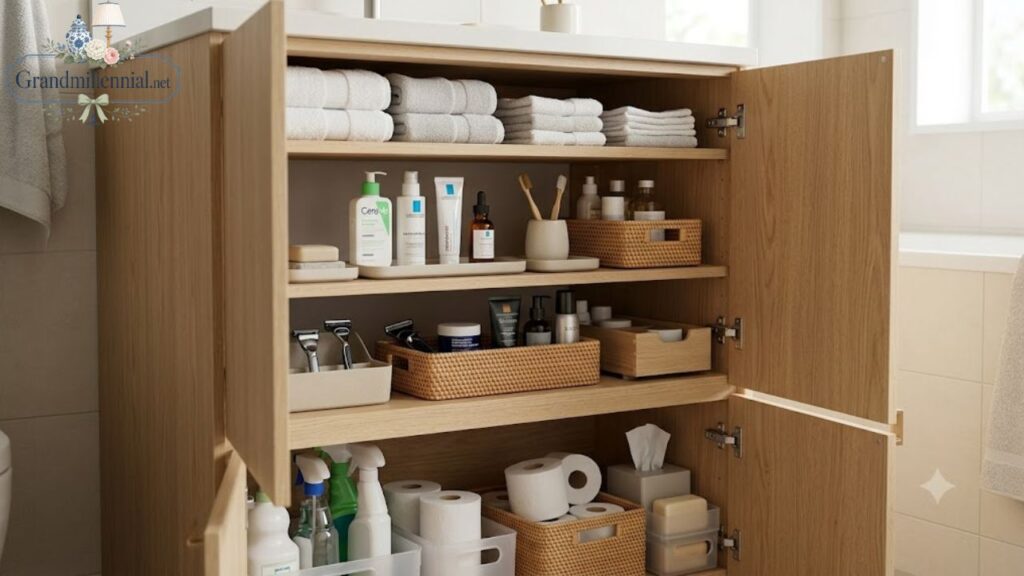
You no longer wonder where a new bottle belongs. You compare it with the purpose of each area. This reduces what organizers sometimes call “decision friction”: the small hesitation that happens every time you put something away. The easier the decision, the more likely the cabinet stays organized.
Keep Countertop Products to a Deliberate Minimum
A cabinet cannot solve bathroom clutter if everything used regularly remains on the counter. At the same time, forcing every item behind a door is not always sensible. Choose deliberately. A toothbrush holder, hand soap, or one frequently used skincare product may reasonably remain visible.
Twenty-two bottles probably should not. A useful question is: Does leaving this item outside make the routine easier, or has it simply never been given a proper home?
If it genuinely earns countertop space, keep it there. If it sits outside only because the cabinet is inconvenient, improve the cabinet. This distinction helps create a bathroom that feels calmer without becoming artificially empty.
Use the Reach Test
Stand naturally in front of the cabinet. Open the door. Notice the areas you can reach comfortably without crouching, stretching, or moving another object. Those are high-value storage positions. Products used frequently should occupy those areas.
The lowest corners, rear sections, and highest shelves can handle things used less often. This sounds simple, but it is one of the most effective principles in bathroom organization. People often organize according to visual symmetry instead.
They put matching baskets evenly across the cabinet because the arrangement looks balanced. But if the most-used basket is awkward to reach, the system will eventually fail. Your body should help determine the layout.
Use Storage Containers Only Where They Improve Control
Organizers should have a clear purpose. Buying a set of twelve matching containers before understanding your cabinet often creates more work. Some products are already perfectly capable of standing on a shelf by themselves.
They do not automatically become easier to use because they are placed inside another box. Use containers where they solve one of four problems.
Items fall over
Use a shallow tray or supportive bin.
Small objects spread everywhere
Use compartments or dividers.
Products disappear at the back
Use pull-out storage or handled baskets.
Categories blend
Use separate bins or trays. That is enough. There is no prize for putting every bathroom product inside acrylic.
Choose Open Storage for High-Turnover Items
Items that are taken out and returned frequently should usually be easy to access. Open trays, shallow baskets, and uncovered bins work well because they remove unnecessary steps. Think about how annoying it would become to open a lid twice a day just to reach toothpaste.
Closed boxes work better for products that need protection or are used infrequently. Every additional action matters. A cabinet stays organized partly because returning an item is easier than leaving it somewhere else.
Create Containment for Products That Leak
One overlooked aspect of how to organize bathroom cabinet storage is protecting the cabinet itself. Bathroom products leak. Pump bottles drip. Cleaning liquids can loosen around caps. Hair products can become sticky. Oil-based skincare can leave difficult residue.
Rather than placing these bottles directly on wood or laminate shelves, group them on washable trays where practical. If something leaks, you can remove and clean the tray rather than scrubbing the entire cabinet.
Under the sink, this is especially useful for household cleaners and refill bottles. It also makes leaks easier to notice. Clean looking storage should not hide maintenance problems.
Make Under-Sink Storage Follow the Plumbing
Under-sink cabinets are rarely symmetrical, so the organization should not be symmetrical either. The plumbing already decides part of the layout. Work around it. Look for three potential zones:
Side columns
The areas beside the pipes often provide the best vertical storage. A narrow drawer unit, basket, or tall bin may fit well here.
Front floor area
This can hold supplies that are easy to pull forward.
Rear irregular area
Use this for items that are lightweight, less frequently accessed, or grouped in removable containers. Avoid burying essential products behind the drain assembly.
Anything stored around pipes should still be removable without wrestling with the plumbing. If you use a sliding organizer, verify that the pipes do not block its movement.
Do Not Build Storage Towers You Hate Using
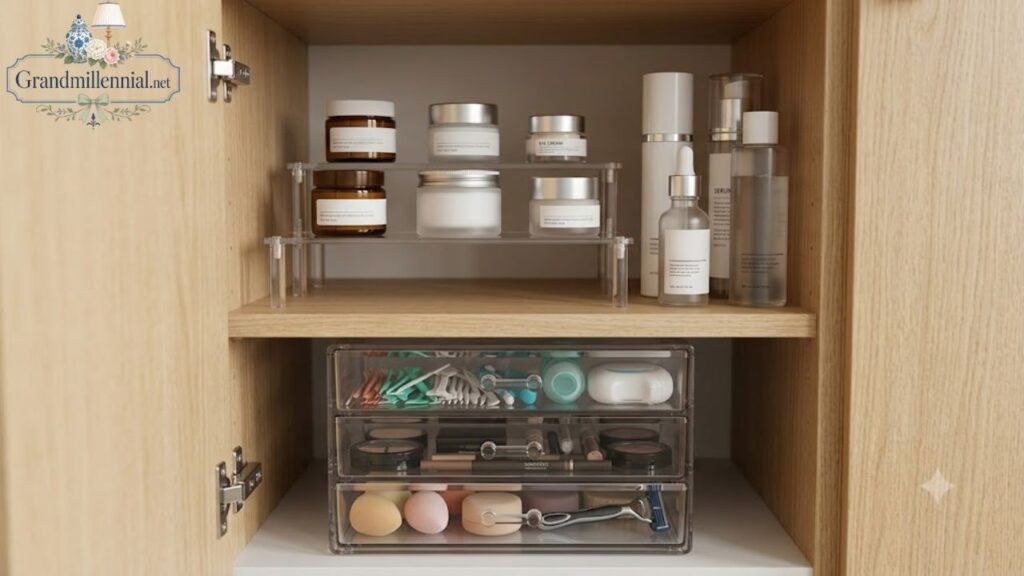
Vertical storage is useful, but there is a difference between using height and creating a puzzle. Stackable drawers can work wonderfully. Stacked open bins that must be lifted apart every time you need the bottom one usually do not. Shelf risers are especially useful because they create another level without making the lower level inaccessible.
You might use a riser for short skincare jars with taller bottles below or beside them. The best vertical solution keeps both levels independently reachable. If reaching one item requires dismantling three layers, the cabinet has gained capacity but lost usability.
Make Small Items Visible at a Glance
Hair pins, nail clippers, floss picks, razor cartridges, makeup items, and similar objects can turn drawers into miniature junk zones. Small items need boundaries. Use shallow compartments instead of one large deep bin. A shallow divider keeps everything visible when the drawer opens.
Deep containers are often surprisingly bad for tiny objects because the contents overlap and pile on top of one another. Visibility matters. If you cannot see an item, you are more likely to forget you own it. That leads to duplicates.
Give Bathroom Drawers a Purpose Before Adding Dividers
Dividers cannot rescue a drawer that has no clear role. Decide what the drawer is meant to hold first. For example: Drawer one: morning grooming. Drawer two: cosmetics. Drawer three: hair tools. Only then add dividers according to the objects that actually live there.
This prevents a common mistake: buying beautifully divided inserts and then forcing random bathroom products into the available compartments. The storage should adapt to your belongings, not the other way around.
Separate Clean Textiles From Chemical Products
If towels, washcloths, cotton products, or tissues share cabinet space with cleaning liquids, give them physical separation. Do not let loose textiles sit directly beside products that can leak. Cleaning products are better kept upright in their own contained area.
Fresh towels work best on a dry, clean shelf away from liquids. This creates clearer hygiene boundaries and makes the cabinet easier to clean.
Reconsider What You Keep in the Bathroom
Bathroom-related does not automatically mean bathroom-stored. Some items deserve another location because bathrooms can become humid or warm. Always follow manufacturer storage instructions for medications, cosmetics, specialty skincare, and similar products.
If a product specifies cool or dry storage, the bathroom may not be the best choice. Medicines deserve particular attention because storage requirements vary. A bedroom cabinet, hallway closet, or another secure dry storage area may be more suitable depending on the product instructions and household circumstances.
Likewise, do not leave hot styling tools inside enclosed storage immediately after use. Let them cool completely. Bathroom organization should support safe storage, not merely efficient storage.
Organize Beauty Products by Decision Speed
If you own many cosmetics or skincare products, traditional categories can become too large. Instead, consider how quickly you make decisions while using them. Products you choose without thinking should be easy to reach.
Products you compare before using can occupy a slightly larger grouped area. For example, one tray may contain your standard everyday skincare routine. Another may contain occasional treatments. A makeup drawer might place daily products near the front and special-event products farther back.
The point is to reduce the number of choices presented during ordinary routines. A cabinet that constantly asks you to choose among 18 nearly identical products can feel cluttered even when everything is perfectly lined up.
Put Unopened Products Somewhere You Can Count Them
Extra products are useful only when you know they exist. Keep replacements in a clearly defined area rather than hiding them throughout the bathroom. Group similar supplies close enough that you can check inventory quickly. Before buying body wash, look at the replacement area.
Before buying toothpaste, look there too. This simple habit helps prevent the familiar situation where you buy another product and later discover two unopened versions hidden behind towels. Avoid storing excessive quantities just because they fit.
Cabinet capacity should not determine shopping volume. Real consumption should.
Create a Small “Use Next” Section
Some products are not quite backups and not quite current favorites. Perhaps you have:
- an almost-finished lotion;
- an open face wash;
- a shampoo you want to finish;
- a product approaching its recommended-use period after opening.
Give these items a visible temporary location. A “use next” section prevents partly used products from becoming permanent cabinet residents. It also creates a natural sequence: finish what is open before introducing another similar product.
This is particularly helpful for skincare, haircare, and body products where people often rotate between several options.
Organize Shared Bathrooms Around Boundaries
Shared bathrooms introduce a different type of clutter. The problem is not simply quantity. It is ownership. When everyone uses the same shelves without boundaries, products slowly spread into one another’s space. One useful solution is to create defined personal zones. A person might have:
- one drawer section;
- one basket;
- one shelf segment;
- one grooming container.
Communal supplies remain separate. This system reduces confusion because each person knows exactly where personal belongings belong. For children, keep organization simple enough that they can actually follow it.
A seven-category system may look beautiful but will probably not survive if the child cannot remember where anything goes.
Plan for Cleaning Day
A good bathroom cabinet should be easy to clean around. This is where many visually impressive storage setups become frustrating. If you must move 30 individual products before wiping a shelf, cleaning becomes inconvenient.
Group frequently moved objects where sensible. A tray holding six bottles can be lifted once. A basket containing grooming supplies can be removed as a unit. Cabinet liners can make certain surfaces easier to maintain. When choosing storage, ask:
“How hard will this make cleaning?” That question is rarely included in organization inspiration photos, but it matters every week.
Avoid Making Labels More Complicated Than the Cabinet
Labels can help shared households and opaque bins. But they should reflect natural categories. Good labels might be:
- hair;
- dental;
- refills;
- travel;
- cleaning;
- guest;
- grooming.
Less useful systems create categories so narrow that every new item becomes difficult to place. Bathroom organization needs flexibility. If you buy a new scalp brush, you should not need to redesign the entire cabinet because no container has the perfect label. Broad, intuitive categories tend to survive longer.
Do Not Hide Everything Just to Make It Look Minimal
There is a difference between minimal appearance and functional minimalism. A cabinet can look beautifully empty while forcing you to reach into three boxes every morning. That is not an improvement. Likewise, opaque baskets can conceal visual clutter without solving it.
Before using closed storage, ask whether the contents need to be hidden or whether you simply want the shelf to look cleaner. For frequently used products, visibility is often more valuable than visual uniformity. Use attractive containers if you enjoy them, but let convenience remain the final test.
A Simple System for a Very Small Bathroom Cabinet
Small cabinets require stronger priorities. Start with the things that must be accessible inside the bathroom. Everything else needs to justify its position. A compact setup could look like this:
Top shelf
Less frequently used lightweight products.
Main shelf
Regular toiletries and grooming essentials.
Small drawer or basket
Tiny items that would otherwise scatter.
Under-sink side
Household supplies.
Under-sink opposite side
Cleaning products.
Another room
Bulk backups, oversized packages, and products that do not need bathroom access. Small spaces become frustrating when they are asked to store the entire household inventory. Sometimes the best bathroom organization decision is moving something out.
How to Handle a Cabinet With No Drawers
When a vanity cabinet has one large open space, create internal structure without permanently modifying it. Useful options include:
- freestanding drawer units;
- shelf risers;
- narrow baskets;
- pull-out bins;
- stacking organizers;
- shallow trays.
Avoid filling the entire cavity with one giant basket. That simply turns the cabinet into another large container. Smaller functional zones make it easier to find specific items without emptying everything. Renters can use freestanding systems that require no drilling or cabinet modification.
How to Organize a Deep Bathroom Cabinet
Depth can create useful capacity, but it needs a retrieval strategy. The mistake is treating a deep shelf like a supermarket aisle. Three rows of bottles may fit, but only the first row remains convenient. Instead, use removable groupings.
A deep basket can contain travel supplies. Another can contain spare grooming products. A tray can hold replacement toiletries. You access the entire group by pulling it forward. Avoid storing frequently used products in the deepest section unless the storage slides easily.
When deciding how to organize bathroom cabinet shelves with extra depth, the most important question is not “How much can fit?” It is: “How will I reach what fits?”
Make Bathroom Organization Affordable
A functional cabinet does not require a complete matching storage set. Start with what you already own. You may already have:
- trays;
- small baskets;
- spare drawer dividers;
- clean boxes;
- unused cosmetic organizers;
- storage caddies.
Test the arrangement before buying anything. After a week, identify which problems remain. Maybe you genuinely need one narrow pull-out drawer. Maybe you need two shelf risers. Maybe the existing baskets work perfectly.
Targeted purchases are usually more useful than buying an entire organizer collection at once. Measure every product before ordering storage, especially for under-sink cabinets.
Know When You’ve Over-Organized
Yes, this can happen. Signs include:
- every tiny item has its own category;
- you spend too long returning products;
- organizers occupy more space than the products;
- multiple lids must be opened during routine use;
- containers have to be moved to reach other containers;
- household members cannot remember the system.
The solution is usually consolidation. Combine similar categories. Remove unnecessary containers. Give frequently used products fewer barriers. Organization should reduce work. If maintaining the cabinet feels like a chore, simplify it.
Use a 30 Second Reset Instead of Waiting for a Big Cleanup
Do not wait until the cabinet becomes chaotic enough to require another full organization session. Use tiny resets. When you notice an empty bottle, remove it. When a product leaks, clean it immediately. When you open the last refill, add the product to the shopping list.
When something consistently lands in the wrong place, reconsider its assigned home. Thirty seconds of maintenance prevents several hours of future sorting. The cabinet should evolve as your routines change.
Use the “Last Thing Out” Test
Here is a useful way to evaluate your cabinet after organizing it. At the end of your morning or evening routine, look at what remains outside. If the same bottle, appliance, or grooming tool repeatedly stays on the counter, its storage may be inconvenient. Instead of simply putting it away again, ask why. Perhaps:
- the shelf is too low;
- the bin is too crowded;
- the lid is annoying;
- the cord does not fit;
- another container blocks access;
- the item is used too frequently for its current position.
The objects you leave out reveal weaknesses in the storage system. Use that information. Organization should adapt to behavior rather than constantly fighting it.
Five Bathroom Cabinet Rules Worth Keeping
You do not need dozens of rules. These five are enough for most bathrooms:
Make common items easier to reach than uncommon items.
Keep products that can leak contained.
Store small items where they remain visible.
Do not use the bathroom as overflow storage for the entire house.
If an organization method creates more steps, question whether you need it.
Everything else can be adjusted according to your space.
Frequently Asked Questions About Bathroom Cabinet Organization
What is the easiest way to organize bathroom cabinets?
Start by emptying the cabinet and separating what genuinely belongs there from items that can be discarded or moved. Assign each shelf, drawer, or section a clear purpose, then place frequently used products in the easiest-to-reach locations.
What should I store in bathroom cabinets?
Bathroom cabinets commonly hold toiletries, grooming products, personal-care items, towels, toilet supplies, and selected household products. Always consider moisture, safety, and the storage instructions of individual products.
How do I organize a bathroom cabinet with a lot of small items?
Use shallow trays, adjustable drawer dividers, or small open containers. Avoid deep bins for tiny items because objects tend to pile on top of one another and become difficult to see.
How do I organize under the bathroom sink?
Plan around the plumbing rather than trying to make the cabinet symmetrical. Use narrow containers on each side of the pipes, low storage where vertical space is restricted, and removable bins for difficult rear areas.
How do I make better use of tall bathroom cabinets?
Add shelf risers or freestanding drawer units where there is unused vertical space. Make sure each level can still be accessed independently without removing everything above it.
How can I organize bathroom cabinets cheaply?
Declutter and measure first. Reuse clean trays, baskets, boxes, and dividers you already own. Buy new organizers only for specific remaining problems such as wasted vertical space or inaccessible deep shelves.
Should I use clear organizers in a bathroom cabinet?
Clear organizers are useful when visibility matters, especially for smaller products. However, they are not necessary everywhere. Open baskets, drawer dividers, and opaque labeled bins may work equally well depending on the category.
How do I stop my bathroom cabinet from becoming messy again?
Make the storage easy to use, avoid overcrowding, remove empty products quickly, and perform small resets instead of waiting for a major decluttering session. Pay attention to products that repeatedly get left on the countertop because their assigned storage may need changing.