

Quick answer: A $200 window attic renovation is realistic only if the window itself is the bargain, not the whole project. The window can cost 200 dollars from a surplus store,
but framing, flashing, installation, permits, and everything else still need budgeting. Full attic finishing costs about 20,000 dollars on average, according to Angi, so the window is a smart small win inside a bigger plan.
There is a famous little attic story behind this search. Apartment Therapy once featured an unfinished, slanted attic that became a bedroom and bathroom suite, and the star of the room was a window found at a surplus store.
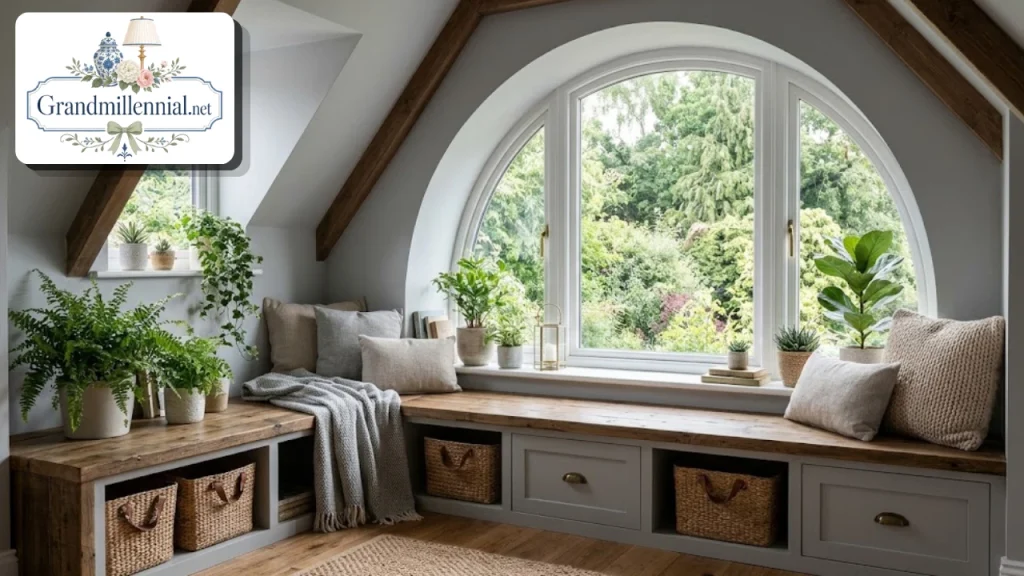
It was a large half-round window with two rectangular windows beside it, marked down to 200 dollars. It brought in the natural light the space badly needed.
That story is the reason so many people type this phrase. They hope one cheap window can turn a dark storage loft into a room worth sleeping in.
It can come close, with the right expectations. This guide explains what the story really tells us, what a $200 window attic renovation leaves out, and how to plan the rest without surprises.
A note on sources. The window story comes from Apartment Therapy, and cost figures come from Angi, This Old House, and other cost guides. I have not renovated this particular attic, and none of the prices here are quotes.
The $200 window story, explained
In the Apartment Therapy feature, the homeowner wanted to add value to the house and create a dedicated suite. The attic had a sloped ceiling and had been used for something other than living.
The big window changed the room more than any other single item. It let daylight into a space that had little, and it gave the angled walls a focal point.
The article mentions only one cost, the 200-dollar window. It does not give a total budget, the room size, or the insulation work, so we cannot treat 200 dollars as the cost of the room.
That matters for anyone copying the idea. The honest reading is that one smart purchase can carry a design, not that an attic can be made livable for the price of a window.
What a $200 window attic renovation does not include
The sticker price of a window is only the beginning. A $200 window attic renovation still needs a plan for everything that happens around the glass.
Here is what the price usually does not cover:
- An opening framed to carry the load above it
- Flashing and sealing so the roof or wall does not leak
- Interior trim, drywall repair, and paint
- Labor for cutting and installing the unit
- Permits and inspections where they are required
- Removing and disposing of the old material
- Delivery, since large units are heavy and awkward
Angi lists dormer windows at around 12,000 dollars each, and dormer additions at 8,000 to 30,000 dollars as a project. That is a different job from swapping a window into an existing opening, but it shows how fast structural work adds up.
If your attic already has a gable wall, a wall window opening is far cheaper than cutting into a sloped roof. Think about where the window will go before you buy it.
How to find a bargain window safely
Surplus stores, salvage yards, building-material resale shops, and online marketplaces are where bargain windows live. Contractors often sell leftover units after a job.
Go with measurements, not a hunch. A window that is almost the right size usually costs more to fit than a standard unit costs new.
Before you pay, check these points:
- Size and shape against your actual opening
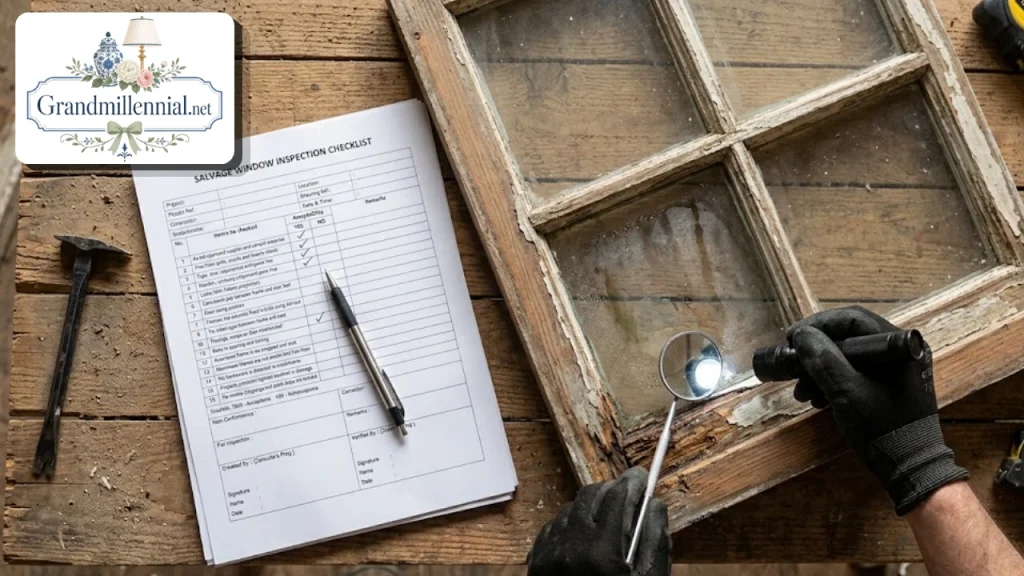
- Glass condition, with no cracks, fogging,g or broken seals
- Frame condition, with no rot, warping,ng or bent metal
- Operation, so sashes slide or crank smoothly
- Any energy-efficiency or safety labels still attached
- Return policy, since many surplus sales are final
Fogged glass between the panes means the seal has failed. That unit will not insulate well, and it may not be a bargain at any price.
If the window will serve a bedroom as an exit, it also needs to meet egress rules. A used window with no labels may be impossible to verify.
Can your attic take a new window?
This is the question that matters most, and it is also where I would stop guessing. Cutting an opening in a wall or roof can affect the structure.
For a gable-end wall, a new opening usually means a header, studs, and proper sealing. For a sloped roof, it means cutting rafters, which is a job for a professional.
This Old House recommends having a structural engineer confirm that the attic can carry the added weight of new finishes and furniture. Angi puts an engineer visit at about 400 to 800 dollars.
That fee is small next to the cost of fixing a sagging floor. I treat it as part of the budget, not an optional extra.
Local rules also matter. Check building codes and zoning with your city office early, because requirements vary. Angi puts permits at roughly 100 to 1,500 dollars or more.
Egress, ceiling height,t and stairs
If the attic will be a bedroom, three rules shape everything. They are egress windows, ceiling height, and stairs.
An egress window is a window large enough to escape through in an emergency. Angi says bedrooms need one with an opening of at least 5.7 square feet. Your local code may differ, so verify it.
This is where a surplus window can become a problem. A beautiful fixed half-round unit will not count as an escape route if it does not open.
You can solve it by pairing a decorative fixed window with an operable egress window elsewhere in the room. The Apartment Therapy design used a center piece with two side windows, a layout that suggests this kind of mix.
Ceiling height matters next. This Old House says at least half of the floor area should have 7-foot ceilings, and a roof pitch of 7/12 or steeper is ideal.
Finally, a permanent staircase with handrails is expected. A pull-down ladder is fine for storage but not for a bedroom.
What an attic renovation really costs
Now for the numbers that surround the window. Angi reports a national average of about 20,000 dollars to finish an attic, with a typical range of 7,500 to 35,000.
Most projects land between 30 and 60 dollars per square foot, with a basic finish near 30 per square foot and a full living space running far higher. Angi lists a bedroom conversion at 9,000 to 65,000 dollars.
Here are some line items from Angi that help you see where money goes.
| Item | Cost |
|---|---|
| Insulation | About $2,500 average |
| Subflooring | $3 to $10 per sq ft |
| Drywall | About $2,100 average |
| Painting | $2 to $6 per sq ft |
| Electrical, total | $750 to $3,200 |
| HVAC ductwork | $1 to $3 per sq ft |
| Permits | $100 to $1,500 or more |
| Structural engineer | $400 to $800 |
| Demolition | $2 to $8 per sq ft |
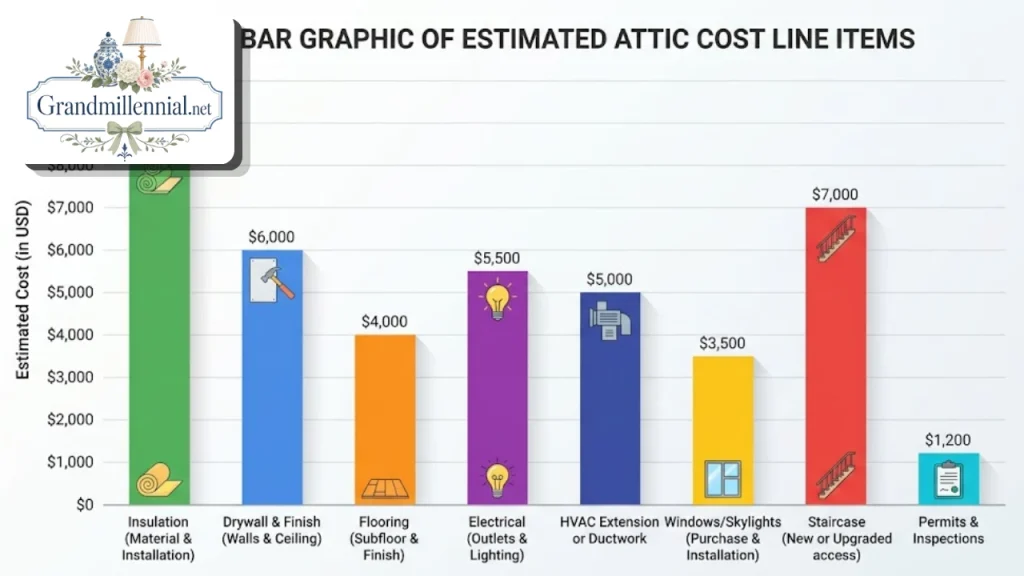
Notice that Angi’s own article is inconsistent. It gives 7,500 to 35,000 dollars in one place and 10,000 to 50,000 in another, so treat any single range as a rough guide.
Against this backdrop, a 200-dollar window is a fraction of one percent of an average project. It is still worth hunting for, because windows are among the few items where a bargain can be a real style upgrade.
A low-budget attic plan
If your goal is a cozy attic without a huge bill, think in phases. Do the structural and safety work first, then spend the rest on what you see.
Phase one is the inspection. Have a pro confirm the floor, the roof,f and the wiring, and ask what code requires before you pay for anything else.
Phase two is the envelope. Add insulation and ventilation, then put in the window and any other openings.
Phase three is the finish. Add drywall, flooring, lighting,ng and paint, and then furnish the space.
Skipping phases is how a cheap project becomes an expensive one. A beautiful window above a damp, uninsulated floor is a poor trade.
For a bigger picture of how to sequence a job like this, our renovation tips guide walks through ordering the work so you do not pay twice for the same access.
Insulation and ventilation
A big new window brings light and also heat loss. If the attic is not insulated well, the room will be cold in winter and hot in summer.
This Old House cites Department of Energy guidance of R49 to R60 for most climate zones in a finished attic. In warmer areas, or where some insulation already exists, R38 to R49 may be enough.
Insulation also helps prevent moisture buildup and ice dams. That makes it as much a protection for the roof as a comfort upgrade.
Ventilation is the other half. A balanced system with intake vents, usually at the soffits, and exhaust vents at the gable or ridge keeps air moving and helps prevent mold.
A $200 window attic renovation does not skip these steps. The window should arrive after the envelope is sound, not before.
Flooring lessons from the bamboo choice
The Apartment Therapy homeowner chose bamboo in a herringbone pattern to match the dark hardwood downstairs. He later said it scratches easily and would not choose it again.
That is a useful, honest note. Flooring in a bedroom takes daily wear, and a pretty surface that marks easily can disappoint.
There is also a structural angle. This Old House advises lightweight, low-profile flooring in attics, since heavy tile or stone strains the joists and thick carpet or padding can cost headroom.
For the subfloor, This Old House suggests 3/4-inch tongue-and-groove plywood screwed to the joists. Angi prices subflooring at 3 to 10 dollars per square foot.
If you want a hard surface that is easier on the budget, look at engineered boards, durable vinyl planks, or a good laminate. Always check weight and thickness first.
Lighting and color for a sloped ceiling
A sloped ceiling can feel cramped or cozy depending on light. The story’s homeowner called lighting and natural light his favorite part of the room.
He used a mix of fixtures and color-changing LED bulbs suited to the angled ceilings. That layered approach works because slopes throw shadows that a single ceiling light cannot fill.
Aim for three layers. Use ambient light for the whole room, task light by the bed and desk, and accent light on the slopes or the window.
Color matters too. Soft grays and grayish whites were used on the walls and linens in the original, and pale, low-contrast shades make small spaces feel larger.
For wall ideas that work with angled surfaces, our guide on how to decorate walls has practical options.
Do not forget the window itself. A big arched window needs a treatment that suits it, and our guide to custom curtains covers how to handle unusual shapes and sunny rooms.
A built-in bench that hides ductwork
One of the smartest details in the original attic was a bench built under the windows. It hid ductwork, added storage, and gave the owner a place for plants and framed photos.
That is a classic way to solve an awkward problem with furniture. Any low knee-wall area can host a bench, a drawer unit,t or a window seat.
A built-in bench also keeps tall furniture off the low sides of the room. It uses the space where you cannot stand anyway.
Plan the bench before you finish the floor and walls. It is much easier to run wiring, outlets, and vent access when the surfaces are still open.
Angi prices HVAC ductwork at roughly 1 to 3 dollars per square foot, and a mini-split at about 3,000 dollars on average. Whichever heating route you choose, leave access for service.
DIY or hire a pro
Many attic tasks suit a capable DIYer. Painting, trim, simple built-ins and furnishing save real money.
Other tasks are best left to licensed pros. Structural openings, electrical work, plumbing, and anything involving the roof carry risks that go beyond cost.
This Old House advises hiring licensed professionals for electrical and plumbing work and obtaining the required permits and inspections. That is the right line to draw.
A reasonable split is to pay for the openings and wiring, and do the cosmetics yourself. That way the window is installed correctly, and your time goes into the work that is safe and forgiving.
General contractor fees add cost, and Angi puts them at 10 to 20 percent of the project price. If you manage the job yourself, you save that fee but take on the scheduling.
Common mistakes
The first is buying the window before measuring the opening. Returns are rare in surplus stores, and an odd size can cost more to fit than a new standard unit.
The second is ignoring egress. A bedroom without a legal exit cannot be sold or rented as one, and it is unsafe.
The third is forgetting weight. Floors and framing not designed for living loads can sag, and fixing joists is expensive. Angi lists joist repair around 6,000 dollars on average.
The fourth is spending on finishes before the envelope. Insulation, ventilation,n and flashing are the least glamorous items and the most important.
The fifth is skipping a contingency. Old attics hide surprises such as pests, wiring, and moisture, and a 10 to 15 percent cushion is a sensible habit.
Where to put the window
Placement decides both the look and the price. A window in a gable wall is the simplest, because the wall is vertical and the framing is easier to modify.
A window in the sloped roof plane behaves differently. It needs a unit made for roofs, careful flashing, and a pro who has done it before.
Think about the view and the sun as well. A west-facing window brings heat in the afternoon, while a north-facing one gives soft, steady light all day.
Privacy and furniture count too. A tall arched window above a bed can look beautiful, but you will want a plan for curtains or film at night.
In the original story, the window sat low enough to pair with a bench underneath. That is a clever way to use the lower part of a sloped wall.
A simple budget checklist
Before you spend a dollar on finishes, write down every line the window touches. A short list prevents the usual surprise at the end.
Start with these questions, and put a number next to each one:
- Does a structural pro need to look at the framing?
- Will the opening need a new header?
- What does flashing and sealing cost for this wall or roof?
- Is the room a bedroom that needs an egress window?
- Do I need a permit, and what does it cost?
- What is the labor, and who is doing it?
- What trim, drywall,l and paint will the opening need?
Add the answers to the window price, then add a contingency of 10 to 15 percent. That total is your real window cost, and it is the number to compare against any quote.
A $200 window attic renovation is a good story because the first number is small. The honest total is bigger, and knowing it early is what keeps the project fun.
Is it worth finishing an attic?
An attic is often the cheapest square footage you can add, because the roof and walls already exist. That is why homeowners keep trying it.
If your goal is more living space, our overview of home additions compares the options and helps you decide whether an attic is the right route.
If your goal is cozy comfort rather than resale value, a smaller project may do the job. A reading nook, a guest room,om or a hobby space needs less than a full suite.
Either way, a single great feature such as a big window can anchor the room. For more ideas on making a sloped, quiet space feel warm, see our guide to creating a cozy living space.
FAQs:
Can you really renovate an attic for 200 dollars?
Not the whole attic. The window in the famous Apartment Therapy story cost 200 dollars from a surplus store, but framing, installation, insulation, flooring, and finishing are separate costs. Angi’s national average for finishing an attic is about 20,000 dollars.
Where can I find a cheap attic window?
Surplus stores, salvage yards, building-material resale shops,s and online marketplaces are the usual places. Check glass seals, frame condition, and exact size, and confirm whether returns are allowed before you buy.
Is a $200 window attic renovation a good idea?
It is a good idea if the window is part of a sound plan. A $200 window attic renovation works when the structure, insulation,n and egress are handled first, and the bargain window then adds light and character.
Does an attic bedroom need an egress window?
Yes, in most places. Angi says bedrooms need an egress window with an opening of at least 5.7 square feet. Check your local code, because requirements vary.
How much does it cost to finish an attic?
Angi reports an average of about 20,000 dollars and a typical range of 7,500 to 35,000, with most projects at 30 to 60 dollars per square foot. A bedroom conversion can range from 9,000 to 65,000.
How high does the ceiling need to be?
This Old House says at least half of the floor area should have 7-foot ceilings, and a roof pitch of 7/12 or steeper is ideal. Lower pitches may need dormers or a raised roof.
How much insulation does a finished attic need?
This Old House cites Department of Energy guidance of R49 to R60 for most climate zones, and R38 to R49 in warmer areas or where some insulation already exists.
Can I cut a window into my roof myself?
I would not. Cutting rafters or a roof opening affects the structure and weatherproofing. Hire a licensed pro, and get a structural check first.