

Quick answer: Published averages for a bathroom remodel run from about 11,400 to 15,600 dollars, and most homeowners land somewhere between 6,500 and 24,700.
The right number for your bathroom depends on scope, size, and finish level. The six steps below work as a bathroom remodel cost estimator you can run with a tape measure and a notepad.
Ask five people what a bathroom remodel cost,s and you will hear five different answers. All of them can be right, because a paint-and-fixtures refresh and a full gut with moved plumbing are different projects.
The trick is to estimate in layers. You decide the scope first, then the size, then the finish level, then add the extras that always show up.
This guide builds a simple bathroom remodel cost estimator from published figures by Quicken Loans (citing Angi), DecorAI (citing This Old House and other sources,) and Houzz. Where those sources disagree, I say so.
Everything here is a US planning range, not a quote. Local labor, your home’s a,ge and your taste will move the final number.
How the bathroom remodel cost estimator works
The estimator rests on a few ideas. Cost depends on how much you change, how big the room, is and how fancy the finishes are.
Here is the method in plain language:
- Choose a scope, from cosmetic refresh to layout change.
- Measure the room and find your size band.
- Pick a finish tier, from basichigh-end end.
- Add line items for big fixtures and extras.
- Check the labor share against the total.
- Add permits and a contingency cushion.
Keep the low and high ends separate at every step. Add the lows together and the highs together, and you get an honest range instead of a falsely precise single number.
If the result lands far outside the published averages, that is not an error. It tells you something about your project, and the next sections help you read it.
Choose a scope
Scope is the biggest driver, and it is the step most calculators skip. DecorAI breaks projects into four rungs.
| Scope | Typical range (DecorAI) |
|---|---|
| Cosmetic refresh | $3,000 to $10,000 |
| Partial remodel | $6,000 to $25,000 |
| Full remodel, same layout | $15,000 to $35,000 |
| Layout or plumbing change | $25,000 to $60,000 |
A cosmetic refresh swaps surface items such as paint, a vanity, lighting, and fixtures. The plumbing and layout stay put.
A partial remodel replaces some major items, such as the tub or the floor, but keeps the rest. A full remodel gets everything new in the same footprint.
The top rung moves walls, drain,s or supply lines. Houzz says moving a toilet, adding a tub, or reconfiguring a shower needs a licensed plumber, and those jobs raise the cost.
Pick the honest rung. Many budgets fail because people price a refresh and then fall in love with a new layout.
Measure the room
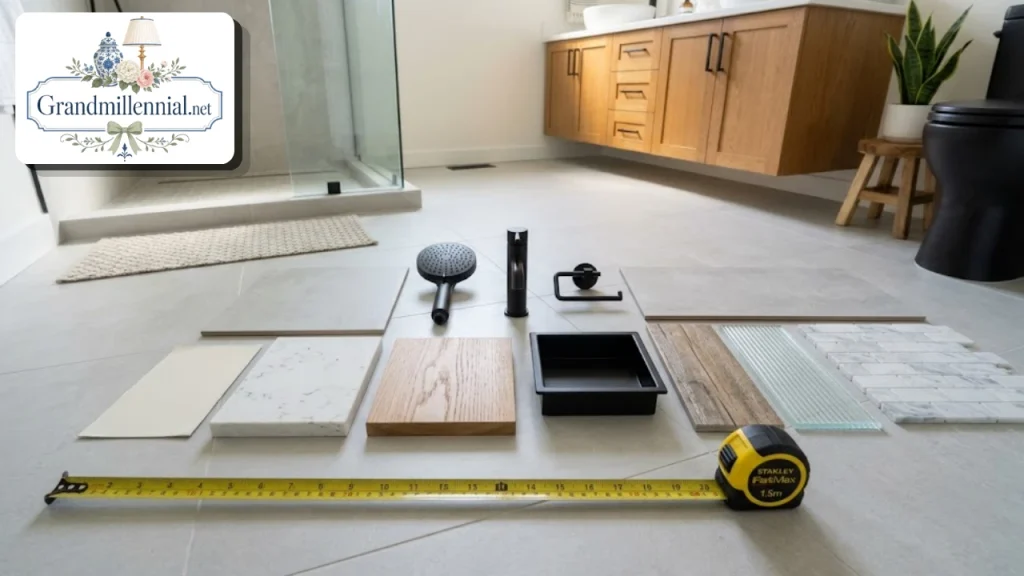
Measure the floor in square feet. Multiply length by width, and for an odd shape, split it into rectangles and add them.
Most bathrooms are small. DecorAI lists a 5 by 7 foot bathroom at 35 square feet and a 5 by 10 at 50.
Quicken groups bathrooms the same way. A half bath is around 30 square feet, a guest bath around 8,0 and a primary bath around 120.
Houzz uses a medium band of 30 to 100 square feet. That covers most guest and hall bathrooms.
Size matters, but not in a straight line. A small room still needs the same toilet, tub or shower, and vanity as a big one, so cost per square foot is higher in tiny bathrooms.
Pick a finish tier
Finish level sets how far you move within each range. DecorAI cites This Old House for tiers on a 50-square-foot bathroom.
| Tier (50 sq ft) | Range |
|---|---|
| Basic | $8,478 to $10,883 |
| Midrange | $14,609 to $19,040 |
| High end | $27,492 to $35,808 |
Basic means stock vanities, standard ti,le and builder-grade fixtures. Midrange adds better cabinetry, nicer t,ile and some design touches.
High end brings custom work, premium stone and upscale fixtures. Houzz names marble, granite, custom-shaped tile, and heated flooring as cost drivers.
You can also use Quicken’s per-square-foot band. It lists 70 to 250 dollars per square foot, which gives 25 square feet at 1,800 to 6,300 and 50 square feet at 3,500 to 12,500.
Notice that the two methods do not agree. At 50 square feet, Quicken’s range tops out at 12,500, while This Old House’s midrange starts at 14,609.
That gap is normal. The sources use different data and definitions, so treat the lower method as a floor for simple work and the higher one as a guide for a full remodel.
Add the line items
Big fixtures and extras can push you above or below the tier range. These figures come from Quicken (citing Angi) and DecorAI.
| Item | Reported cost |
|---|---|
| Shower installation (DecorAI average) | $8,044 |
| Plumbing (DecorAI average) | $5,545 |
| Tile (DecorAI average) | $1,326 |
| Painting (DecorAI average) | $1,145 |
| Flooring (DecorAI average) | $1,114 |
| Toilet (DecorAI average) | $467 |
| Countertops (DecorAI average) | $332 |
| Shower, range (Quicken) | $500 to $5,000 |
| Freestanding tub (Quicken) | About $3,700 |
| Vent fan (Quicken) | About $400 (range $130 to $425) |
| Light fixture (Quicken) | $150 to $930 |
| Sink installation (Quicken) | $215 to $625 |
DecorAI says its line items apply only when the component is part of the project and are not a single project breakdown. Added together, they exceed its own overall average.
So do not stack all of them blindly. Use the table to check whether a tier range feels right for what you want to change.
Quicken also lists some bigger swings. A walk-in tub runs 4,000 to 12,000 dollars, and a wet room 2,000 to 30,000 with an average near 9,000.
Check the labor share
Labor is a large part of the bill. Houzz says it can make up at least 50 percent of the budget.
Quicken says 40 to 65 percent, and DecorAI gives 50 to 65 in one section and 40 to 65 in another. The ranges overlap around 50 percent.
Quicken lists a general contractor at 10 to 20 percent of project cost and plumbers and electricians at 45 to 200 dollars per hour. Those are wide ranges because of region and skill.
Use labor share as a sanity check. If a quote has almost no labor line, something is missing.
If you do some of the work yourself, you can save part of that share. Quicken estimates DIY savings of about 1,500 to 5,300 dollars on a 40-square-foot bathroom, but only for work you can do safely and correctly.
Permits, extras, and contingency
Add the costs that sit outside the tier. Quicken lists permits at 100 to 1,000 dollars, and floor plan changes at around 5,000.
Houzz adds that demolition should be confirmed as part of the contractor’s labor, and repairs to leaks or water damage can appear once walls are open.
Water damage is the classic surprise. A rotted subfloor or a leaking drain does not show until the old shower is out.
I would add a contingency of 10 to 20 percent. That is a common rule of thumb, though the pages I reviewed for this guide do not give a percentage, so treat it as a planning habit rather than a sourced figure.
Quicken says unexpected costs can break a remodeling budget and advises planning for permits, floor plan change,s and structural engineering when walls or heavy fixtures are involved.
A worked example: 50 square feet, midrange
Let me run the bathroom remodel cost estimator on a realistic case. The room is 5 by 10 feet, a full midrange remodel with the same layout.
| Line | Low | High |
|---|---|---|
| Midrange base (DecorAI / This Old House) | $14,609 | $19,040 |
| Permit (Quicken) | $100 | $1,000 |
| Vent fan (Quicken) | $130 | $425 |
| Subtotal | $14,839 | $20,465 |
| Contingency (10% low, 15% high) | $1,484 | $3,070 |
| Total | $16,323 | $23,535 |
So the planning range is roughly 16,300 to 23,500 dollars. That sits inside DecorAI’s full remodel range of 15,000 to 35,000.
A caution about double counting. The base range may already include a vent fan or other basics, so the high end here is deliberately cautious.
Compare it with the simple formula. Quicken’s per-square-foot band gives 3,500 to 12,500 for 50 square feet, which is far lower and suits only basic work.
The lesson is that your scope and tier decide which method fits. A full midrange remodel belongs near the top rung, not at the bottom of the per-foot band.
Cost by bathroom type
Not every bathroom is a 50-square-foot hall bath. Quicken gives ranges by type.
| Type | Size | Range (Quicken) |
|---|---|---|
| Half bath | About 30 sq ft | $2,100 to $7,500 |
| Guest bath | About 80 sq ft | $5,600 to $20,000 |
| Primary bath | About 120 sq ft | $8,400 to $30,000 |
DecorAI gives a different view. It lists half baths at 1,200 to 15,000, and primary bathrooms at 20,000 to 50,000.
Primary baths cost more because they usually hold a bigger shower, a double vanity, better finish,es and sometimes a separate tub. They also tend to involve more plumbing.
Pick the table that matches your room, then use the tier and scope steps to narrow it down.
Why published numbers disagree
Anyone who researches this for an hour sees the confusion. The averages quoted here alone run from about 11,400 to 15,600.
Quicken gives 11,398 and cites Angi data stated as current as of May 2023. Houzz’s calculator headline gives 12,350 to 13,650, while its description says 7,500 to 17,000. DecorAI gives 15,600 for 2026.
Part of the difference is date, since prices rise over time. Part is scope, since some averages include partial projects.
DecorAI is also internally inconsistent in places. Its cosmetic remodel figure of 11,582 falls outside its own cosmetic range of 3,000 to 10,000, and its 120 dollars per square foot average implies about 6,000 for 50 square feet, well below its own midrange figures.
The honest takeaway is to use ranges, match your scope to the right rung, and trust a written local quote over any national average.
DIY or hire a pro
Doing it yourself removes much of the labor line, which is the largest share of the bill. For cosmetic w,ork it can make sense.
DecorAI lists a DIY cosmetic remodel for a 5 by 10 bathroom at 6,000 to 10,000, against 12,000 to 20,000 for a professional midrange job.
Hire licensed pros for plumbing, electrical ,work and anything involving waterproofing. Houzz notes that moving a toilet or reconfiguring a shower needs a licensed plumber.
Waterproofing mistakes are expensive. A shower that leaks inside the wall may not show for months.
A sensible split is to hire out the plumbing, elect,rical and wet areas, and do demolition cleanup, pa,inting and fixtures yourself.
Check your local rules too. Many places require permits for plumbing and electrical changes, and unpermitted work can cause trouble when you sell.
How to read a bathroom quote
A good quote lists the same items this estimator uses. If yours does not, ask for it to be broken out.
Here is what to check:
- Scope of work, with the layout clearly stated
- Demolition and disposal included or listed
- Fixtures and finishes named, not just allowances
- Plumbing and electrical as separate lines
- Waterproofing method for the shower or tub
- Permits and who pulls them
- A process for change orders in writing
- Payment schedule and warranty terms
Compare at least three written quotes. If one is far lower, ask what it leaves out.
Allowances are a common trap. A tile allowance that is too low means you pay the difference later when you choose real tile.
Ask who handles surprises, such as rot or old pipes. A fair contract says how those costs are approved and priced.
Ways to save
You ccostsut cost without cutting quality if you plan well. The biggest savings come from not moving plumbing.
Keep the toilet,, shower and vanity where they are. Houzz notes that bathroom costs depend more on plumbing changes than on size.
Choose standard sizes and stock items for the big pieces. A stock vanity costs far less than custom cabinetry, and our guide to the small bathroom vanity shows how to pick one that fits a tight room.
Check the clearances before you buy. Our guide to bathroom vanity depth explains how much space you need in front.
Spend where you touch and see every day, such as the shower valv,e, faucet and lighting. Save on things you rarely notice.
Plan the order of work. Our renovation tips guide helps you avoid paying twice for the same access.
Finish with the details that make the room feel yours. Our guide on how to decorate walls has ideas, and custom curtains cover the window or shower curtain.
Is it worth it?
A remodel improves daily life, and it can help resale too. Houzz says the return can be as high as roughly 70 percent depending on scope, quali,ty of work and local market.
I would treat that as an upper figure, not a promise. The return varies, and a high-end bathroom in a modest neighborhood rarely pays back in full.
If you plan to stay for years, comfort and function matter most. If you plan to sell soon, a clean midrange update is usually the safer bet.
Think about who uses the bathroom too. Safety features such as grab bars and a curbless shower matter more over time, and Quicken lists an accessible bathroom from scratch at around 9,000 on average.
Where you live and how old your house is
Two things no calculator can see are your zip code and your walls. Both change the answer more than most people expect.
Houzz lists higher local labor rates, especially in metropolitan areas, as a cost driver. A remodel in a big city can cost noticeably more than the same job in a small town.
Age matters just as much. Older houses can hide galvanized pipes, outdated wiring,, lead paint or rot, and each of those turns a simple job into a bigger one.
A bathroom remodel cost estimator works best as a first pass. Once you have your range, a contractor visit adds the local and structural facts that the numbers cannot capture.
Ask the contractor to open the shower valve access or look under the vanity before quoting. Ten minutes with a flashlight can reveal leaks or damage that change the scope.
If your house predates modern codes, ask what has to be brought up to date. Electrical outlets near water and exhaust ventilation are common examples, and they add cost.
A quick budget checklist
Before you sign anything, write down your answers to these questions. They turn a loose idea into a number you can defend.
- Which scope rung am I on: refresh, p,artial, full or layout change?
- How many square feet is the room?
- Which finish tier fits my taste and my home’s value?
- Which big items am I replacing: shower, tub, vanity, toilet, floor?
- Does any plumbing or wiring move?
- Who is doing the labor, and what share of the total is it?
- What do permits cost where I live?
- How much cushion have I set aside for surprises?
Put a low and a high number next to each answer, then add them up. If the total is more than you can spend, reduce the scope before you reduce quality.
The cheapest cut is usually layout. The next is custom items, and the last is waterproofing, which you should never skimp on.
Use the bathroom remodel cost estimator again after each decision. Seeing the number move as you change one choice is the fastest way to find savings.
Common mistakes
The first is skipping the scope step. Without it, every number that follows is guesswork.
The second is pricing a refresh and building a remodel. Changes in layout multiply cost quickly.
The third is ignoring labor. A quote with almost no labor line is missing something.
The fourth is forgetting permits and demolition. They are small next, to the total but they are real.
The fifth is no contingency. Walls hide surprises, and a cushion turns a crisis into an inconvenience.
The sixth is buying fixtures before checking fit. Measure the space and the clearances first.
FAQs:
How much does a bathroom remodel cost?
Published averages run from about 11,400 (Quicken, citing Angi) to 15,600 (DecorAI) dollars. DecorAI says most homeowners spend 6,500 to 24,700, and the full span is about 3,000 to 35,000 or more.
How much does a bathroom remodel cost per square foot?
Quicken gives 70 to 250 dollars per square foot. DecorAI cites about 120 on average with a range of 70 to 400. Small rooms cost more per foot than large ones.
How much does a small bathroom remodel cost?
Quicken lists 25 square feet at 1,800 to 6,300 and 40 square feet at 2,800 to 10,000. De5-by-7-foot a 5 by 7 foot bathroom at 5,000 to 15,000.
How accurate is a bathroom remodel cost estimator?
A bathroom remodel cost estimator is accurate to the extent that your scope, size, and finish choices are. It gives a planning range rather than a quote, and local labor and surprises can move the final number.
How much of the budget is labor?
Houzz says at least 50 percent. Quicken gives 40 to 65 percent, and DecorAI gives 40 to 65 or 50 to 65 depending on the section.
How much should I set aside for surprises?
The pages I reviewed do not give a percentage. A common planning habit is 10 to 20 percent, higher for older homes with hidden plumbing or rot.
Do I need a permit?
Often yes for plumbing and electrical changes, and Quicken lists permits at 100 to 1,000 dollars. Check with your local building department.
Is a bathroom remodel worth the cost?
Houzz says the return can reach roughly 70 percent depending on scope, qualit,y and market. Treat that as an upper figure, not a guarantee.