

You notice one on the bathroom wall. Small, grey, and oddly fuzzy, like a miniature moth. It barely moves when you lean in. The next morning there are three, and one is perched on the edge of the sink.
Those are almost certainly drain flies, and the good news is that they’re harmless, common, and completely fixable. The less good news is that the usual quick fixes, such as pouring boiling water or bleach down the drain, rarely work for long.
This guide explains what they are, how to confirm which drain they’re coming from, and the step-by-step routine that actually ends an infestation, along with the hidden sources that keep some homes battling them for months.
Quick answer: Drain flies breed in the slimy film inside drains. To get rid of them, find the drain they’re coming from, scrub the pipe inside with a stiff drain brush to remove the slime, then use an enzyme drain cleaner regularly. Killing adult flies alone won’t stop new ones hatching.
What drain flies are
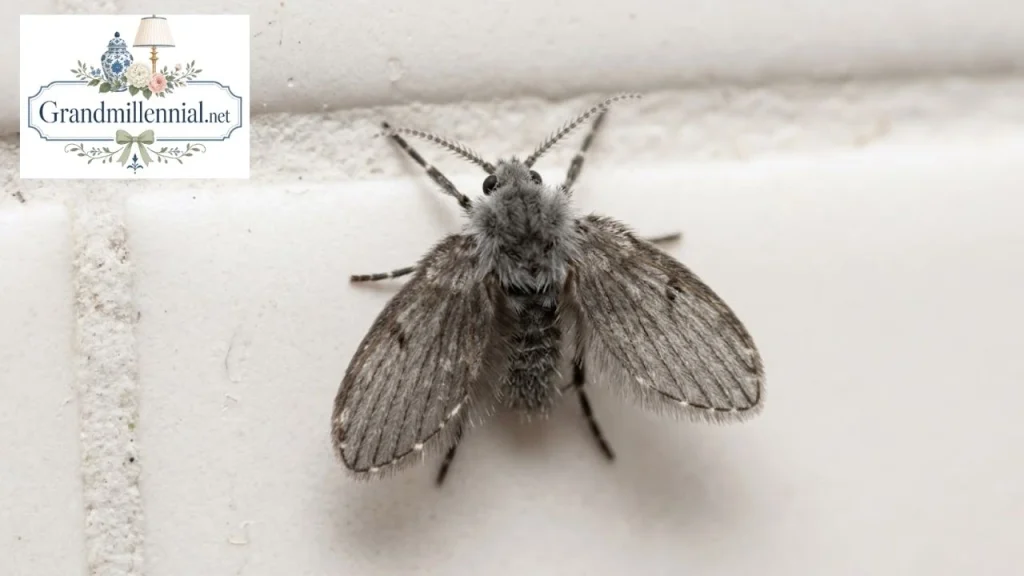
Drain flies are small true flies in the family Psychodidae. They go by several names, including moth flies, sewer flies, filter flies, and bathroom flies, according to the University of Arkansas Extension.
Adults are tiny: roughly 1/16 to 1/4 inch long, says the University of Maryland Extension, and usually pale grey-brown to black. Their bodies and wings are covered in fine hairs, which gives them that soft, furry look.
At rest, they hold their wings flat or roof-like over the body, rather than folded neatly behind like a house fly. Look closely,y and you may see the wings’ distinctly parallel veins, a feature Arkansas Extension highlights for identification.
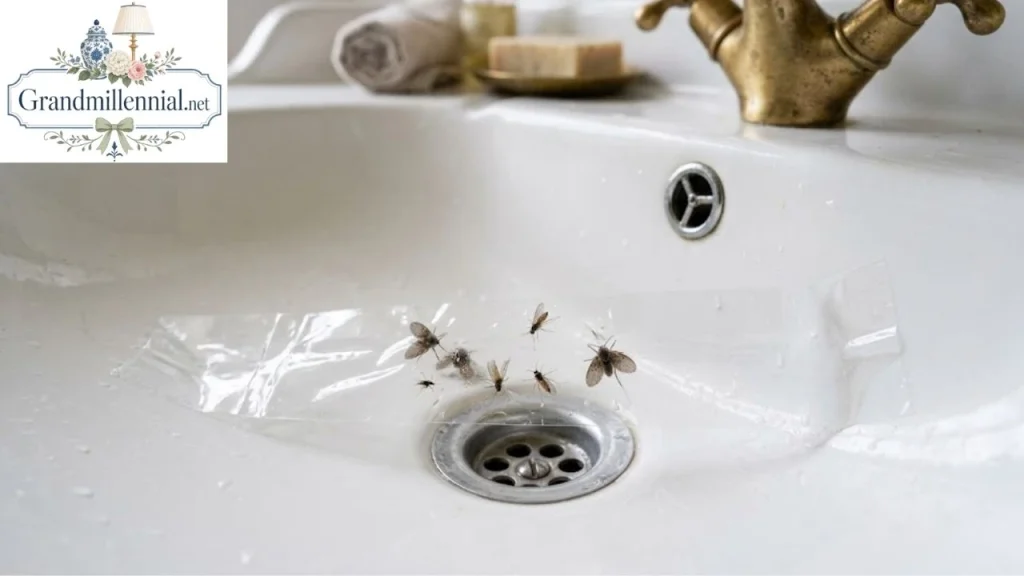
They’re weak fliers. Rather than buzzing around the room, they make short, hopping flights and spend most of their time resting on walls, tiles, and the sides of tubs and sinks, often near the drain they came from.
Drain flies vs. other small flies.
Several small flies show up indoors, and each one points to a different source. Getting the identification right saves a lot of wasted effort.
| Fly | Look | Where you see it | Usual source |
|---|---|---|---|
| Drain fly | Fuzzy, moth-like, grey to black, wings held flat or roof-like | Bathroom and kitchen walls, near sinks, tubs and floor drains | Slime inside drains and other wet organic film |
| Fruit fly | Tan or yellowish body, often red eyes | Around fruit bowls, bins, recycling | Ripe or fermenting fruit, spilled juice, drains with food residue |
| Fungus gnat | Slender, dark, long legs, mosquito-like | Near houseplants and windows | Damp potting soil |
| Phorid fly | Small, humpbacked, often runs quickly on surfaces before flying | Kitchens, bathrooms, basements | Decaying organic matter, including broken drain or sewer lines |
There’s some overlap. Maryland Extension notes that fungus gnats can also breed in drains, and fruit flies will use a kitchen drain full of food residue. If the flies look fuzzy and moth-like, though, you’re dealing with drain flies.
Life cycle, and why they keep coming back
Understanding how drain flies develop explains why so many people think they’ve solved the problem, only to see flies again a week later.
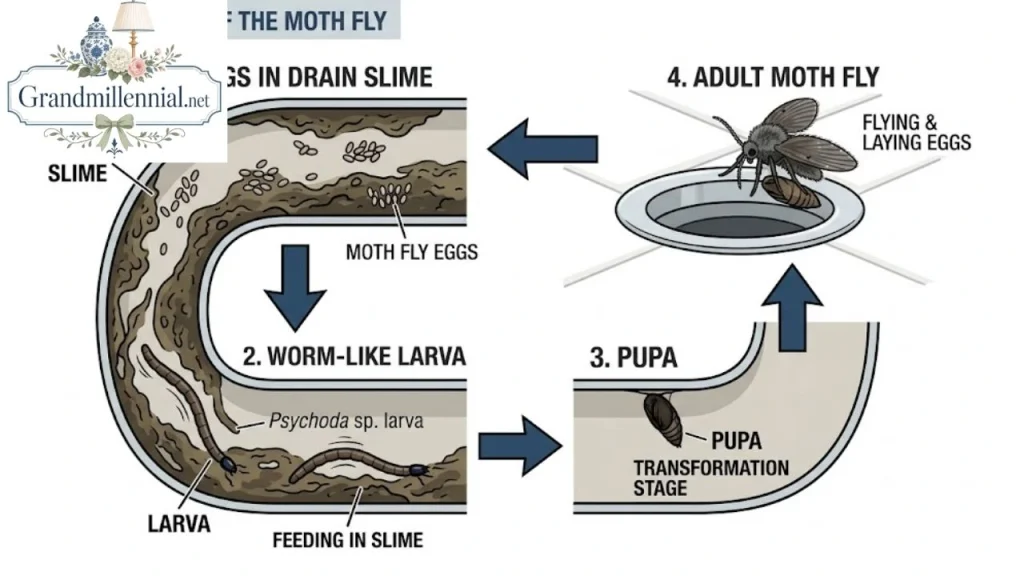
Adults lay eggs in the gelatinous film that builds up inside drains, traps,aps and overflows. The eggs hatch quickly, often within about 48 hours, into tiny worm-like larvae sometimes called “drain worms.”
The larvae live in that slime, feeding on the algae, bacteria, and fungi in it, as Maryland Extension explains. They then pupate in the same spot before emerging as adults.
The whole cycle can be fast. The University of Kentucky puts it at roughly 10 to 15 days at about 70°F, and Maryland Extension gives a broader range of 7 to 28 days. Adults typically live around one to two weeks.
That speed is the key point. Swatting adults does nothing to the eggs, larvae, and pupae already developing in the pipe. Once an infestation is underway, Maryland Extension notes that new flies emerge daily.
Why you suddenly have drain flies
If you’re wondering why you suddenly have drain flies, the answer is usually a drain that’s been sitting still.
The University of Kentucky notes that they often appear when a home has been unoccupied, then disappear after normal use resumes and water moves through the traps again. A guest bathroom, a basement shower, or a sink you rarely use is a classic source.
Other common triggers include a slow-draining sink with built-up gunk, a garbage disposal that isn’t cleaned, a floor drain whose trap has dried out, or a hidden leak that keeps soil or debris wet.
Kentucky also points out that finding many flies over several weeks usually means a more permanent breeding site, one that has to be found and removed rather than waited out.
Are drain flies harmful?
For most households, they’re a nuisance rather than a danger. They don’t bite people or pets, and they don’t damage your home.
The University of Arkansas notes that they’re not necessarily unsanitary in themselves, though they do indicate organic build-up somewhere in your plumbing. The most common bathroom species, Clogmia albipunctata, is not known to carry human diseases.
Some pest-control sources say large numbers may aggravate asthma in sensitive people, as with other airborne insect debris. If anyone in your home has respiratory problems, that’s one more reason to deal with an infestation promptly.
The bigger concern is what they can reveal. Persistent flies with no obvious source can be an early sign of a leaking drain or sewer pipe, which is worth catching early.
Find the source first.
This is the step most people skip, and it’s the reason treatments fail. Flies may be coming from more than one drain, so UC IPM recommends inspecting every drain in the room where adults appear.
The tape test
At night, after the last use of the sink or shower, place a strip of clear packing tape sticky side down across the drain opening. Leave a small gap so air can still move. Check it in the morning.
Flies stuck to the underside of the tape confirm that the drain is a breeding site, as Texas A&M AgriLife recommends. Repeat for a few nights and test every drain in the room, including tub and sink overflows.
The cup trap
Alternatively, coat the inside of a clear plastic cup with a thin layer of vegetable oil or petroleum jelly and set it upside down over the drain. Emerging flies get stuck to the sides.
Look and smell
Remove the drain stopper or cover and shine a flashlight inside. A dark, slimy coating on the pipe walls is the breeding material. A sour or sewage smell is another clue.
How to get rid of drain flies:
Once you know which drain is responsible, this routine gets rid of drain flies in most homes. The goal is simple: remove the slime the larvae need, and keep it from coming back.
Remove the stopper and any visible gunk.
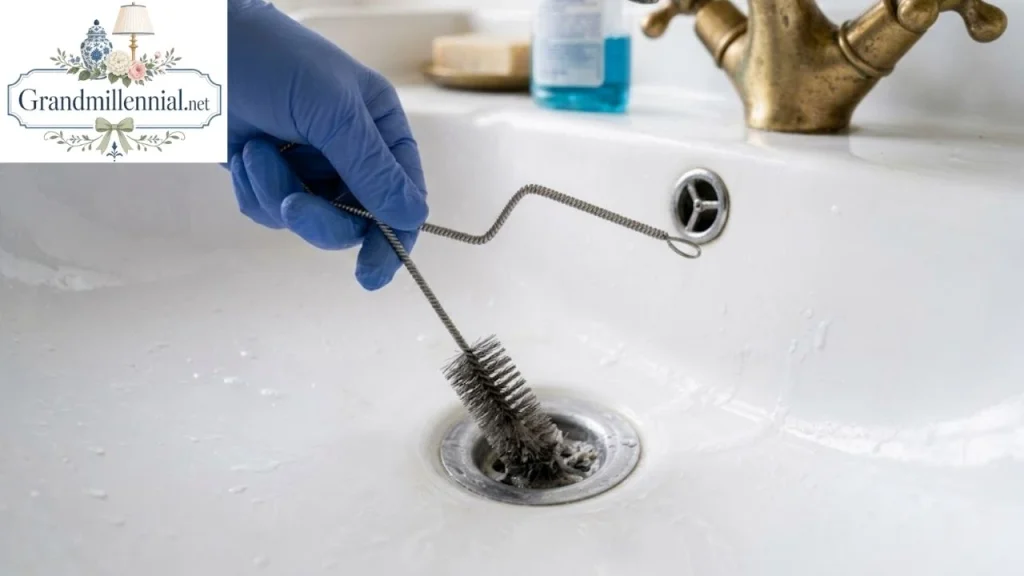
Take out the pop-up stopper, strainer, or drain cover. Pull out hair and debris with gloves or a drain-cleaning tool, and wipe the stopper clean.
Scrub the inside of the pipe.
This is the step that matters most. UC IPM calls physical control an integral part of eliminating these flies, because chemicals poured down a drain flow past the slime instead of removing it.
Use a stiff, long-handled drain brush or a flexible pipe brush and scrub the inside of the drain and as far down the pipe as you can reach, including the trap where possible. Don’t forget the overflow hole on sinks and tubs; a thin bottle brush works well there.
Flush with hot water.
Run hot tap water for a minute or two to wash away the loosened film. Very hot water is fine for metal pipes, but avoid pouring repeated pots of boiling water into plastic (PVC) drains, which can soften joints.
Treat with an enzyme or bacterial drain cleaner.r
Apply an enzyme or bacterial drain gel according to the label, usually at night when the drain won’t be used for several hours. These products digest the organic build-up that larvae feed on, and UC IPM notes that regular use can help prevent it from returning.
Repeat as the label directs, often nightly for about a week, then weekly or monthly for maintenance.
Clean other breeding spots in the room
Wipe under sink rims, clean the toilet bowl and tank if the toilet is rarely used, and check the saucers under houseplants. Empty and dry any standing water you find.
Deal with the adults.
While you work on the source, adults will keep emerging for a while. Sticky traps or a small bowl of water with a drop of dish soap and a splash of vinegar will catch some.
They’re useful for monitoring, but Arkansas Extension is clear that traps alone won’t eliminate an infestation.
Monitor for three weeks.
Repeat the tape test every few days. Because the life cycle can take up to a few weeks, keep going until you see no new flies for at least two weeks.
If flies persist despite clean drains, the source is somewhere else, which is covered below.
What doesn’t work (and why)
Many popular drain fly hacks provide a few days’ relief, then the flies return. Here’s why.
| Common fix | Does it work? | Why |
|---|---|---|
| Boiling water | Short-term at best | UC IPM notes it doesn’t remove the organic film; larvae can also survive by trapping air bubbles |
| Bleach | Short-term at best | It flows past the slime rather than removing it, per UC IPM |
| Vinegar and baking soda | Limited | Fizzing doesn’t scrub the pipe walls; may help loosen light build-up |
| Insecticide sprays down the drain | Not recommended | Kentucky Extension advises against pouring insecticides into drains |
| Bug zappers and sticky traps alone | Monitoring only | They catch adults but don’t stop larvae developing |
| Ignoring them | Sometimes | Kentucky notes they may fade once a drain is used regularly again, but persistent flies need action |
The University of Kentucky adds that drain fly larvae are hard to drown because they trap air bubbles and can stay submerged for a day or more, which explains why simply flushing water through rarely solves the problem.
One important safety note: never mix bleach with other drain cleaners. Texas A&M AgriLife warns that combining bleach with certain drain products can release dangerous chlorine gas.
Hidden breeding sites to check
If you’ve cleaned every drain and the flies keep coming, look further. These are the sources extension services mention most often.
Overflow holes in sinks and tubs collect slime that ordinary cleaning misses.
Garbage disposals hold food residue under the splash guard. Scrub the rubber baffle and grind ice and citrus peel regularly.
Rarely used toilets, including the tank. Kentucky Extension notes the slime layer along the water line in infrequently used toilets can support larvae.
Floor drains and dried-out traps in basements, garages, and laundry rooms. Pour water in monthly to keep the trap sealed.
Drip pans under refrigerators and condensate pans and lines on air conditioners, both mentioned by Kentucky and Maryland.
Sump pits and elevator pits, which UC IPM lists as known breeding sites.
Leaking drain or sewer pipes, including under a concrete slab, where wet soil can support larvae. UC IPM notes moth flies have been found developing in material beneath leaking drain and sewage pipes.
Outdoors: clogged gutters, wet areas where air conditioners drain, and dirty garbage bins can produce flies that wander in through doors and windows.
Room-by-room tips
Bathroom sinks: clean the overflow and stopper, which collect hair and soap scum. If you’re storing cleaning supplies under the sink, keep them organised so you can reach the trap easily; these bathroom cabinet organisation ideas help.
Showers and tubs: hair catchers reduce the build-up larvae feed on. Scrub the drain, body, and tub overflow monthly.
Kitchen sinks: grease and food scraps make an ideal breeding film. Run hot water after washing up, and clean the disposal weekly.
Basements and laundry rooms: floor drains and sump pits are the usual suspects. Keep traps filled with water and the area dry; these over-washer shelf ideas can help keep supplies off damp floors.
Guest bathrooms and holiday homes: run every tap and flush every toilet weekly so water keeps moving through the traps.
Your three-week timeline
Knowing what to expect keeps you from giving up too soon.
| When | What you’ll likely see |
|---|---|
| Days 1–3 | Adults still present; some new ones emerging from pupae already in the pipe |
| Days 4–7 | Fewer flies if the source was found and scrubbed |
| Week 2 | Occasional stragglers; tape tests mostly clean |
| Week 3 | No new flies if the breeding site is gone; if they persist, look for a hidden source |
Prevention routine
A little routine maintenance keeps drain flies from returning.
| How often | Task |
|---|---|
| Weekly | Run hot water through every drain; flush unused toilets; clean disposal and sink stoppers |
| Monthly | Brush drains and overflows; use an enzyme drain treatment; refill floor-drain traps |
| Every few months | Check AC condensate pans, fridge drip trays and sump pits |
| Before travel | Run all taps; consider covering seldom-used drains with stoppers |
| Yearly | Have slow drains professionally cleaned if they keep building up |
Keeping the rest of the home clean helps too. Crumbs and spills feed other small flies, and a gentle cleaning routine like this one for hardwood floors keeps kitchens and bathrooms fresher overall.
When to call a plumber or pest professional
Most drain fly problems can be solved at home. Call a professional if any of these apply:
Flies persist for more than three or four weeks despite thorough drain cleaning
You smell sewage, or see damp patches on floors or walls
Several drains are slow or gurgling
Flies appear in a room without any drain, or around cracks in a concrete floor
You find flies breeding in a sump pit or floor drain you can’t reach
A plumber can use high-pressure drain cleaning, which Arkansas Extension notes can clean the full length of a pipe, and a camera inspection to find cracks or leaks. A pest management professional can help locate breeding sites in commercial or complex buildings.
If you’re renovating a bathroom anyway, it’s a good moment to replace old, slow drains. Choosing a well-sized vanity with easy access to plumbing makes future maintenance easier; see these small bathroom vanity ideas.
FAQs:
What kills drain flies instantly?
Traps and household sprays kill adults quickly, but nothing instant ends an infestation. Scrubbing the drain and using an enzyme cleaner removes the larvae’s food and breeding site.
Why do I suddenly have drain flies?
Usually, it’s a drain that’s been sitting unused or has built up slime. They often appear after a holiday or in a rarely used bathroom.
How long does it take to get rid of drain flies?
Expect one to three weeks after cleaning the source, because flies already developing in the pipe will still emerge.
Do drain flies bite?
No. They don’t bite people or pets.
Does bleach kill drain flies?
Only briefly. Bleach flows past the slime where larvae live rather than removing it, and it must never be mixed with other drain cleaners.
Can drain flies come from the toilet?
Yes, especially from rarely used toilets, where slime builds up along the water line in the bowl and tank.
Will drain flies go away on their own?
Sometimes, if the drain starts being used regularly. Persistent flies over several weeks point to a breeding site that needs cleaning.
Are drain fly larvae in my drain harmful?
No, but their presence means organic build-up that should be removed.