

Most homeowners should budget between 1,200 and 3,500 dollars for the cost of a tankless water heater with installation, according to This Old House’s June 2026 figures. That page puts the average at 2,800 dollars.
The range is wide for good reasons. Swapping an electric unit costs far less than converting a gas tank heater that needs a new vent and a bigger gas line.
Some sources run well past that band. ConsumerAffairs prices full conversions at 6,000 to 10,500 dollars.
Below, the published ranges sit side by side, and the extras are priced one at a time. Three example totals show how a bill gets built.
Those totals are my own arithmetic, not quotes. Your plumber’s written estimate is the number that counts.
What the installed price actually includes
Every quote stacks four things. First comes the heater itself. Then labor, which covers mounting, plumbing connections,s and startup. Third are permit and inspection fees. The fourth layer is whatever your house forces on the job.
That fourth layer is where totals drift. Gas models may need a larger gas line and new venting. Electric models may need a new circuit or a panel upgrade. None of this shows up in the unit price on a store shelf.
Expect the old heater to come out, too. This Old House puts removal at 100 to 500 dollars, and ConsumerAffairs at 100 to 300. Some contractors fold it into labor, and others list it separately, so ask which.
Here is the simplest way to read any quote. Unit price plus labor is the baseline. Everything else is a line item you can question.
A fair cost of a tankless water heater with installation is that baseline plus only the extras your house truly needs.
The national ranges, side by side
Published figures for the cost of a tankless water heater with installation agree near the middle and fight over the edges. The table shows what each page I opened actually says.
| Source | Date shown | Installed range | Typical or average | Who is behind it |
|---|---|---|---|---|
| This Old House | Updated 12 June 2026 | $1,200 to $3,500 | $2,800 average | Home media; RSMeans data and market research |
| ConsumerAffairs | Updated 1 July 2026 | $1,600 to $10,500 | $2,400 to $5,400 most pay | Consumer media; named fact-checker |
| Bob Vila | Modified October 2023 | $1,333 to $3,721 | $2,527 average | Home media; cites Angi and HomeAdvisor |
| Eccotemp | No date shown | $1,400 to $5,400 | None given | Tankless manufacturer |
Two things stand out. ConsumerAffairs’ low end of 1,600 dollars appears nowhere in its own scenario table, where the cheapest case is 2,800 dollars. And the Bob Vila page carries a 2026 label on 2023 data.
I saw a few more figures only as search snippets, so treat them as unverified. Hunker shows 1,200 to 3,375 dollars with a 2,271-dollar average. Homeyou shows 2,876 to 7,421 for gas and 1,689 to 4,785 for electric.
A practical reading: 1,200 to 3,500 dollars is the common band for simple jobs. ConsumerAffairs prices moderate retrofits at 3,900 to 6,000 dollars.
Check numbers at the original page, too. One manufacturer blog I read quoted This Old House’s installed total as a unit price.
Gas, propane, or electric
Fuel type changes both the equipment and the labor. This Old House’s fuel table, built on RSMeans data, is the clearest split I found.
| Fuel | Unit | Installation | Total |
|---|---|---|---|
| Electric | $500 to $1,500 | $150 to $1,000 | $650 to $2,500 |
| Propane | $500 to $2,000 | $900 to $1,500 | $1,400 to $3,500 |
| Natural gas | $750 to $2,000 | $900 to $1,500 | $1,650 to $3,500 |
Electric is cheaper because there is no vent and no gas line. ConsumerAffairs agrees on labor, with 650 to 950 dollars for electric and 750 to 1,300 for gas.
But the electric advantage can vanish. A high-draw electric unit may need a panel upgrade. ConsumerAffairs’ electric install-and-upgrade scenario runs 4,500 to 8,000 dollars, well above its 2,800 to 3,200 dollar basic replacement.
Running costs point the other way. Bob Vila puts gas at about 200 dollars a year and propane at about 350. It gives no electric figure, because that depends on your local power rates.
Gas units still need an electrical outlet nearby to run. Check that the outlet exists before you price the job.
Sizing and unit prices
Size drives the unit price more than brand does. Tankless heaters are rated by flow, in gallons per minute. This Old House lists four tiers, and I read these as unit prices, though the page does not say so outright.
| Unit size | Flow rate | Price range |
|---|---|---|
| Point-of-use | 1 to 2 GPM | $150 to $500 |
| Small whole-house | 2 to 4 GPM | $500 to $1,000 |
| Medium whole-house | 5 to 7 GPM | $1,000 to $2,000 |
| Large whole-house | 8 to 10 GPM | $1,500 to $3,000 |
Flow depends on how much the water must be warmed. The Department of Energy recommends a 120-degree setting.
If water arrives at 55 degrees, that is a 65-degree rise. That figure is my illustration, so use your own winter inlet temperature.
An older DOE publication says residential gas models can heat more than five gallons per minute by 60 degrees. It calls that generally enough for two showers at once.
A home where two bathrooms run together lands in the medium or large tier. Buying too small means lukewarm showers. Buying too large adds money, and a larger gas unit may also need a larger gas line.
Ask the installer for the manufacturer’s flow-versus-temperature-rise chart for the exact model. A sizing guess is not a sizing calculation.
Labor, permits, and inspections
Labor is the second-largest piece. This Old House gives a licensed plumber’s rate as 75 to 150 dollars an hour and four to eight hours on the job. By my arithmetic, that is 300 to 1,200 dollars.
The same page also lists professional installation at 500 to 1,500 dollars. The two do not line up exactly, which is a good reason to ask for a flat, written labor price. Bob Vila says labor usually averages 600 to 1,850 dollars.
ConsumerAffairs also puts the work at four to eight hours. A tricky location slows it down. Bob Vila adds 10 to 15 percent for difficult access.
Permits and inspections are small but real. This Old House gives 50 to 200 dollars for permits and 74 to 150 for inspections. ConsumerAffairs gives a combined 50 to 500 for permits, inspections,s and code fixes.
Timing matters as well. Eccotemp lists emergency or after-hours work as a cost driver. A heater that fails in January invites a rushed, pricier job, so shop early if yours is aging.
Rules vary by place. Gas, venting,ng and high-voltage wiring are not casual DIY work, and many jurisdictions require a licensed professional and a permit. Your local building department can tell you what applies.
Add-ons that move the total
Add-ons are why one neighbor pays 2,000 dollars, and another pays 6,000. The three sources I opened price them differently, so the table shows all of them.
| Add-on | This Old House | ConsumerAffairs | Bob Vila |
|---|---|---|---|
| Gas line upsizing or meter sizing | $400 to $800 | $500 to $2,000 | Up to $1,000 |
| Venting | $400 to $800 | $300 to $1,500 (with combustion air) | Not given |
| New electrical circuit | $200 to $600 | Not given | Not given |
| Electrical panel | $1,000 to $2,000 (full upgrade) | $1,000 to $3,000 (panel and wiring) | Not given |
| Condensate drain and neutralizer | Not given | $200 to $500 | Not given |
| Old heater removal | $100 to $500 | $100 to $300 | $500 or more |
This Old House also lists a smaller electrical panel figure of 200 to 800 dollars in another section. It never explains the difference from the 1,000 to 2,000 dollar full upgrade. Ask your electrician which one your house needs.
Venting deserves special care. Eccotemp says existing vent material should never be assumed compatible. A qualified professional needs to check the exact model, gas capacity, and vent path.
ConsumerAffairs says add-ons together run 500 to 3,000 dollars. Its own line items add up to more than that, so budget for the high side if your house needs several.
Three worked examples
These totals are my own arithmetic. I picked a point inside each published range, so they are illustrations and not quotes.
| Line item | Gas swap | Gas tank conversion | Electric with panel work |
|---|---|---|---|
| Unit | $1,000 | $1,200 | $1,000 |
| Labor | $1,200 | $1,500 | $800 |
| Venting | $0 | $600 | $0 |
| Gas line upsizing | $0 | $600 | $0 |
| New circuit | $0 | $0 | $400 |
| Panel upgrade | $0 | $0 | $1,500 |
| Permit and inspection | $150 | $200 | $200 |
| Old heater removal | $200 | $200 | $200 |
| Total | $2,550 | $4,300 | $4,100 |
The gas swap lands just under This Old House’s 2,800 dollar average and a little below ConsumerAffairs’ 2,800 to 3,200 dollar basic replacement. That fits a job where the old vent and gas line are reused.
The conversion total of 4,300 dollars sits inside ConsumerAffairs’ moderate retrofit range of 3,900 to 6,000. The electric case shows how a panel upgrade can make the “cheap” fuel cost as much as gas.
Some electricians fold the new circuit into the panel price. If yours does, the electric total falls by about 400 dollars.
The point is not the exact totals. When you read a quote, the cost of a tankless water heater with installation should break into lines like these. If it does not, ask for the breakdown.
Replacing a tank heater
Moving from a tank to a tankless heater costs more than replacing like with like. In my examples, the gap between the gas swap and the gas conversion is 1,750 dollars. The money goes to venting and gas supply.
Tank heaters and tankless heaters vent differently. As far as I know, tankless units also draw a higher burst of gas than most tanks, which is why line size comes up. Your installer should confirm both, in writing, for your model.
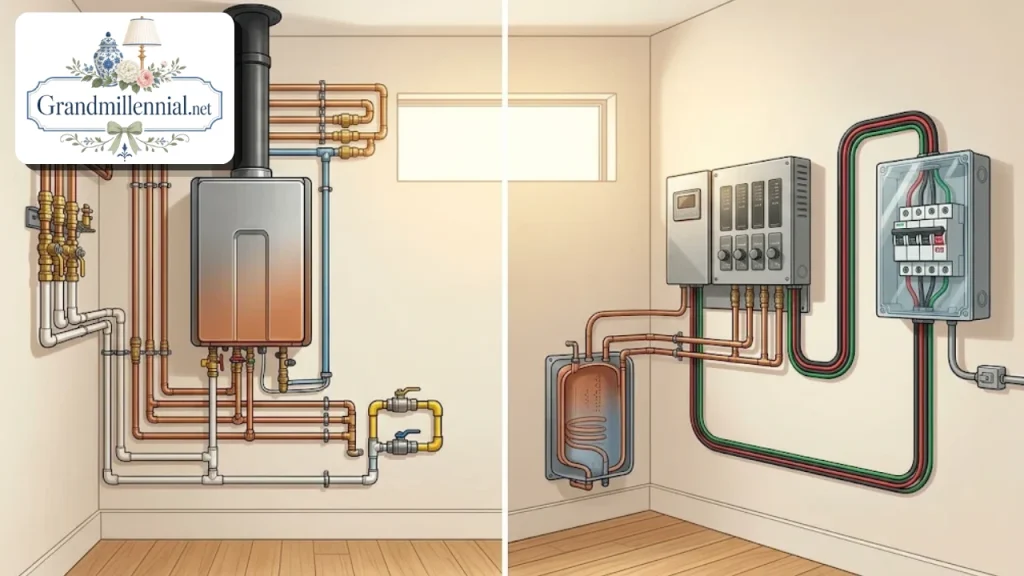
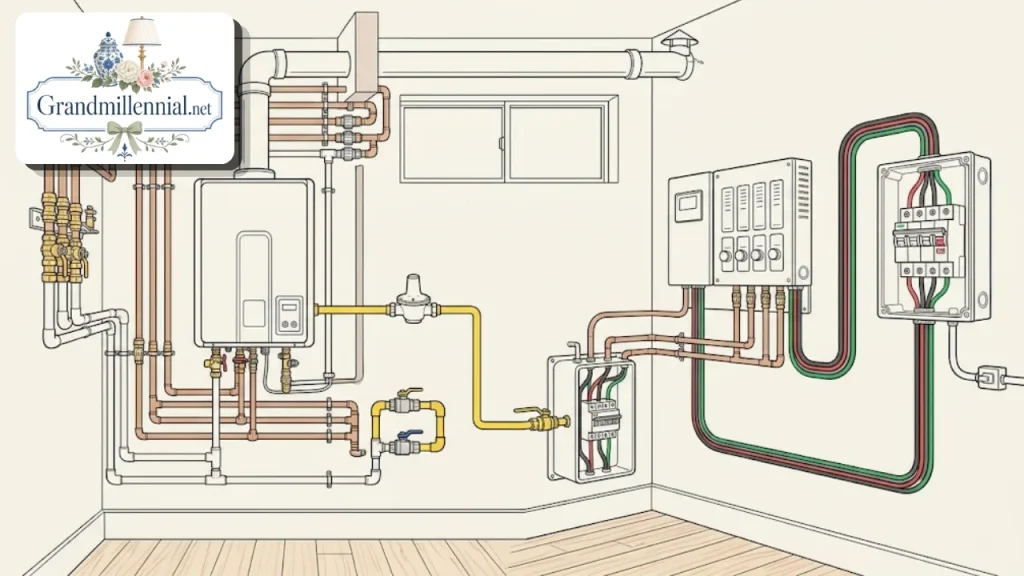
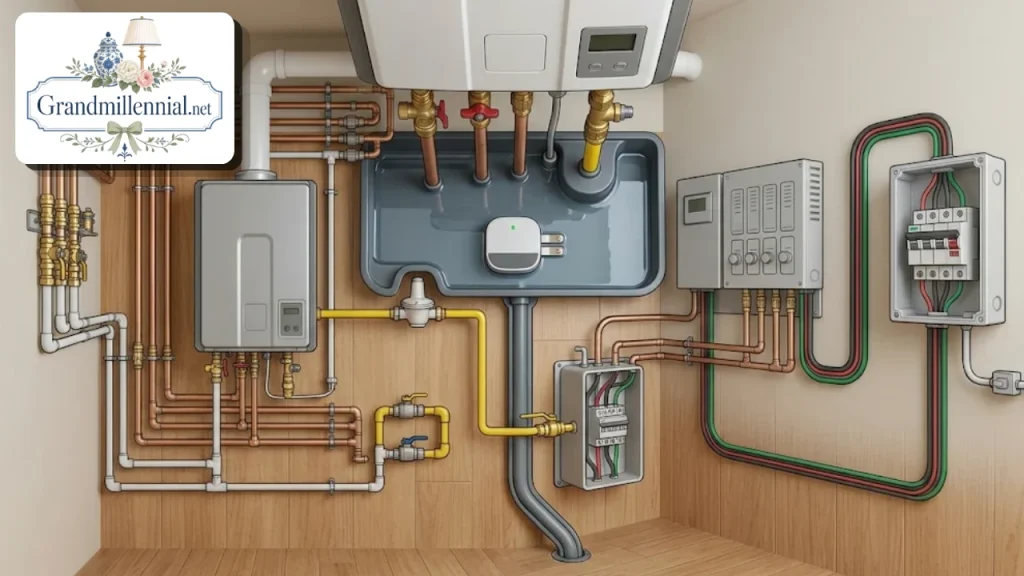
Space and plumbing change as well. A wall-mounted unit frees floor space, but it needs a wall that can take it and a spot where venting can exit. Isolation valves and a drain path are part of a proper setup.
ConsumerAffairs prices a moderate retrofit at 3,900 to 6,000 dollars and a full conversion at 6,000 to 10,500. It says such projects can include relocating the heater or installing new gas lines.
Plan for a day of work. Both This Old House and ConsumerAffairs describe a four- to eight-hour job.
Condensing or non-condensing
Condensing gas units extract more heat from exhaust, and they cost more.
A 2023 manufacturer filing with the Department of Energy listed average retail prices of 1,056 dollars for non-condensing gas tankless units and 1,509 for condensing ones. That is a gap of about 450 dollars.
That filing is from Rinnai, a manufacturer with a stake in the outcome, and I saw it only as a search excerpt. Use the numbers as a rough guide.
The same filing lists efficiency of 0.81 for non-condensing models and 0.91 to 0.93 for condensing ones. Condensing models also need a condensate drain, which ConsumerAffairs prices at 200 to 500 dollars with a neutralizer.
The filing also argues against a federal proposal that would favor condensing units. I did not confirm where that rule stands now. Ask your installer which models they can supply and what vent each one needs.
ConsumerAffairs prices a high-efficiency gas upgrade at 4,500 to 8,500 dollars all in. That is a ceiling to keep in mind, not a typical result.
Running costs and payback
The cost of a tankless water heater with installation is only the first half of the bill. Running cost is the second.
This Old House gives annual operating costs of 440 to 580 dollars for a tank, 300 to 540 for electric tankless, and 192 to 264 for gas tankless. The page does not say how those were calculated.
Here is a rough payback using the midpoints of those ranges. This is my arithmetic, and a midpoint is a crude stand-in for your house.
| Item | Tank | Gas tankless | Electric tankless |
|---|---|---|---|
| Installed cost midpoint | $1,150 | $2,350 | $2,350 |
| Annual running cost midpoint | $510 | $228 | $420 |
| Extra upfront cost | n/a | $1,200 | $1,200 |
| Yearly saving | n/a | $282 | $90 |
| Years to recover | n/a | about 4.3 | about 13.3 |
The tank midpoint uses This Old House’s 800 to 1,500 dollar installed range. The tankless midpoint uses its 1,200 to 3,500 dollar range. The same extra cost applies to both fuels because the page does not split them.
Now the conflict. The Department of Energy says demand water heaters can be 24 to 34 percent more efficient for homes using 41 gallons or less of hot water a day.
For homes using about 86 gallons, it says 8 to 14 percent.
Apply 24 to 34 percent to the 510 dollar tank figure, and the savings are about 122 to 173 dollars a year. That stretches the gas payback to roughly seven to ten years. The DOE publication I used is from 2022.
So the honest answer is a range. A tankless heater can pay for itself in four to ten years on gas, and a decade or more on electric. Heavy hot-water households save less. Longevity can still tip the decision.
Incentives: what ended and what is left
Here is where several cost guides are out of date. This Old House lists a federal tax credit of up to 600 dollars on qualifying gas units. That credit no longer applies to new installs.
ENERGY STAR’s page says the credit covered products purchased and installed between January 1, 2023, and December 31, 2025. Kiplinger reports that the home-improvement credit is repealed for property placed in service after December 31, 2025.
If a unit went in during 2025, you may be able to claim it on that year’s return. I am not a tax professional, so confirm with one. A 2026 install does not qualify.
Smaller incentives remain. Subtract a rebate from the cost of a tankless water heater with installation only once it is approved.
This Old House lists utility rebates of 100 to 300 dollars, brand rebates of 100 to 400, and local incentives of 20 to 1,000. Those are unverified ranges from one page.
ENERGY STAR runs a rebate finder for utility, state, and local programs. Check it before you sign, since program terms differ. Treat any rebate as a bonus, not as part of the budget.
Hard water, upkeep and lifespan
Tankless heaters need maintenance, and hard water raises the stakes. This Old House lists annual descaling for natural gas units at 100 to 500 dollars and annual cleaning at 100 to 200. Those figures overlap, so ask your installer for their price.
Scale builds up inside the heat exchanger. If your water is hard, ask whether a softener or scale filter is wise for your unit.
This Old House shows water softener installation at 500 to 6,000 dollars in a related-cost box on its page.
Lifespan is the other half of the math. The Department of Energy says tankless heaters can last more than 20 years, against 10 to 15 for storage models. That is from a 2022 guide.
An Angi article from 2021 says many tankless units carry a 20-year warranty on the heat exchanger. It also repeats an industry prediction of 25 to 30 years.
Warranty length is not the same as service life, and warranties often depend on proper installation and upkeep.
Read the warranty before buying. Look at what it covers, who may install the unit, and whether it requires annual service.
Getting quotes you can compare
Get two or three written quotes. A Grandmillennial guide on hiring painters offers advice that carries over to any trade: what a good estimate includes. It suggests asking what is missing when one quote comes in far lower than the others.
For a tankless job, the missing piece is often venting, a permit, or the gas line. A low quote that leaves them out is not low.
Ask every contractor to put the same items in writing:
- The exact model and its flow rate
- Venting type and whether the old vent is reused
- Gas line size and any meter work
- Electrical circuit or panel changes
- Permit, inspection, and who pulls them
- Removal of the old heater
- Warranty terms for the unit and the labor
Then compare line by line. Two quotes with the same bottom line can hide different scopes.
Ask what happens if the plumber finds a problem once the old heater is out, such as corroded pipe or a failed shutoff valve. Agree on how extra work gets priced before the job starts.
Be wary of a price given over the phone without seeing the house. Gas line size, vent path,h and panel capacity cannot be judged from a model number.
Protecting the room
A water heater is a leak risk even when it works well. A small leak under or beside the unit can soak flooring or a cabinet before anyone notices.
Another Grandmillennial guide lists leak sensors near heaters, sinks,ks and pipes among the most practical home devices. It tells readers to check alarm volume, battery reporting,ing and how alerts are delivered.
A companion guide describes an automatic shutoff valve that can close when a sensor trips. It also warns that sensors must suit the conditions where they are installed.
Location matters. A guide on second-floor flooring notes that a leak upstairs doesn’t stay upstairs. If the heater sits above living space, a drain pan and a sensor are cheap protection.
Small spaces can use compact units. A guide to container homes lists utilities as a cost layer for a backyard studio or ADU, and a point-of-use unit may suit one.
Electrical work near water must follow local code. Use devices rated for the location, and let a qualified professional handle fixed wiring.
Before you sign
You now have the pieces to judge a quote. Before you sign, run through a short list.
- Does the quote break the total into lines?
- Is the unit sized from your own flow and temperature numbers?
- Has the installer checked the vent and gas line for this exact model?
- Does the price include the permit and removal?
- Have you checked for utility rebates?
- Do you know what the warranty requires?
If the answer to most is yes, the quote is probably sound. A fair cost of a tankless water heater with installation is one you can explain line by line.
Keep the written estimate with your home records. It helps with warranty claims, and it gives the next owner a clear picture of what was installed and why.
FAQs:
How much does a tankless heater cost once it is installed?
Most sources land between about 1,200 and 3,500 dollars. This Old House gives an average of 2,800. Conversions with new venting or panel work can run far higher.
Is gas or electric cheaper to install?
Electric is usually cheaper because it needs no vent or gas line. This Old House shows 650 to 2,500 dollars for electric against 1,650 to 3,500 for natural gas. A panel upgrade can reverse that.
How long does installation take?
Both This Old House and ConsumerAffairs describe four to eight hours. Difficult access, a new vent, or a panel upgrade can add time.
Do I need a permit?
Often yes, but rules vary by jurisdiction. Gas, venting,g and high-voltage wiring are regulated work in many places. Ask your local building department.
Is there still a federal tax credit?
Not for new installs. The credit covered products installed through December 31, 2025. Ask a tax professional about a 2025 install.
How long does a tankless heater last?
The Department of Energy says more than 2years, compared withst 10 to 15 for storage models. Upkeep and water hardness affect the result.
Why does converting from a tank cost more?
Venting and gas supply often change. A tankless unit usually needs different vent material and may need a larger gas line, which adds labor and parts.
Will a tankless heater lower my bills?
Usually, but by how much depends on use. The Department of Energy says 24 to 34 percent for homes using 41 gallons a day or less, and 8 to 14 percent at about 86 gallons.