

You are mowing the lawn, or pulling weeds near the fence, and suddenly a cloud of angry insects pours out of a small hole in the soil. Within seconds, you are running, and someone may be stung more than once.
Most people call that experience a run-in with aggressive bees that live in the ground. The label is understandable, but it hides an important detail.
The insects behind the sting are usually not bees at all, and the real ground-nesting bees are often gentle.
This guide sorts out who is who, explains why the trouble happens when it does, and lays out clear steps for nests, stings,s and prevention. It leans on university extension sources, and it says plainly where those sources disagree.
The short answer: usually not bees at all
When people report stinging “ground bees,” the insect is most often a yellowjacket. The University of Wisconsin insect diagnostic lab puts it directly: these nests are neither the work of hornets nor bees, but rather yellowjackets, which are a type of wasp.
The same source adds that true ground-nesting bees exist, but they tend to be docile, solitary creatures. That one distinction explains most of the confusion online.
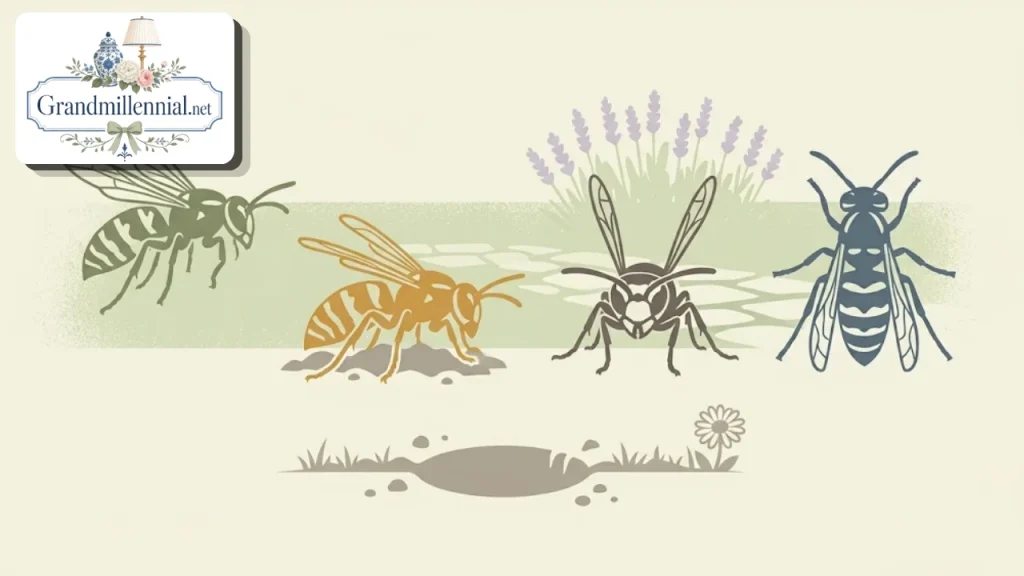
So the phrase aggressive bees that live in the ground covers four different situations. Yellowjacket wasps nest in the soil and defend the colony hard. Mining bees and other solitary bees dig individual burrows and rarely sting.
Bumble bees sometimes take over old rodent holes. And a few look-alikes, such as digger wasps, cause scares without much danger.
Knowing which one you have changes everything you do next. A nest of docile mining bees needs patience. A yellowjacket nest near a play area needs a plan.
Four ground-dwelling insects at a glance
The table below pulls together the main differences reported by university extension sources. Use it as a first filter, then read the sections that follow for detail.
| Insect | Social or solitary | Typical nest sign | Sting behavior | Best first move |
|---|---|---|---|---|
| Yellowjacket (a wasp) | Social colony, one main entrance | Single hole with many workers flying in and out | Workers aggressively defend the colony if disturbed | Keep away, mark the spot, plan carefully |
| Mining bee | Solitary females, each with her own burrow | Many small holes, often with a tiny soil mound | Not aggressive, seldom sting | Watch and wait, they leave in weeks |
| Bumble bee | Social colony, small | Hole in an old rodent burrow or under grass | Will defend the nest if disturbed | Give space, avoid the entrance |
| Other solitary bees (sweat, digger, leafcutter) | Mostly solitary | Scattered small holes in bare or thin turf | Not programmed to sting people | Leave alone or improve turf later |
Sources for the table: Virginia Tech, University of Maryland Extension, NC State Turf Files, and the University of Minnesota Nest Quest program.
Yellowjackets, the real ground aggressors
Yellowjackets are the insects that earn the label aggressive bees that live in the ground in everyday speech. Virginia Tech Extension says workers will aggressively defend themselves and their colony by stinging if disturbed.
Unlike most true bees, they live in a social colony. Many workers share one nest, so a single disturbance can bring many defenders at once. That is why a mowing mishap can turn into several stings in a few seconds.
They often take over an abandoned rodent burrow or similar hollow. An Ask Extension answer notes that ground-nesting yellowjackets often take over a disused rodent burrow, while most native bees dig their own tunnel.
The entrance can be easy to miss. A pest-control company describes nests buried with only a small, hard-to-see hole, usually discovered by accident during mowing or weeding.
That comes from a commercial source, but it matches the extension accounts of disturbance as the usual trigger.
Their numbers also change through the year. Colonies are small in spring and grow all summer, and Virginia Tech notes that in the fall, colonies are at their largest size with many foraging workers.
Workers can fly up to a mile from the colony in search of food.
Mining bees and other solitary ground bees
True ground bees live a very different life. The University of Maryland Extension says mining bees are solitary, and each female usually digs her own burrow to rear her young.
The same page says they are not aggressive and seldom sting. Their flying season lasts only 2 to 4 weeks, so the show is short.
The burrow entrances are small. Maryland describes holes about 1/4 inch across, sometimes ringed by a little mound of soil.
You may see dozens in a small patch of thin grass or bare ground, which can look alarming even though each hole belongs to a separate bee.
Males sometimes hover over one spot for days. They look like they are guarding something, and they can seem pushy.
The University of Florida’s panhandle extension notes that males of some solitary bees, which cannot sting, make aggressive-looking bluffing flights when defending a territory.
NC State describes solitary bees as not “programmed” to sting people, with no mass-attack signal of the kind used by honey bees or yellowjackets. The University of Georgia adds that there are more than 3,500 species of solitary bees in North America.
There is a caveat. Any insect can sting if it is trapped, stepped on or swatted.
A barefoot step into a busy patch can still earn a sting, and NC State says management can be justified where large numbers overlap with children, pets, or people with severe allergies.
Bumble bees nesting underground
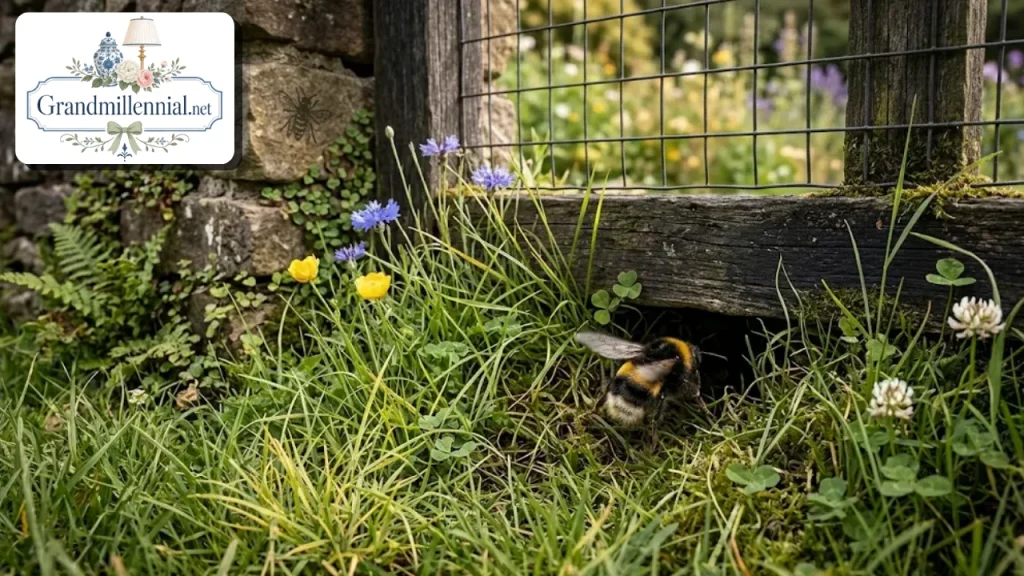
Bumble bees sit in the middle ground. They are social, they do nest below ground, and they can defend a nest. They are also valuable pollinators, so the goal is usually to avoid them rather than remove them.
The University of Minnesota’s Nest Quest program says bumble bees often nest in abandoned rodent dens underground or under tufts of grass. A rodent leaves behind a roomy chamber lined with grass and fur, and the queen moves in.
A bumble bee colony is smaller than a yellowjacket colony, and the bees are fuzzy and round. Still, one pest-control reference warns that they will defend the nest if it is disturbed, so treat a busy bumble bee hole with the same respect you would give any nest.
Because the colony is active for one season, there is rarely a reason to act. Mark the spot, keep children and pets away, and mow around it until the colony winds down in autumn.
How to tell them apart in your yard
When you are sorting out aggressive bees that live in the ground in your own yard, you rarely get a close look, and you should not try to get one.
Use distance and patience. Watch from at least a few steps away on a calm, sunny day when insects are flying.
Count the entrances. A single main hole with a steady stream of workers suggests a yellowjacket or bumble bee colony. Many separate holes, each with one bee going in and out, point to solitary bees.
Look at the body. Mining bees are fuzzy and often dark with reddish hair, according to NC State. Yellowjackets look smoother, with sharply banded yellow and black bodies.
Treat this fuzzy-versus-smooth rule as a rough guide, since you will seldom see the insect up close.
Watch the behavior. Solitary bees wander slowly and do not mob you. Yellowjacket workers fly fast and in a line, and they may rise toward you if you stand near the entrance.
If you are not sure, send a clear photo from a safe distance to your local extension office. They can often help you confirm what you have.
The nest calendar from spring to frost
Knowing the calendar tells you how worried to be. For yellowjackets, a single queen starts a new nest each spring, according to Virginia Tech. Colonies start small and grow through the summer.
Late summer is the danger window. The Wisconsin insect lab reports that nest disturbances peak in August and September, when colonies reach their largest size and populations can grow quickly over just a few weeks.
That can make a nest seem to appear overnight.
Then the cycle ends. Virginia Tech states that yellowjackets completely abandon their nests each fall. A small group of females destined to become next year’s queens survives winter in sheltered spots such as rotting logs.
Solitary ground bees follow a different calendar. NC State says adults become active in mid to late spring, when females dig nesting burrows that generally reach six or more inches deep.
Larvae develop through the year, and the new generation emerges the following spring.
Practically, this means spring holes in the lawn are probably bees that will be gone within weeks. A busy hole in September deserves more caution.
If a nest sits in a rarely visited corner, the Wisconsin lab suggests waiting for several hard frosts to end the colony naturally.
Why they sting
Stinging is a defense tool, not a hobby. A yellowjacket colony holds the queen, the bro,od and food stores, and the workers act to protect it. Their response grows when the nest is bumped, flooded, mowed over,ver or shaken by heavy footsteps.
That explains the usual story of a sudden attack. Most people do not notice the nest until they are on top of it.
Solitary bees have little to defend. Each female guards only her own burrow and her few cells of pollen and eggs, and she is not backed by an army of sisters. NC State notes that solitary bees have no mass-attack signal.
Food and trash can also draw yellowjackets away from the nest. Virginia Tech advises keeping trash lids closed, emptying open containers regularly, and keeping workers away from food sources, which works better than trapping.
Found a nest: leave it, watch it, or act
Before you act on any report of aggressive bees that live in the ground, start by asking where the nest is. A nest at the far end of a large yard that nobody visits is a different problem from a nest beside a back door.
If it is out of the way, leaving it alone is often reasonable. The Wisconsin lab suggests waiting for hard frosts. Mark the area so no one mows or digs there by accident.
If it is in a busy area, you have a choice. For solitary bees, extension sources suggest patience and, where needed, simple habitat changes. For yellowjackets or an active bumble bee colony, think about safety first.
Do not block the hole, pour liquids into it, or dig it out. These actions stir the colony into a defensive response and put you in the line of fire.
The University of Georgia article treats jet-spray aerosols as a last resort for aggressive species such as yellow jackets, and it urges you to identify the insect first. Chemical treatment is generally impractical for solitary bees because each nest cell must be treated separately.
For a yellowjacket nest in a risky spot, the safest route is a licensed pest professional. A trade association page also recommends that homeowners not try nest removal themselves.
This article names no companies, so compare local licensed providers on your own.
If you do plan to deal with it yourself, read the product label fully and follow its protective-gear instructions. Virginia Tech’s guidance for treatment is to mark the nest and return late at night after the workers have returned, but that is an extension summary, not a how-to.
Product labels and local professionals set the real limits.
If you are stung: first aid
Most stings cause pain, redness,s and swelling that fade within a day or two. Move away from the nest first, because more workers may follow. Walk calmly out of the area, then deal with the sting.
If a stinger is in the skin, remove it quickly. A university health page advises scraping it out with a straight, dull edge such as a plastic card, and not squeezing it with tweezers or fingers, which could force more venom in.
Wash the area with soap and water. Cool compresses or ice wrapped in cloth can ease swelling and pain. A major clinic’s guide says not to apply heat.
Over-the-counter options such as antihistamines or pain relievers may help itching and soreness. Follow the label, and ask a pharmacist if you are unsure what is safe for a child or if you take other medicines.
Keep a record if you had many stings. Seek medical help after multiple stings or a sting in someone with a known allergy, as one health source advises.
This is general information, not medical advice. For your own situation, a clinician or poison center can give advice that fits.
Emergency signs that need 911
Severe allergic reactions, called anaphylaxis, can start within minutes. Do not wait to see if symptoms pass.
Call 911 if the person has wheezing or difficulty breathing, or swelling of the face, lips, tongue,ue or mouth. Brown Health lists wheezing and facial or tongue swelling as reasons to call.
Poison control guidance adds that hives or swelling anywhere other than the sting site are a medical emergency. Other warning signs listed by health sources include stomach cramps, vomiting, dizziness, a rapid heartbeat, and faintness.
If the person has a prescribed epinephrine auto-injector, help them use it as directed, then call 911 anyway. Health sources describe epinephrine as a rescue medicine only, and the person still needs emergency care.
Virginia Tech also warns that for allergic people, a single sting may cause a serious, life-threatening reaction. If someone in your household has a known insect allergy, treat any ground nest as a priority and talk to their doctor about a plan.
When to call a professional
Call a licensed professional when the nest is near a door, play area, pool, walkway, or garden path that people use daily. Call when anyone at home has a known sting allergy.
Call if you cannot identify the insect and the nest is in a high-traffic spot. Identification is the most important step, and a trained person can do it safely.
Call if the nest is large, in a wall void or under a structure, or if you have already been stung during an attempt to deal with it. A professional can often handle the nest in a way that avoids more stings.
A professional is usually not needed for a thin patch of mining bees in spring. UMD says control should be avoided if possible, since these are important pollinators, and the activity lasts only 2 to 4 weeks.
Ask any provider what they plan to treat, what they will use, and what they want you to do before and after. Check local licensing rules, because they vary by area.

Prevention that works in a lawn
The best long-term fix for solitary ground bees, and the calmest answer to worries about aggressive bees that live in the ground, is not poison. It is a thicker lawn.
NC State, UG, and Maryland all say dense turf is the best long-term deterrent, because these bees favor bare, sunny, well-drained soil.
Fill in thin patches. Reseed in the right season for your grass, keep the mowing height reasonable and feed the lawn according to local advice.
Where grass will not grow, use a groundcover or a heavy layer of mulch. A low evergreen groundcover such as the one in this creeping phlox guide forms a dense mat that holds surface soil in place and leaves less bare ground for nesting.
Water can help too. Several extension sources say heavy watering with a sprinkler during nest-building can discourage nesting by solitary bees. Do not use water against a yellowjacket nest, because that can trigger a defensive response.
Tilling may partly destroy tunnels, according to NC State and UGA, though they describe the effect as modest. Think about timing so you do not harm bees that are already active.
For yellowjackets, prevention is more about sanitation and early action. Virginia Tech says sanitation works best when started early in summer and continued through mid-autumn.
Seal food waste, cover compost, and clean up fallen fruit. Check the yard in spring for early nests, when they are small and the queen is alone.
Fill unused rodent holes and gaps where you can do it safely, and when no insects are using them. An empty burrow is a ready-made nest site.
Safer mowing and yard habits
Many stings happen at the moment a mower passes over a hidden entrance. A quick walk around the lawn before you mow can save a bad afternoon.
Look for steady insect traffic, new mounds, or small holes in a cluster. Pay attention to edges, tree stumps, stone walls,s and slopes, where hidden nests often start.
Wear closed shoes and long pants when working near brush or tall grass. Avoid loose clothes that can trap insects.
Keep children and pets away from marked nests. Tell everyone in the household where the nest is, and keep a visible marker around it.
If you are mowing and hear a rising buzz, leave the mower and walk away calmly. Do not swat. Return later, after the insects calm down, to retrieve the machine.
For older gardeners or anyone who finds mowing physically hard, this garden design for aging in place guide covers layouts and tools that reduce strain and make lawn care safer.
A seasonal property walk can be part of a larger home checklist. This ranch-style home guide lists crawl spaces and landscaping among the areas to inspect for pests and moisture, and the same habit helps you spot ground nests early.
If you like to relax outdoors in summer, a screened or covered outdoor room can help. This home additions guide mentions insect screening as one way to make an outdoor room more usable.
Conclusion
The phrase aggressive bees that live in the ground points to a real problem and a common mix-up. In most stinging cases, the culprit is a yellowjacket wasp defending a colony, especially in late summer.
True ground-nesting bees are mostly solitary, seldom sting and are active for only a few weeks. They deserve patience, not poison.
Identify first, keep your distance, and plan around the calendar. Get help when a nest is near people, when allergies are involved, or when you are unsure.
Build a thick lawn to keep solitary bees from settling where you do not want them.

FAQs:
Are ground bees aggressive?
Most are not. Extension sources describe solitary ground-nesting bees such as mining bees as seldom stinging. The aggressive insects usually reported are yellowjacket wasps and, in defense of their nests, social bumble bees.
How do I tell a yellowjacket nest from a mining bee patch?
Count the holes. One main entrance with many workers in a steady stream suggests yellowjackets. Many small holes, each with a single bee, point to mining bees. If unsure, keep your distance and ask your extension office.
When are ground-nesting yellowjackets most dangerous?
Late summer. A Wisconsin insect lab says nest disturbances peak in August and September, when colonies are largest. Nests are abandoned in fall.
Should I pour water or chemicals into a ground nest?
No. Water can calm solitary bees during nest-building, but it can provoke a yellowjacket colony. Do not block, flood, or dig out an unidentified nest.
What should I do right after a sting?
Walk away calmly, scrape out any stinger, wash the area, and use a cool compress. Watch for hives, trouble breathing,g or swelling of the face or tongue, and call 911 if they appear.
Will a thicker lawn keep ground bees away?
It often helps. NC State, U,GA and Maryland name dense turf as the best long-term deterrent for solitary ground bees.
Are bumble bees aggressive?
They defend their nest if disturbed, so keep away from the entrance. Otherwise,ise they are valuable pollinators and usually need no action.
When should I hire a professional?
When a yellowjacket nest is near a door, play area, or walkway, when anyone is allergic, or when you cannot identify the insect. Check local licensing before hiring.