

Spotting yellow mold on a wall or in a pot can feel alarming. The color looks strange, the smell may be musty, and the internet is full of scary answers.
The truth is calmer and more useful. Color alone tells you very little, but the moisture behind the growth tells you a lot.
This guide explains what it can be, how to judge the risk, and how to clean small patches safely. It draws on university extension pages, a UK building advice site, and summaries of EPA and CDC guidance.
None of this is medical advice. If you feel unwell, or live with someone who has asthma or a weak immune system, talk to a doctor.
What it is, and what it often isn’t
Mold is a fungus that feeds on organic material when moisture is present. Plenty of species can look yellow, mustard, or yellow-green, so the label describes a color, not one organism.
Homebuilding.co.uk notes that these growths most often belong to the Aspergillus family, which has hundreds of species. The same page says only a few dozen are known to cause disease in people.
Penicillium can also look fuzzy and yellowish. The site adds that color does not reliably identify the type, so testing is needed to be sure.
A page from Inspect and Test makes the same point. Any species named from a photo is a guess without a lab test.
That caution matters, because several other things look alike. Before you treat it, rule those out.
Look-alikes worth checking
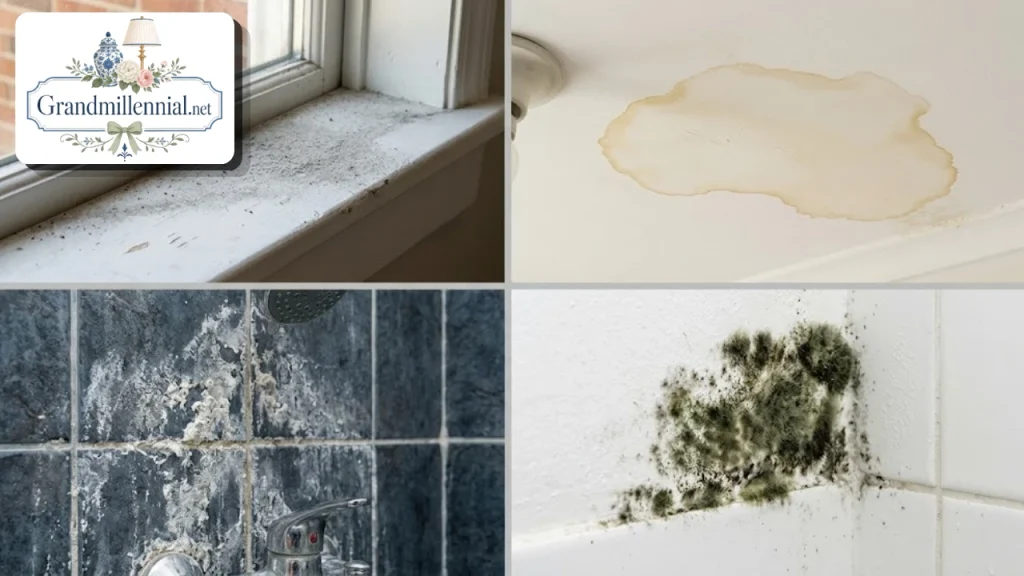
Hunker lists a handful of substances that can pass for yellow growth. These include water damage, pollen, dust, pet urine, mineral deposits,s and sprayed foam insulation.
| Look-alike | Where you might see it | Quick clue |
|---|---|---|
| Water stain | Ceiling or wall below a leak | Flat, with no fuzzy or powdery texture |
| Pollen or dust | Window sills, outdoor furniture | Wipes off dry and leaves no stain |
| Mineral deposits | Around taps, tile, basement walls | Crusty and hard, often white to yellow |
| Pet urine | Baseboards, carpet, corners | Strong smell, near floor level |
| Sprayed foam insulation | Attics, crawl spaces | Dense foam texture, not spotty |
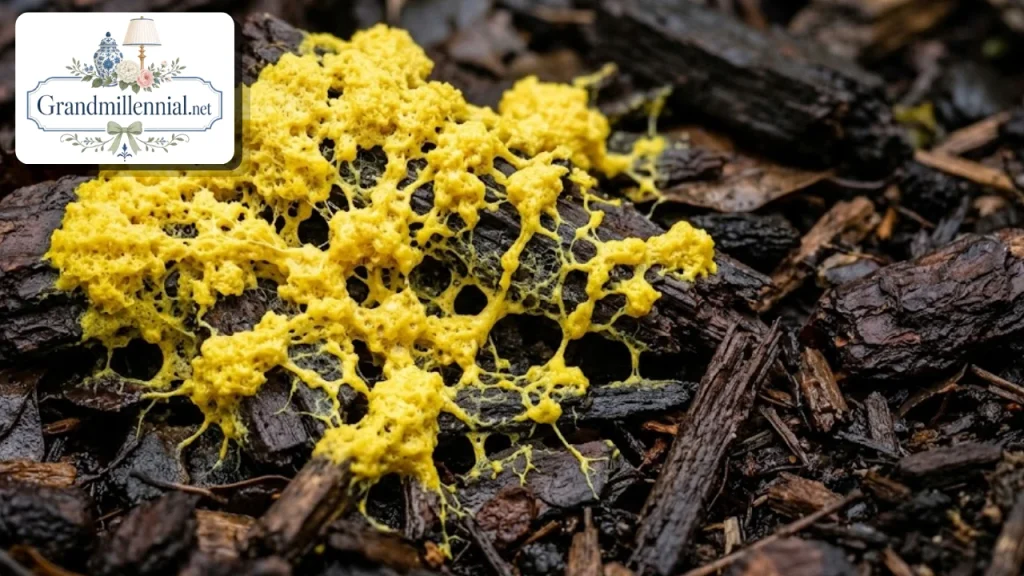
| Slime mold | Mulch, lawns, wet wood outdoors | Foam or blobs, appears outdoors |
Hunker also says only a lab test can confirm mold. If the patch is flat and dry and wipes away clean, mold may not be the answer.
If it is fuzzy, powdery, slimy, or comes with a musty smell, treat it as mold until proven otherwise.
Where it grows indoors
Mold needs moisture and something to eat. That is why it tends to show up in the same few places.
Homebuilding.co.uk names damp wood, wallpaper adhesive, insulation and plant-pot soil. It also lists bathrooms and kitchens, where condensation collects.
Loft spaces and the area under floors count too, because moisture can hide there for months. Rising damp from failed damp-proofing often shows behind furniture, where airflow is poor.
Missouri Extension adds basements, leaky areas, and poorly ventilated attics. Its page also says a musty odor often signals hidden mold, and air fresheners only mask it.
Hunker notes that visible, mushroom-like or thick growth is a sign of a severe infestation, and severe cases can weaken wood.
If you see this on a wooden beam or support, look closely for softness. Damaged wood may need replacing instead of cleaning.
Why it shows up: moisture
Every source agrees on the cause. Persistent dampness is the real problem, and the visible patch is a symptom.
Common triggers include roof or plumbing leaks, condensation on cold surfaces, basement seepage, and humid air that never gets out. Homebuilding.co.uk also lists penetrating damp from cracked render or a faulty roof.
Cleaning without fixing the water source is a short-term win. The growth usually comes back, sometimes in the same spot within weeks.
A cheap hygrometer helps. Missouri Extension says simple models cost less than 10 dollars and measure indoor humidity.
Targets vary slightly between sources. Missouri Extension suggests 30 to 50 percent, and Inspect and Test cites a ceiling of 60 percent with 30 to 50 percent as ideal.
Hunker, an older 2009 piece, says to keep relative humidity below 55 percent. In practice, aim for that 30 to 50 percent band and watch for condensation on windows.
How dangerous is it, really?
Here is the short answer. Color is not a safe or dangerous signal, and the risk depends on how much there is, where it is, and who is exposed.
Inspect and Test says yellow mold can cause the same effects as other molds, such as irritation and allergic reactions in sensitive people. It describes risk as depending on the amount, the location, and the person.
Homebuilding.co.uk is more specific. It says the growth is not toxic in itself, but its spores can worsen respiratory problems.
Hunker cites the CDC for the point that mold can worsen asthma and allergies and cause hay fever-like symptoms. The CDC symptoms listed on the Inspect and Test page include a stuffy nose, a sore throat, coughing or wheezing, burning eyes and skin rash.
Some people notice nothing at all. That is normal, and it should not make you relax about a growing patch.
The same page notes that EPA says even dead mold can still cause allergic reactions. This is why removal beats killing.
Homebuilding.co.uk also advises against touching it with bare hands, especially in a bedroom or living space.
Treat this as a reason to act sensibly, not to panic. A small, surface patch cleaned quickly is rarely an emergency.
Who faces higher risk?
Some people react more strongly. According to the Inspect and Test summary, these groups need extra caution:
- People with asthma or mold allergies
- People with chronic lung disease, such as COPD
- People with weakened immune systems, for example during chemotherapy
- Infants, young children and older adults
For immunocompromised people and those with chronic lung disease, the same page says mold can lead to lung infections in some cases.
If someone in your home fits one of these groups, avoid cleaning large patches yourself. Missouri Extension says people sensitive to mold should not remove more than 10 square feet.
Ask a doctor about symptoms, and think about asking a professional to handle bigger jobs.
Should you test?
Testing sounds sensible, but the agencies are cautious about it. Inspect and Test says the CDC does not recommend routine testing, and EPA says sampling is usually unnecessary when growth is visible.
Hunker agrees on the practical side. For smaller jobs, it says cleaning without testing is enough, and lab testing can be costly.
Testing can help in two cases. One is hidden mold you suspect but cannot see, and the other is confirming a cleanup worked.
The same page warns that do-it-yourself kits cannot say whether a level is safe, because there are no federal mold limits.
If you do test, use a qualified professional and ask what the results will change. Often, the better spend is on finding the water.
A quick way to decide what you have
Use this simple path before you reach for a sponge. It sorts the three common cases in about a minute.
First, look at where it is. Indoors, on a wall, ceiling, wood, or stored item points to yellow mold or one of the look-alikes in the table above. Outdoors in mulch points to slime mold, and in a pot points to a mushroom or slime mold.
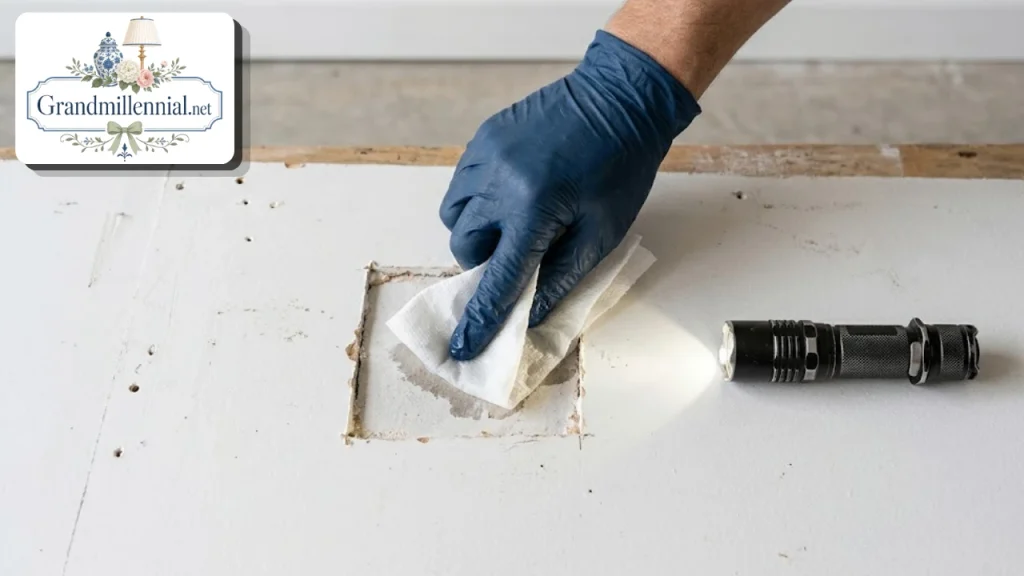
Next, touch the surface with a gloved finger or a damp paper towel. If the color wipes off and leaves a clean surface, it may be dust or pollen.
If the surface feels fuzzy, powdery, or slimy, or the spot returns after a wipe, treat it as mold. Then check for a source of water above, behind, or below it.
Finally, check the size. A small patch fits the cleaning steps below. A large or spreading area, or one near soft wood, belongs with the professional section at the end.
Can you clean it yourself? The size rules
Size is the key decision point. The sources use two different numbers, and they answer different questions.
Inspect and Test reports EPA’s suggestion that homeowners can usually handle patches under about 10 square feet. That is roughly a 3-foot by 3-foot area.
Larger areas, water damage, HVAC involvement, or health concerns point toward a professional.
Missouri Extension cites EPA for a higher line. It says to hire a professional when mold covers more than 100 square feet.
Read the two together. Under 10 square feet is the common DIY zone, and over 100 square feet clearly belongs to a pro. Between them, use judgment.
In that middle zone, consider who lives in the home, what the surface is, and whether you found the leak. When in doubt, choose the cautious option.
Step-by-step cleaning for small areas
This method fits hard, non-porous surfaces such as tile, glazed surfaces, and sealed wood. It follows the steps in Hunker, Homebuilding.co.uk and Inspect and Test.
Fix the water source first. Stop the leak or condensation, or the growth will return.
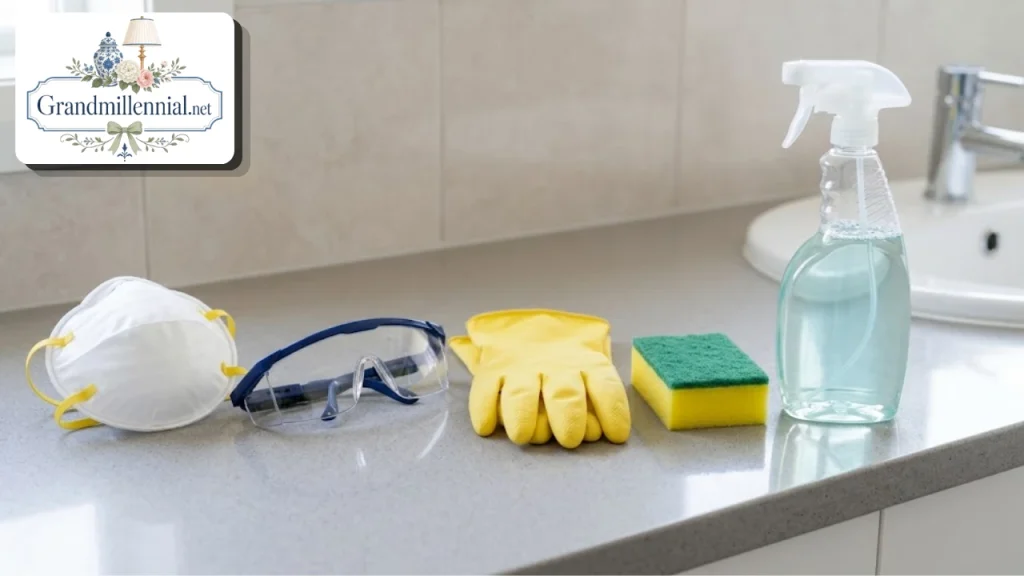
Suit up. Wear gloves, goggles, and an N-95 respirator. Missouri Extension says other masks may not filter mold particles well.
Ventilate. Open a window and run a fan that blows outward.
Avoid dry brushing. Inspect and Test advises against it because it can stir up spores.
Scrub with detergent and water. Use a mild dish detergent in warm water on a sponge or brush.
Let it work. Hunker suggests letting a cleaning solution stand 10 to 15 minutes before scrubbing.
Wipe and rinse. Use a clean, damp cloth, then wipe the area dry.
Dry thoroughly. Inspect and Test says to dry water-damaged areas within 24 to 48 hours.
Discard the rags. Bag cloths and sponges, and wash your hands.
Keep a dehumidifier running in the room until things feel dry. Hunker lists it as an optional help.
Paint only after the surface is clean and fully dry. Covering a damp wall just hides the issue.
The bleach debate
Sources disagree on bleach, and it helps to see exactly how. Hunker suggests a mix of 3 parts water to 1 part bleach.
Inspect and Test mentions that the CDC cites a bleach solution of no more than 1 cup per gallon. It also says never to mix bleach with ammonia.
Missouri Extension takes the opposite view. It cites EPA guidance to use mild detergent instead, and warns that bleach can itself harm the lungs.
Homebuilding.co.uk adds a practical point. It says to avoid bleach on porous surfaces, because it can push moisture deeper and encourage regrowth.
Taken together, detergent and water are the safest starting point. If you choose bleach, use it only on hard surfaces, follow the label, and keep the room well ventilated.
Never combine bleach with ammonia or other cleaners. Mixing chemicals can create dangerous fumes.
Drywall, wood, and carpet
The surface decides your options. Hard, sealed surfaces can be scrubbed, while porous ones are tricky.
Missouri Extension says to discard moldy porous materials such as ceiling tiles and carpet, because mold is almost impossible to remove from them. It also warns against steam-cleaning carpet and upholstery, which adds moisture.
Homebuilding.co.uk agrees on carpet. It also suggests replacing affected skirting boards and door frames, since wood is hard to treat once the growth soaks in.
For drywall, a small surface patch on painted board may clean up. If the board is soft, stained through,h or crumbling, cutting it out is usually the better route.
Wood is the middle case. Sealed wood often cleans well, while soft or rotted wood needs a pro.
Inspect and Test lists dry rot, Serpula lacrymans, as a possible cause of yellowish tints on wet wood. The main worry there is structural damage, not just spores.
If wood feels spongy or breaks apart, stop cleaning and call a qualified contractor.
Yellow slime mold in the garden
Not every yellow patch is a problem. If you see bright yellow foam or a blob in mulch, it may be a slime mold.
Iowa State Extension says the example pictured is Fuligo septica, nicknamed the dog vomit slime mold. The page says it does not harm plants and feeds on bacteria and other organisms in the mulch.
It is usually a temporary nuisance. Within a few days,ys it dries into white, powdery masses that most people let fade.
If it bothers you, scoop it up and throw it away. That is the whole fix.
Wild Yards says the spores may irritate skin and sinuses, so gloves and a mask are sensible when you clear it. Raking mulch away from shady beds helps it dry faster.
Keep children and pets from handling it, and do not eat it. One source calls it edible, but that is not a reason to try.
Yellow growth in plant pots
Yellow growth in houseplant soil is often a mushroom. Wild Yards identifies one common type as Leucocoprinus birnbaumii, a bright yellow mushroom that is 1 to 3 inches tall.
It thrives in warm, humid, shady conditions and overwatered soil with poor drainage. The page says it does not harm plats, because it feeds on decaying matter in the soil.
It is moderately toxic if eaten, according to the same page, and can cause nausea, vomiting,ng and diarrhea. If children or pets are around, remove it promptly.
To remove it, cover the mushroom with a plastic bag and pull it up, ideally before it releases spores. Then repot in fresh soil if it keeps coming back.
Prevention is about water. Improve drainage, and water only when the top inch of soil is dry.
Wear gloves and wash your hands afterward. If you are unsure what it is, a local extension office can help with identification.
What to expect after cleanup
A good cleanup leaves the surface clean, dr,y and free of any musty smell. That is the target, and it should hold for weeks, not days.
Check the spot again after a few days, then weekly for a month. Use a flashlight and look from an angle, because faint regrowth shows up better in side light.
If the patch comes back, the surface is still damp or the cause is still active. Do not simply scrub again. Look for a slow leak, a cold wall that collects condensation, or a blocked vent.
Stains may remain on porous surfaces even after the growth is gone. A stain is not proof that the mold is alive, but you can seal and repaint once everything is fully dry.
If you notice new symptoms during or after cleaning, stop, leave the room, and get fresh air. Persistent symptoms deserve a call to your doctor.
What it costs to deal with
The sources give few price tags, so be wary of any article that quotes exact cleanup totals. Costs depend on the surface, the s,ize and the cause of the damp.
What the sources do mention is small. A basic hygrometer costs less than 10 dollars, according to Missouri Extension, and inexpensive N-95 masks are sold at hardware stores. The same page puts a bathroom fan at about 50 dollars plus about 100 dollars in labor.
Everything beyond that depends on what is behind the wall. Fixing a plumbing leak, a roof de,fect or a drainage problem often costs far more than the cleaning itself, which is why quotes vary so much.
When you compare bids for a larger yellow mold problem, ask each company how they will find and fix the moisture source. A quote that only covers cleaning and painting may leave the real cause untouched.
Preventing it from coming back
Prevention is mostly about moisture control. The same short list appears across the sources.
Use exhaust fans in kitchens and bathrooms. Missouri Extension puts a bath fan at about 50 dollars plus about 100 dollars in labor.
Keep humidity in range. Aim for 30 to 50 percent, and use a dehumidifier where needed.
Fix leaks fast. Dry anything wet within 24 to 48 hours, according to Inspect and Test.
Clear gutters and downspouts, and slope the ground away from the foundation.
Keep water out of basements and crawl spaces.
Use mold-resistant paint after the area is clean and dry, as Homebuilding.co.uk suggests.
Improve airflow behind furniture on cold exterior walls.
Good airflow helps decor too. If you are refreshing rooms after a cleanup, our home decor ideas and renovation tips can guide the next step.
Common mistakes to avoid
A few habits make things worse. Watch for these.
- Painting over damp or moldy surfaces.
- Dry brushing or sweeping, which can stir up spores.
- Mixing bleach with ammonia or other cleaners.
- Steam-cleaning carpet or upholstery.
- Using air fresheners to cover a musty smell.
- Ignoring the leak and only cleaning the patch.
When to call a professional
Some jobs are better left to experts. Call one if any of these apply:
The area is larger than about 10 square feet, and certainly if it exceeds 100 square feet.
The cause is unclear, or the growth keeps returning.
It involves your HVAC system or follows major water damage.
Wood is soft, rotted, or structurally affected.
Someone in the home has asthma, a lung condition, or a weak immune system.
Homebuilding.co.uk recommends remediation that also tackles the moisture source. That second part is what separates a lasting fix from a repeat visit.
Ask for a written scope, and check licenses and insurance where your area requires them.
A note on the sources behind this guide
This article leans on university extension pages and plain-language summaries of EPA and CDC guidance. It does not rely on forum posts or on photo-based diagnosis.
Some of the pages are commercial, and one is a UK building site, so figures and product names may not fit every home. Where sources disagreed, such as on bleach and humidity targets, this guide shows both sides.
The Hunker cleaning piece is a 2009 legacy article, so treat its details with extra care. Always check the label on any cleaner, and follow local rules for your region.
For anyone building a long-term plan around yellow mold or any other indoor growth, your local health department or extension office is the best next stop.
Final thoughts
The color is the least useful clue. What matters is the moisture, the size of the patch, and who lives in the home.
Clean small, hard-surface patches carefully with detergent and water. Throw out soft, porous materials, and call a professional for big or recurring problems.
Most of all, fix the source of the water. If you do that, yellow mold has very little reason to return.
FAQs:
Is it dangerous to have in my home?
It can be, as with any mold, because it can irritate or trigger allergies in sensitive people. Color does not show the risk. Size, location,n and who is exposed matter more.
What causes it to grow?
Moisture plus something to feed on, such as drywall paper, wood, or adhesive. Leaks, condensation, and poor ventilation are the usual causes.
Can I clean it with bleach?
Sources disagree. Detergent and wateare thehe safest start, and bleach should stay off porous surfaces. Never mix bleach with ammonia.
How big a patch can I clean myself?
EPA guidance, as summarized by Inspect and Test, points to patches under about 10 square feet. Over 100 square feet should go to a professional.
Do I need a mold test?
Usually no. The CDC does not recommend routine testing, and EPA says sampling is usually unnecessary when growth is visible.
Is the yellow foam in my mulch harmful?
Iowa State Extension says it is a slime mold that does not harm plants. It usually dries into white powder within days, and you can scoop it up.
Is the yellow mushroom in my plant pot poisonous?
Wild Yards says Leucocoprinus birnbaumii is moderately toxic if eaten. Remove it if children or pets are around.
How do I stop it from coming back?
Fix the water source, keep humidity near 30 to 50 percent, use exhaust fans, and dry spills within 24 to 48 hours.