

The first time most people buy one, they nearly throw it away. The skin is wrinkled and leathery, a little dented, and looks well past its best. Then you cut it open, and the kitchen fills with the scent of the tropics.
That wrinkly shell is the first lesson passion fruit teaches: looks can deceive. Inside is a golden, jelly-like pulp studded with crunchy seeds, with a flavour that’s sweet, sharp and intensely aromatic all at once.
This guide covers everything from the shop to the garden: the main types, how to tell when one is ripe, how to eat and store it, what it offers nutritionally, how to use it in the kitchen, and how to grow your own vine, including why some vines flower beautifully but never fruit.
Quick answer: Passion fruit is the fruit of the Passiflora edulis vine. Choose fruit that feels heavy and has slightly wrinkled skin, cut it in half, and scoop out the pulp and seeds, both of which are edible. Don’t eat the rind. Vines need warmth, a sturdy trellis, and good pollination to fruit well.
What passion fruit is
Passion fruit grows on a vigorous climbing vine in the genus Passiflora, a large group of around 530 species, according to UF/IFAS Extension. Many are grown for their elaborate flowers; a smaller number produce good edible fruit.
The fruit itself is round or oval, roughly the size of an egg to a small orange, with a firm rind. Inside, each black seed is wrapped in a juicy, translucent sac of pulp. The flowers are just as memorable: intricate, often purple and white, with a fringed corona that gave the plant its name, linked by early European missionaries to symbols of the Passion.
UF/IFAS Extension in Marion County describes the vine as a short-lived evergreen perennial. It grows quickly and fruits within a year or two in good conditions, but most vines are productive for a limited number of years before needing replacement.
Where it comes from
Passiflora edulis is native to South America, generally associated with southern Brazil, Paraguay and northern Argentina. Over the centuries,s it spread across the tropics and subtropics, and today it’s grown commercially in places such as Brazil, Colombia, Ecuador, Kenya, India, Vietnam, Australia and Hawaii.
It goes by many local names. In Hawaii it’s often called lilikoi; in parts of Latin America, maracuyá or granadilla; in Brazil, maracujá. Whatever the name, the wrinkled purple fruit and its fragrant pulp are recognised around the world, especially in juices, desserts and cocktails.
Types of passion fruit
Two forms of Passiflora edulis dominate shops and gardens, but they’re not the only edible passion fruit varieties.
| Type | Appearance | Flavour | Growing notes |
|---|---|---|---|
| Purple passion fruit (P. edulis) | Small, dark purple, wrinkles when ripe | Sweet, aromatic | The more common type; self-fertile; tolerates light frost better |
| Yellow passion fruit (P. edulis f. flavicarpa) | Larger, glossy yellow | Tarter, often used for juice | More tropical; largely self-incompatible, needs cross-pollination |
| ‘Possum Purple’ and other hybrids | Purple, larger fruit | Sweet | Hybrids between purple and yellow; popular in home gardens |
| Sweet granadilla (P. ligularis) | Orange-yellow, hard shell | Very sweet, mild | Prefers cooler, high-altitude climates |
| Maypop (P. incarnata) | Green to yellow, egg-shaped | Mild, sweet-tart | Native passion flower of the southeastern US; much hardier |
UF/IFAS notes that purple passion fruit varieties and their hybrids are self-compatible, while yellow passion fruit is largely self-incompatible and needs cross-pollination to set fruit. It also describes ‘Possum Purple’ as a cross between purple and yellow types.
If you’re buying a plant labelled simply “passion flower,” check the botanical name. Many ornamental passion flowers produce small, poor-tasting fruit or none at all.
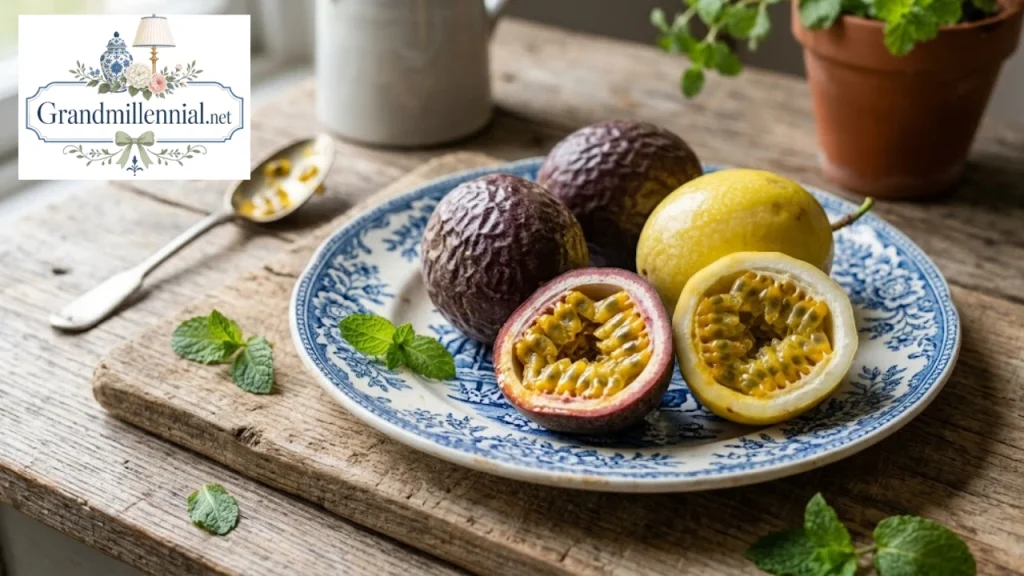
What does passion fruit taste like?
The flavour is hard to compare with anything else. Purple fruit is typically sweet and perfumed, with a pleasant sharpness. Yellow fruit is often tangier and more acidic, which is why it’s widely used for juice.
The texture is half the experience: slippery, juicy pulp around small, crunchy black seeds. Some people love the crunch; others prefer to strain the seeds out and use the juice.
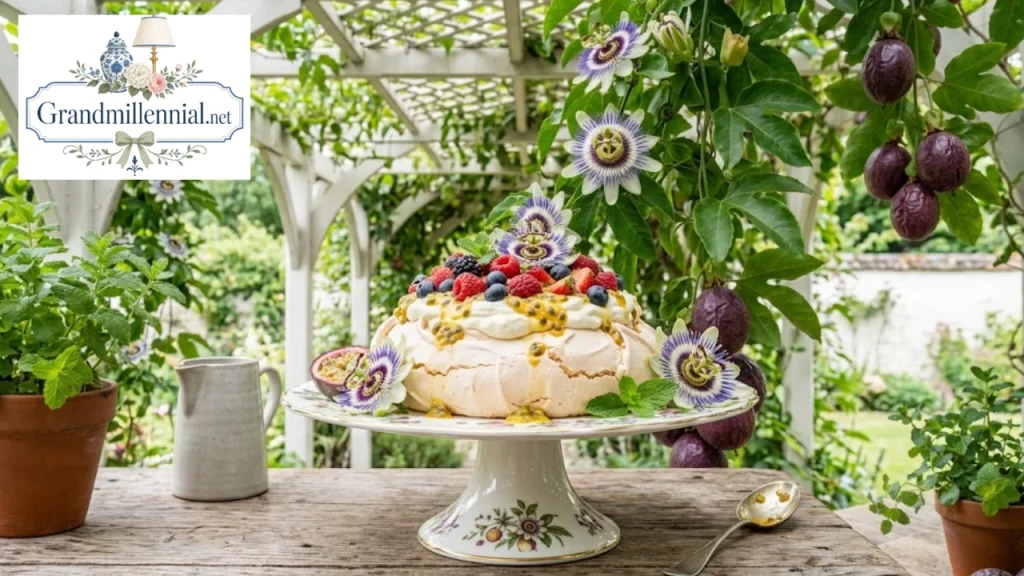
Because the aroma is so strong, a little goes a long way. A single fruit can lift a bowl of yogurt, a jug of lemonade or a whole pavlova.
How to tell if passion fruit is ripe
This is where many people go wrong. With purple passion fruit, wrinkles are a good sign.
- Wrinkled skin: slightly wrinkled or dimpled skin usually means the pulp inside is fully developed and sweet. Smooth, taut fruit is often still sharp.
- Heavy for its size: a heavier fruit holds more juicy pulp.
- Deep colour: purple fruit should be deep purple; yellow fruit should be fully golden, without green patches.
- Fragrance: ripe fruit smells sweet and tropical, even through the skin.
Avoid fruit that is mouldy, cracked open, leaking, or very light and hollow-feeling. If your fruit is smooth when you buy it, leave it at room temperature for a few days until it begins to wrinkle.
How to eat passion fruit
Eating one takes less than a minute.
Wash the fruit to remove dirt from the rind before cutting.
Cut it in half with a sharp knife on a board. A serrated knife works well on firm shells.
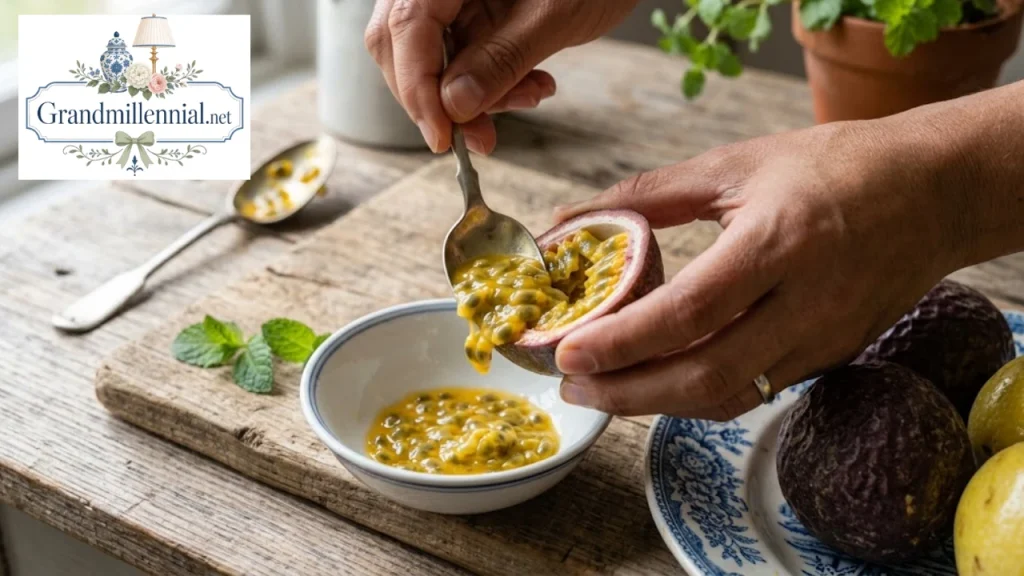
Scoop out the pulp with a teaspoon, seeds and all.
Eat it straight, or spoon it over something else.
The pulp and seeds are both edible. The rind is not eaten; discard it or compost it. If you’d rather avoid the seeds, press the pulp through a sieve to collect the juice, as Healthline suggests.
Storing and freezing
Passion fruit keeps well with a little care.
| Situation | How to store | How long (approx.) |
|---|---|---|
| Not yet ripe (smooth skin) | Room temperature, in a bowl with airflow | 1–2 weeks to ripen |
| Ripe | Refrigerator | About 1 more week |
| Pulp for later use | Freeze in ice-cube trays or small containers | Up to about 12 months |
These timings follow guidance from Listonic’s nutrition guide. Freezing pulp in ice-cube trays is especially handy: drop a cube into a drink, a smoothie or a sauce whenever you need a burst of flavour.
Nutrition and benefits
For such a small fruit, passion fruit is surprisingly nourishing, mainly because you eat the seeds along with the pulp.
| Nutrient (approx.) | Per fruit (about 18 g edible) | Per 100 g pulp and seeds |
|---|---|---|
| Calories | About 17 | About 97 |
| Dietary fibre | About 1.9 g | About 10 g |
| Vitamin C | About 5 mg | About 30 mg |
| Potassium | About 63 mg | About 350 mg |
| Carbohydrate | About 4 g | About 23 g |
Figures are approximate values for raw purple passion fruit, based on USDA FoodData Central.
The standout is fibre. Because the seeds are eaten, passion fruit provides more fibre per serving than many fruits, which supports digestion and helps you feel full. It also contributes vitamin C, vitamin A, and plant compounds such as polyphenols.
UF/IFAS has published on the fruit’s health-related compounds, but as with any single food, the benefits come from including it in a varied, balanced diet rather than from eating large amounts.
Who should be careful
For most people, ripe passion fruit is a safe and healthy treat. A few cautions are worth knowing.
Latex allergy: some people with latex allergy also react to certain fruits, including passion fruit (“latex-fruit syndrome”). If you have a latex allergy, introduce it carefully or talk to your doctor.
Eat ripe fruit only: stick to ripe pulp and seeds, and don’t eat the leaves, stems, or rind.
Digestive comfort: the high fibre content can cause bloating if you eat a lot at once and aren’t used to it.
Medicines and supplements: concentrated passion flower supplements are different from the fruit; ask a pharmacist if you take regular medication and use herbal products.
Ways to use passion fruit
Once you have a few fruits, the possibilities are almost endless.
Breakfast: spoon over yogurt, porridge or chia pudding.
Fruit salads: pair with mango, pineapple, banana or berries.
Desserts: pavlova, cheesecake, panna cotta, sorbet and passion fruit curd.
Drinks: stir into lemonade, iced tea, smoothies or sparkling water.
Dressings and sauces: whisk the pulp with olive oil, a little honey and salt for a bright salad dressing, or reduce it with sugar for a dessert sauce.
Baking: fold strained juice into icing or a simple sponge for a tropical twist.
A bowl of fruit on the table is also lovely to look at. Purple passion fruit alongside lemons and figs on a vintage platter makes an easy, colourful centrepiece; these home decor ideas that actually work include more ways to style everyday kitchens and tables.
Three simple ideas to start with
Passion fruit yogurt parfait. Layer thick Greek yogurt with granola and sliced banana, then spoon the pulp of one or two fruits over the top. The sharp pulp cuts through the creamy yogurt beautifully, and it’s ready in two minutes.
Passion fruit lemonade. Strain the pulp of four fruits to collect the juice. Stir it into a jug with the juice of two lemons, a few spoonfuls of simple syrup to taste, and cold still or sparkling water. Add ice, mint and a few seeds back in for colour.
Quick passion fruit curd. Gently heat strained juice from about six fruits with sugar, butter and beaten eggs in a heatproof bowl over simmering water, stirring constantly until it thickens enough to coat a spoon. Cool, then spread on scones, fill tarts or swirl into whipped cream. Stored in a clean jar in the fridge, it keeps for a week or so.
These are forgiving recipes, so adjust sweetness to your fruit. Purple passion fruit is usually sweet enough for desserts; yellow fruit may need a little more sugar.
How to grow passion fruit at home
Growing your own passion fruit is rewarding, and the vines are beautiful even before they fruit. Climate is the main limiting factor.
Climate
Passion fruit vines like warmth. UF/IFAS Marion County stresses that frost protection is essential, and recommends planting when frost is no longer a concern. Purple types tolerate some light frost better than yellow types, according to UF/IFAS Charlotte County, but hard freezes can kill vines.
In cool climates, grow passion fruit in a large container that can move into a conservatory, greenhouse, or sunny porch for winter. Hardy maypop (P. incarnata) is an option for colder gardens, though its fruit is smaller.
Site and soil
Choose a spot with full sun and shelter from strong winds. Passion fruit prefers well-drained, fertile soil; it dislikes waterlogged roots. Work in compost before planting, and avoid low spots where water pools.
Trellis
The vines climb by tendrils and grow vigorously, so give them a sturdy support from the start: a strong fence, pergola, arbour or wire trellis. A horizontal top wire lets the fruiting stems hang down, which makes harvesting easier.
Planting
Plant nursery vines at the same depth they grew in the pot, water them in well, and mulch around the base without touching the stem. Grafted plants are sometimes sold; UF/IFAS notes that purple passion fruit is sometimes grafted onto yellow rootstock to reduce nematode problems.
Watering and feeding
Water regularly, especially during flowering and fruit development. UF/IFAS lists high water demand while fruit is developing as a reason fruit can drop prematurely. Feed lightly with a balanced fertiliser during the growing season; too much nitrogen encourages leaves at the expense of flowers.
Pruning
UF/IFAS recommends pruning at the end of winter, when the vine isn’t actively growing. Thin out tangled, weak, or dead growth to let light and air in, and encourage new fruiting shoots.
Harvesting
Purple fruit typically changes colour and often drops to the ground when ripe. Collect fallen fruit daily, then let it wrinkle a little at room temperature for the best flavour.
Growing passion fruit in containers
If you live somewhere with cold winters, a container lets you enjoy passion fruit without risking the vine outdoors in frost. Choose a large pot (at least 15 to 20 gallons, or about 60 to 75 litres) with drainage holes, filled with a free-draining potting mix enriched with compost.
Add a sturdy obelisk or trellis to the pot itself, or set the container against a wall-mounted trellis. Water more often than you would for a vine in the ground, as pots dry quickly in summer, and feed lightly every few weeks during the growing season.
Before the first frost, move the pot to a bright, frost-free spot such as a conservatory, greenhouse,e or sunny enclosed porch. Container vines may fruit less heavily than those in the ground, but they’re a lovely way to grow the plant in cooler regions, and the flowers alone are worth it.
Propagating new vines
Because vines are relatively short-lived, many gardeners grow replacements every few years. Seeds from ripe fruit can be cleaned, dried,ed and sown in warm conditions, though seedlings may not be identical to the parent, especially from hybrids. Cuttings taken from healthy, non-flowering stems in warm weather root fairly readily and produce plants true to the parent. If disease is a concern in your area, buying grafted, healthy nursery plants is often the safest option.
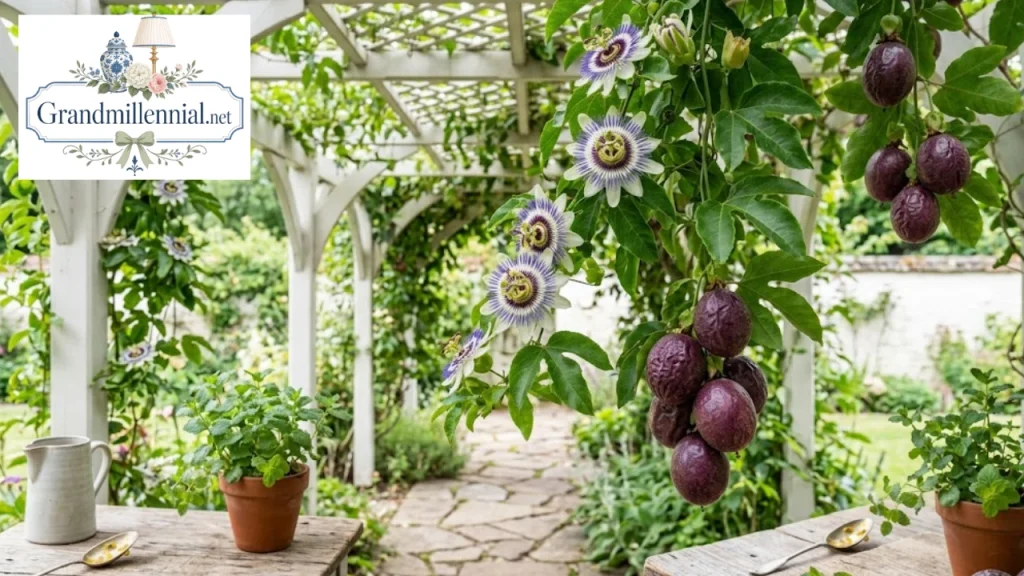
Pollination: the secret to more fruit
Passion fruit flowers are spectacular, but they need help to become fruit.
UF/IFAS identifies honey bees and carpenter bees (Xylocopa species) as the primary pollinators, and notes that wind pollination is ineffective. The Charlotte County Extension describes large, shiny black carpenter bees as especially good pollinators.
Remember the difference between types: purple varieties and their hybrids are self-compatible, while yellow passion fruit generally needs pollen from another compatible vine.
If you don’t see bees working the flowers, try hand pollination:
Choose a freshly opened flower, usually in the morning or midday when pollen is ready.
Use a small, soft paintbrush or cotton bud to collect yellow pollen from the anthers.
Brush the pollen onto the stigmas, the three upright structures at the centre.
Watch for the base of the flower (the ovary) to swell over the following days, a sign of success.
Planting nectar-rich flowers nearby can help attract more pollinators to your garden.
Troubleshooting the vine
Even healthy vines can disappoint. These are the problems UF/IFAS addresses most often.
| Problem | Likely causes | What to try |
|---|---|---|
| Flowers but no fruit | Poor pollination, cold or wet weather, a yellow type without a pollination partner | Encourage bees, hand pollinate, plant a compatible second vine |
| Fruit drops while green | Water stress during fruit development, heat, poor pollination | Water consistently; mulch the root zone |
| Fruit with soft, empty seeds or little pulp | Poor pollination or boron deficiency | Improve pollination; test soil before adding boron |
| Brown spots on leaves and fruit | Fungal brown spot (Alternaria) | Improve airflow, remove infected material, ask local extension about treatment |
| Distorted, mottled leaves | Viral diseases such as passion fruit woodiness | Remove badly affected vines; start with healthy plants |
| Vine dies back after frost | Cold damage | Protect with frost cloth; grow in a container in colder areas |
When problems persist, your local extension service can help diagnose diseases and soil issues in your region.
Passion fruit in the home and garden
A passion fruit vine is as decorative as it is productive. Trained over a pergola or arbour, it creates dappled summer shade, and its flowers become an instant talking point.
In a cottage or grandmillennial garden, pair it with a painted trellis, terracotta pots and herbs such as mint and lemon verbena, both of which taste wonderful with the fruit.
Indoors, the fruit brings colour to the kitchen. A coastal-inspired kitchen with blue and white ceramics, like those in these coastal kitchen ideas, makes a beautiful backdrop for a bowl of tropical fruit. And a fresh-looking splashback, such as one of these modern kitchen backsplash ideas, keeps juice splashes easy to wipe away.
FAQs:
Can you eat passion fruit seeds?
Yes. The seeds are edible and add crunch and fibre. If you prefer, strain them out and use just the juice.
How do you know when passion fruit is ripe?
Look for slightly wrinkled skin, deep colour, a sweet scent, and fruit that feels heavy for its size.
Is passion fruit good for you?
Yes, in a balanced diet. It’s especially rich in fibre and provides vitamin C and other nutrients.
Can you eat the skin of passion fruit?
No. Eat the pulp and seeds and discard or compost the rind.
How long does passion fruit last?
Unripe fruit can ripen at room temperature over 1–2 weeks; ripe fruit keeps about a week longer in the fridge. Frozen pulp lasts up to about a year.
Why is my passion fruit vine not producing fruit?
Usually poor pollination, cold weather, or a yellow variety without a compatible partner. Encourage bees or hand-pollinate.
Can I grow passion fruit in a pot?
Yes. Use a large container with a trellis, and move it somewhere frost-free in winter if you live in a cool climate.
What’s the difference between purple and yellow passion fruit?
Purple is smaller, sweeter, and self-fertile; yellow is larger tangiere,r and usually needs cross-pollination.