

You crack the left board in three guesses and feel brilliant. Then you look right, see a row of grey tiles, and realise you have four guesses left for a word you know almost nothing about.
That’s the moment that makes Dordle so compelling and so easy to lose. This guide covers the rules, then the part most guides skip: how to manage two boards at once without burning your guesses.
What Dordle is (and who made it)
Dordle is a Wordle spin-off created by indie developer Guilherme S. Töws, who publishes games as Zaratustra. He describes it, fittingly, as “Wordle plus Wordle.”
The original version lives on itch.io under the creator’s Zaratustra page, where it’s free and plays in any browser. Many other sites host copies; to find the creator’s version, search for “dordle zaratustra.” (Add the direct itch.io link here before publishing.)
It appeared in early 2022, during the wave of Wordle variations that followed the original’s viral moment. Unlike Wordle’s one-puzzle-a-day rhythm, it offers two modes: Daily, where everyone gets the same pair of words, and Free, which you can replay as often as you like.
How to play Dordle
The rules take a minute to learn. You’re shown two empty grids side by side, each hiding a different five-letter word.
Type any valid five-letter word, and it’s entered on both boards at once. Each board then colors the tiles based on its own hidden word.
You have seven guesses to solve both words. Once you solve one board, it locks, and your remaining guesses only affect the other.
Words can contain repeated letters, and guesses must be real words from the game’s list. Random letter strings won’t be accepted.
Reading the split keyboard
This is where new players get confused. On a regular Wordle keyboard, each key has one color. Here, each key is split into two halves.
The left half of a key shows that letter’s status on the left board. The right half shows its status on the right board. A key that’s green on the left and grey on the right means “this letter is placed correctly in word one and absent from word two.”
Once that clicks, the keyboard becomes your best tool. Before every guess, scan for letters that are still uncolored on the board you’re struggling with; those are your unknowns.
A three-phase strategy: scout, split, finish
Most Wordle advice assumes you’re chasing one word. In Dordle, the winning habit is to treat your guesses in three phases.
Scout
Use your first two guesses to cover as many common letters as possible, with no repeats between them. Pairs such as SLATE and CORNY, or CRANE and SPLIT, test ten different letters across both boards.
Don’t chase a hunch yet. Two clean scouting guesses usually give you more information than one clever early attempt.
Split
Now look at which board is further along. If one board has three or four greens, it’s usually worth solving it now, as long as you still have at least three guesses for the other.
If both boards are vague, play a “bridge” word that tests open letters on both. The best bridge guesses use unknown letters in positions that could fit either word.
Finish
By now you should be committing to one answer per guess. If a board still has several possible words, pick a guess that rules out the most options rather than one that could only be right by luck.
Your seven-guess budget
Seven guesses sounds generous until you split them across two words. A simple budget keeps you out of trouble.
A useful rule: if you reach guess five with one board unsolved and more than three candidates left, spend a guess eliminating letters rather than guessing a single answer.
An example game, turn by turn
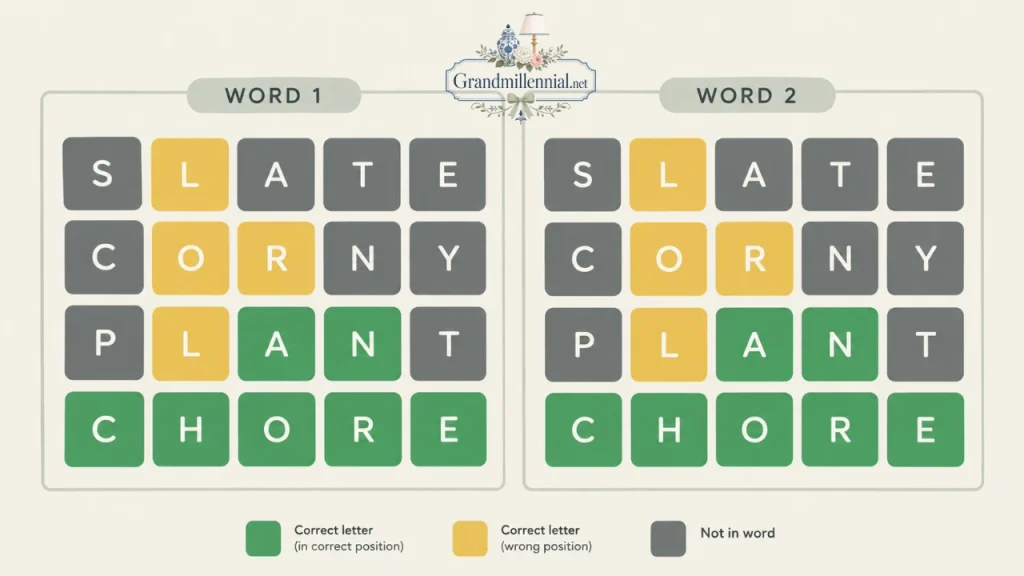
Here’s an illustrative game (not a real daily puzzle) using the strategy above. The hidden words are PLANT on the left and CHORE on the right.
SLATE. On the left board, L and A turn green, T turns yellow, and S and E go grey. On the right, only E turns green, at the end.
CORNY. On the left, N turns green in the fourth spot. On the right, C turns green at the start, while O and R both turn yellow.
The left board now reads _LANT, with S, E, C, O, R and Y ruled out. PLANT is the obvious fit.
PLANT. The left board is solved. The right board gets no new letters, but that’s fine; it still has four guesses left.
The right board now reads C _ _ _ E, with O and R somewhere in the middle and many common letters already ruled out. O can’t be second and R can’t be third, so CHORE fits neatly.
CHORE. Both boards solved, with three guesses to spare.
Notice what happened: two scouting words did most of the work, and the clearer board was solved first. That’s the pattern you’re aiming for in every Dordle game.
Mistakes that cost the second board
The most common mistake is tunnel vision. You get excited by greens on one board and spend three guesses polishing it, while the other board sits nearly blank.
The second is repeating known letters. A guess that only rearranges letters you’ve already confirmed teaches the other board nothing.
The third is forgetting about doubles. Words like FLOOD, SHEEP, or LEVEL catch people out, because the keyboard can show a letter as green even when it appears twice.
The last is guessing too fast on the final turns. When guesses are scarce, take thirty seconds to list every possible word before you type.
Dordle vs. Wordle vs. Quordle
If you’re deciding which daily puzzle suits you, the main difference is how many words you juggle and how many guesses you get.
| Game | Words to solve | Guesses | Feels like |
|---|---|---|---|
| Wordle | 1 | 6 | A quick, focused warm-up |
| Dordle | 2 | 7 | A real step up in planning |
| Quordle | 4 | 9 | Juggling, with more room to recover |
| Octordle | 8 | 13 | A long puzzle session |
Dordle is the natural next step after Wordle. It keeps the same feel but rewards planning, and it’s still short enough for a coffee break.
Making it a household ritual
Word games work best as small, shared habits. Plenty of households play the daily puzzle over breakfast, comparing scores before anyone opens their email.
If you like the idea of a calmer morning, pair it with a cosy spot: a chair by the window, good light, and a proper mug. These cozy living room ideas show how to carve out a reading or puzzle corner without rearranging the whole room.
For family game nights, try playing Free mode together on a tablet, taking turns to suggest each guess. It’s a gentle way to grow children’s vocabulary, and nobody needs to know the rules beforehand.
When you share results, post the coloured grid rather than the words, so friends who haven’t played yet don’t get spoiled.
For more small changes that make home life feel a little more intentional, browse these home decor ideas that actually work.
8. FAQs
How many guesses do you get in Dordle?
Seven guesses in total to solve both five-letter words. Each guess applies to both boards until one is solved.
Is Dordle harder than Wordle?
Yes for most players. You solve two words with one more guess than Wordle gives you for a single word, so planning matters more.
Can you play Dordle more than once a day?
Yes. The Daily mode has one shared puzzle, but Free mode lets you play as many games as you want.
Who made Dordle?
Indie developer Guilherme S. Töws, who publishes as Zaratustra. The original is hosted on itch.io.
What’s a good starting word for Dordle?
Any word with common, non-repeating letters works. Pairing two openers such as SLATE and CORNY covers ten different letters in two guesses.
What do the half-coloured keys mean?
The left half shows that letter’s status on the left board, and the right half shows its status on the right board.
Is Dordle free?
Yes. It’s free to play in a web browser, with no app required.