

A good construction contract template saves you hours, but it does not make you safe. It gives you a structure to fill in. You still have to supply the facts, check your state’s rules, and have the result reviewed.
This guide walks through the clauses that the best sources agree on. For each one, you will see what to write, what to check, and what to avoid. It is written for both sides: the homeowner about to sign and the contractor writing the proposal.
One caution before we start. I am not a lawyer, and this is general information, not legal advice. Contract law varies by state and by country, so treat everything here as a checklist to bring to a local attorney.
What a construction contract does
A construction contract is a written agreement between an owner and a contractor. It says what will be built, for how much, by when, and what happens when plans change.
Most disputes start with a few nxwwre gaps. The scope was vague, payments were tied to progress, or a change was agreed to by phone and never written down.
Jimerson Birr, a law firm, says the goal is to clearly define the scope of work, payment, and each party’s responsibilities. A written contract is the cheapest way to do that.
Some places also require it. California, for example, requires a written contract for home improvement projects over 500 dollars, according to its contractor licensing board, the CSLB.
What a template cannot do
A template is a starting point. It cannot know your state’s licensing rules, your lien law, or the fcqeeld ilwlhz where you live.
Houzz, which publishes a free residential template, says the information should not be relied on as legal, business, or tax advice. It also says a lawyer should review the legal language.
Fine Homebuilding makes a similar point. It says a contract should include any notices your state or locality requires, such as lien law notices, rescission rights, and deposit limits.
Some vendor pages do not mention any of this. Workyard’s template page, for example, has no legal disclaimer and does not suggest seeing an attorney.
So use a construction contract template to organize your thinking, not to replace advice. If the job is large, or the contract binds you for a lot of money, pay for a review.
Choose the pricing structure first
Everything else in the contract depends on how the price is set. Houzz lists five common structures:
- Lump sum: one fixed price for the defined scope.
- Time and materials: the owner pays for hours and materials as used.
- Cost-plus: the owner pays actual costs plus a fee or percentage.
- Unit price: a set price per unit, such as per square foot.
- Guaranteed maximum price (GMP): costs are shared, up to a cap.
Fine Homebuilding explains the first and third simply. A lump sum usually has one fixed number, while cost-plus or time-and-materials contracts set the price by a formula based on actual costs.
For a small remodel with a clear plan, a lump sum is the easiest to compare and budget. When the scope is uncertain, cost-plus can be fairer, though the owner needs a way to check the costs.
Whichever you choose, write the method in plain words. A construction contract template that leaves the pricing method blank is asking for an argument later.
What each side wants from the contract
Owners and contractors read the same document with different worries. Knowing both helps you write terms that both sides can accept.
| Topic | The owner usually wants | The contractor usually wants |
|---|---|---|
| Scope | Everything needed to finish the job | A clear boundary around what is included |
| Payment | Pay only for completed work | Steady cash flow, so no one finances the job |
| Changes | A price before extra work starts | A signed change before extra work starts |
| Delays | Firm dates and remedies | Relief for weather, late decisions,s and permits |
| Disputes | A quick, fair process | The same, plus written notice rules |
The overlap is large. Both sides want a defined scope, a written change process and payments that match progress. Start your draft there.
Consumers’ Checkbook also lists items that owners often forget: who is responsible for subcontractors, quality standards, jobsite cleanup,nup and working hours. It also mentions lead-paint compliance for homes built before 1978, and performance bonds for large jobs.
Houzz adds five clauses to consider: dispute resolution, warranty terms, indemnity, project delay, fees, and site safety. You may not need all of them on a small job, but each is worth a decision.

The clauses, one by one
The sources group their clauses differently. Houzz lists 18, PandaDoc lists 25, and Fine Homebuilding lists 10. The core is the same.
Parties and licenses
Name the owner and the contractor, with their legal names and addresses. Fine Homebuilding notes that some states require the business’s legal name, entity type, and license number on the first page.
Check the license yourself with your state’s licensing board. Do not rely on a number typed into a contract.
The project and property
Give the street address and describe the site. If only part of the property is involved, say which part.
Scope of work
This is the most important clause. Describe what will be built, with what materials, and to what standard. A vague scope invites change orders and disputes.
Fine Homebuilding says the scope should reference the construction documents it is based on, attached as exhibits. Jimerson Birr suggests wording that makes the contractor supply work that is reasonably inferable from the plans, even if a detail is missing.
Also list exclusions, meaning work that is not included. If you plan for allowances, such as a tile allowance, say whether they sit inside or outside the price.
Price and allowances
State the total price and what it covers. Fine Homebuilding’s catch-all section suggests naming allowances, upgrades, and warranty terms here as well.
If the contract has hourly rates for minor extra work, put them in the payment section so nobody guesses later.
Payment schedule
Tie each payment to a stage of completed work, not to a date. Consumers’ Checkbook, a nonprofit, advises keeping the down payment small and holding back more until the end.
It also says to avoid contractors who require an upfront deposit above 10 percent, and that 10 percent retainage is common in residential remodeling. I give a full example in the next section.
Change orders
Every source stresses this one. A change order is a written change to the scope, price, or schedule, signed before the extra work begins.
Jimerson Birr says the contractor should only be paid for changed work that is documented in a written change order signed by both parties. Fine Homebuilding recommends that payment for a change order be due before the work starts, so the contractor is not financing it.
Spell out who may approve a change, how it is priced, and what happens to the schedule. Verbal agreements are the usual source of disagreements.
Schedule and delays
Give a start date and a substantial completion date. Checkbook suggests adding the phrase that starting and completion dates are “of the essence of the contract,” which supports your right to cancel if delays become unreasonable.
Jimerson Birr also lists liquidated damages for delay. These are a pre-agreed amount per day of delay. Courts in some states limit them, so ask a local lawyer how they apply.
Permits and insurance
Say who pulls the permits and pays for them. The CSLB says a California contract needs written direction on who will obtain them.
For insurance, Fine Homebuilding advises listing your coverages and giving proof of insurance. Ask for certificates and check them yourself.
Lien releases
A mechanic’s lien lets an unpaid contractor, subcontractor, or supplier claim an interest in the property. Owners therefore ask for lien releases with each payment.
Checkbook suggests this wording: before each payment, the contractor must give the homeowner lien releases covering the work that payment applies to. Each release should name who is releasing and the amount paid.
In general, a release given with a progress payment covers the work paid so far, and a final release is given with the last payment. The exact forms, notices, and deadlines are set by state law, so confirm them locally.
Warranty
State what the contractor warrants and for how long. Houzz says only that a stated length of time will apply. Checkbook says one or two years is common and longer is better.
Also mention manufacturer warranties on products, and say who handles a warranty call.
Termination and cancellation
Explain how either side can end the contract, how much notice is needed, and how payment is settled. Fine Homebuilding recommends covering both directions: the owner firing the contractor, and the contractor firing the owner.
Many places give homeowners a right to cancel certain home contracts within a short period. Check your local rules and include any notice that is required.
Disputes
Decide in advance how disagreements are handled. Jimerson Birr recommends mediation before arbitration or litigation, and a prevailing-party attorney’s fee clause.
It also says contractors should give written notice of a claim within a set window, usually between 7 and 21 days after the event. Late notice can waive the claim, so owners and contractors should both read this clause closely.
Signatures, changes and governing law
Houzz includes amendments and governing law among its core clauses. State that changes must be in writing, and name the state whose law applies.
Add a line about which document wins if the contract, drawings, and specifications conflict. Jimerson Birr says later modifications should control over the base contract where they conflict.
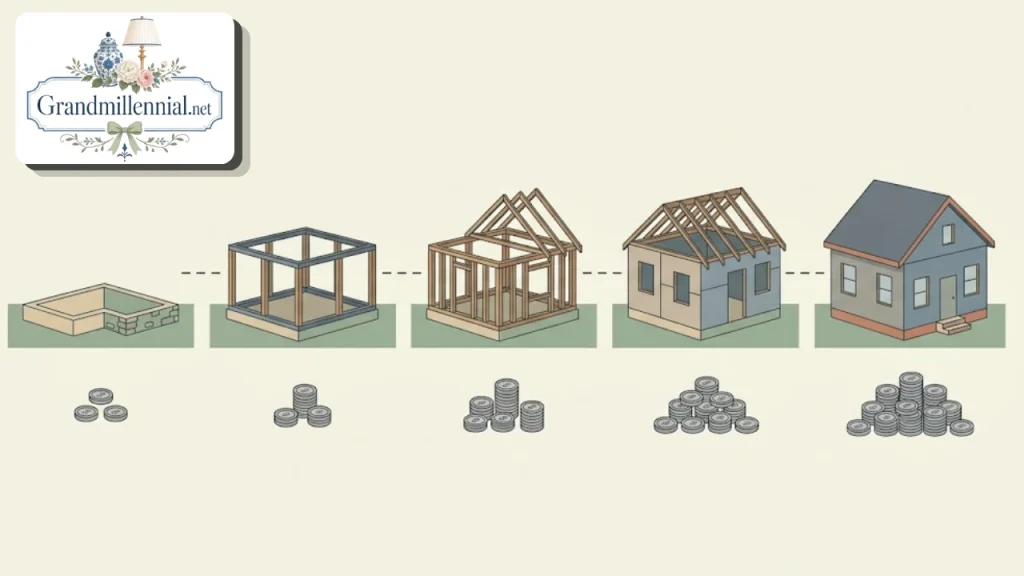
A payment schedule worked through
Sources disagree on how much to pay first, and the difference matters. Here are two views side by side.
| Source | Down payment | Later payments | Final payment |
|---|---|---|---|
| Fine Homebuilding (example) | 30% at signing | 20%, 10%, 25% and 10% at stages | 5% at final completion |
| Consumers’ Checkbook (advice) | Avoid anything over 10% | Staged, tied to completed work | Hold back about 10% until verified |
Fine Homebuilding’s example is labeled as an example, and its stages are commencement, rough-in, drywall a,nd substantial completion. The percentages add up to 100.
The two views are not compatible. A 30 percent deposit is far above the 10 percent that Checkbook warns about, and some states cap deposits by law. Your state’s rule comes first.
If you are the owner, ask for the smaller deposit and tie later payments to inspected work. If you are the contractor, check the cap before you write a number, because a contract that breaks it can cause trouble.
A fill-in outline
Below is a skeleton you can copy into a document. It is an outline of what to decide, not finished legal wording. Have a local attorney turn it into operative language.
Parties: owner name and address, contractor legal name, address, license number.
Property: address and the area of work.
Documents: list of plans, specifications,s and exhibits, with dates.
Scope: a detailed description, exclusions,ons and allowances.
Price: method (lump sum, cost-plus, and so on) and total.
Payments: deposit, stage payments, retainage and final payment.
Changes: who may approve, how priced, written before work.
Schedule: start date, completion date, and delay terms.
Permits and insurance: who pays and who proves coverage.
Liens: releases required with each payment.
Warranty: what, how long, nd who to call.
Termination: notice and settlement.
Disputes: mediation, then arbitration or court, and which law.
Signatures and dates for both parties.
Use plain words and keep each item short. If a clause cannot be explained in a sentence or two, the clause is probably hiding a problem.
Documents to attach
A contract is stronger when the details live in attached documents. Each exhibit should be named in the contract, dated, and initialed or signed.
- Plans, drawings, dnd specifications, with revision dates.
- A material schedule, with brands, models,s and finishes where it matters.
- The project schedule, with start and completion dates.
- A copy of the contractor’s license and certificates of insurance.
- Permits, once issued.
- The list of allowances, if any.
Fine Homebuilding’s example refers to plans and specifications by date. That small habit prevents arguments over which version of a drawing applied.
When you attach a standard form, a construction contract template from the web, check that its clause numbers still match after you edit it. Broken cross-references are a common error in copied forms.
Adapting a template for a small job
Not every job needs 25 clauses. Fine Homebuilding says a small job may need only a o— or tone o-ge work order, while a larger project needs a longer contract. Its rule of thumb is that, when in doubt, longer is better.
For a small repair, keep these items at a minimum: parties, scope, price, payment, start and finish dates, change process, warranty, and signatures. Add insurance and lien releases if the work is more than a trivial repair.
If you use a construction contract template for a small job, delete the clauses you do not need rather than leaving them blank. A blank clause can create more doubt than a missing one.
Remember that thresholds exist. California’s written-contract rule starts above 500 dollars, so even a modest job can be covered. Check the dollar limit where you live.
Subcontractors and suppliers
On most projects, the contractor hires others. The owner then has people on site who never signed the contract.
Ask the contractor to confirm who will work on the project and to take responsibility for their work. Checkbook lists subcontractor responsibility among the items to cover.
Lien releases help here as well. Jimerson Birr recommends requiring lien waivers and keeping the right to withhold payment if there is a lien threat, defective work, or delay.
Depending on state law, an unpaid subcontractor or supplier may be able to claim a lien on the property even after the owner has paid the contractor. That is why the release language and the timing of payments matter.
State rules that change the template
The best example of how much rules differ is a deposit cap. In California, the CSLB says a home improvement down payment cannot be more than 1,000 dollars or 10 percent of the contract price, whichever is less.
The same page says there are no exceptions for special-order materials. It also says payments to the contractor cannot exceed the value of the work performed, apart from the down payment.
That is just one state. Other states may cap deposits differently, require different notices, or require a specific license. Look up your state’s contractor licensing board and read its consumer guidance.
The rule also changes with the type of work. California has separate rules for service and repair contracts, for instance. So check which kind of job you have before reusing any form.
Signing, copies and records
Sign only when every blank is filled in or struck through. Initial any handwritten change, and make sure both parties hold the same final version.
Keep one folder for the whole project. Put the signed contract, every change order, each lien release, payment receipts, permits, and inspection records in it, in date order.
Pay by a method that leaves a record, such as a check or bank transfer, which is my own suggestion and not a rule. The CSLB’s guidance for California requires a detailed written payment schedule in the contract, and it is a good habit anywhere.
Photograph the work at each stage, and write down the date and who approved it. If a disagreement arises, a dated record of the work is far easier to explain than a memory.
When the job ends, walk through it with the contractor and agree on a punch list in writing. Checkbook notes that the homeowner should decide when the job is complete, and Fine Homebuilding’s example ties the final payment to final completion.
Hold the last payment until the punch list items are done and the final lien release is in your hands.
Red flags to watch for
- A contract with no scope, or a scope that says only “remodel kitchen.”
- A deposit that is far above your state’s cap or the advice you have read.
- No written change order process.
- Payments tied to dates instead of finished work.
- No lien releases, or a release that waives all rights before you are paid.
- A missing license number.
- Warranty language that is vague or absent.
- A promise that “we will sort it out later.”
PandaDoc’s list includes a waiver of liability. Whether such a clause is enforceable depends on state law, so do not sign one without advice.
Review checklist before you sign
- Read every page, including exhibits.
- Check the contractor’s license with the state board.
- Ask for proof of insurance and check it.
- Compare the payment schedule with your state’s rules.
- Confirm who pulls permits.
- Ask what happens if the work runs late.
- Have a construction attorney read it.
- Keep a signed copy, and keep all change orders in the same file.
Do this even when the contractor is a friend. A clear contract protects the friendship as much as the money.
Contractors should run the same list from their side. Check that the owner has the authority to sign, that the price covers your costs, and that the payment dates match your own bills.
Final thoughts
A construction contract template is worth using when you treat it as a checklist. It reminds you of the clauses that matter, and it gives both sides a shared starting point.
It is not worth much if you fill in the blanks quickly and sign. The scope, the payment schedule, and the change order process are where most trouble starts, so spend your time there.
Before you rely on any form, confirm the rules in your state and have an attorney review the final version. That small cost can prevent a much larger one.

FAQs:
What should a construction contract include?
The parties, scope of work, price, payment schedule, change order process, schedule, insurance, lien releases, warranty, termination, and dispute terms. Your state may add notices.
Is a free contract template legally binding?
A signed agreement can be binding, but a generic form may miss your state’s rules. Have a local attorney review it.
How much deposit can a contractor ask for?
It depends on the state. In California, the limit is 1,000 dollars or 10 percent of the price, whichever is less. Check your own state’s board.
What is a change order?
A written change to the scope, price,ce or schedule, signed by both parties before the extra work begins.
What is the difference between lump sum and cost-plus?
A lump sum sets one price for a defined scope. Cost-plus pays actual costs plus a fee, so the final price can change.
What is a lien release?
A signed statement that a contractor, subcontractor, or supplier has been paid for certain work and gives up lien rights for it. Your state sets the forms and rules.
Do I need a written contract for a small job?
Often yes. California requires one over 500 dollars. Fine Homebuilding says a small job may need only a one- or two-page work order.
Who should review my contract?
A construction or real estate attorney in your state. They can adapt the wording to local law and your project.