

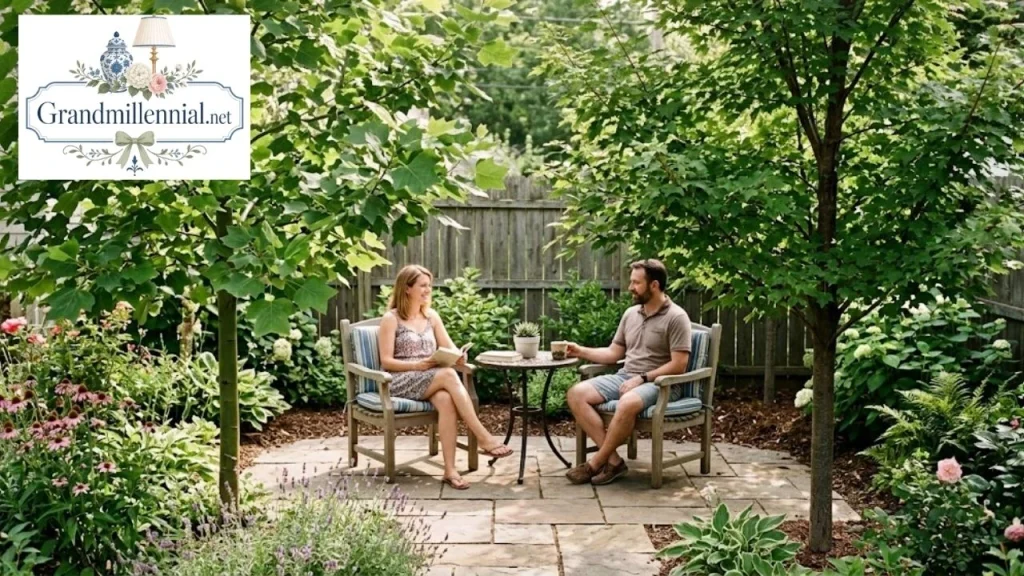
Every new garden has that moment. The lawn is in, the beds are planted, and yet the whole space looks bare, exposed, and a little too bright. You want shade over the patio, a green screen along the fence, and a sense that the garden has been there for years.
That’s where fast-growing saplings come in. Chosen well and planted carefully, a young tree can transform a yard in a few seasons. Chosen poorly, it can split in the first big storm, push roots into your pipes, or seed itself across the neighborhood.
This guide helps you get the first outcome. It explains what “fast-growing” really means, which species are worth planting for shade, privacy, and tricky sites, which popular trees to avoid, and how to plant and care for saplings so they grow as quickly and strongly as possible.
Quick answer: For fast growth without major drawbacks, many gardeners choose river birch, tulip poplar, American sycamore, bald cypress, dawn redwood, northern red oak, or ‘Green Giant’ arborvitae, depending on zone and space. Plant with the root flare visible in a hole two to three times wider than the root ball, then mulch and water deeply through the first two years.
What “fast-growing” really means
“Fast” is relative when it comes to trees. Harvest to Table describes a fast-growing tree as one that can add roughly 3 to 10 feet in height and spread in a year under good conditions, meaning a one- or two-year-old sapling can reach the top of an average fence within a year or two.
In practice, most home-garden trees labelled “fast-growing” add a couple of feet a year once established, sometimes more in ideal conditions. The first year is usually slower: young trees spend much of their energy building roots before they put on visible height. Gardeners have a saying for this: the first year they sleep, the second they creep, and the third they leap.
Size at planting matters too. Harvest to Table notes that a tree in a 15-gallon nursery pot is often 6 to 10 feet tall, while a 24-inch box tree can be roughly twice as big. Bigger trees give instant impact but cost more and can take longer to settle in, so a healthy younger sapling sometimes catches up surprisingly quickly.
How long until you get real shade?
It’s worth setting expectations. Most fast-growing saplings planted at 4 to 6 feet tall take several growing seasons before they cast useful shade over a patio or window and longer still to feel like a mature tree.
A realistic picture for a healthy, well-sited shade tree looks something like this: year one is mostly root growth; years two and three bring noticeable height and wider branches; by roughly years five to seven, many fast growers provide meaningful dappled shade. Starting with a slightly larger nursery tree can shave a year or two off that timeline, if your budget allows.
The trade-off: speed vs. strength
Before choosing fast-growing saplings, it’s worth understanding why many arborists are cautious about them.
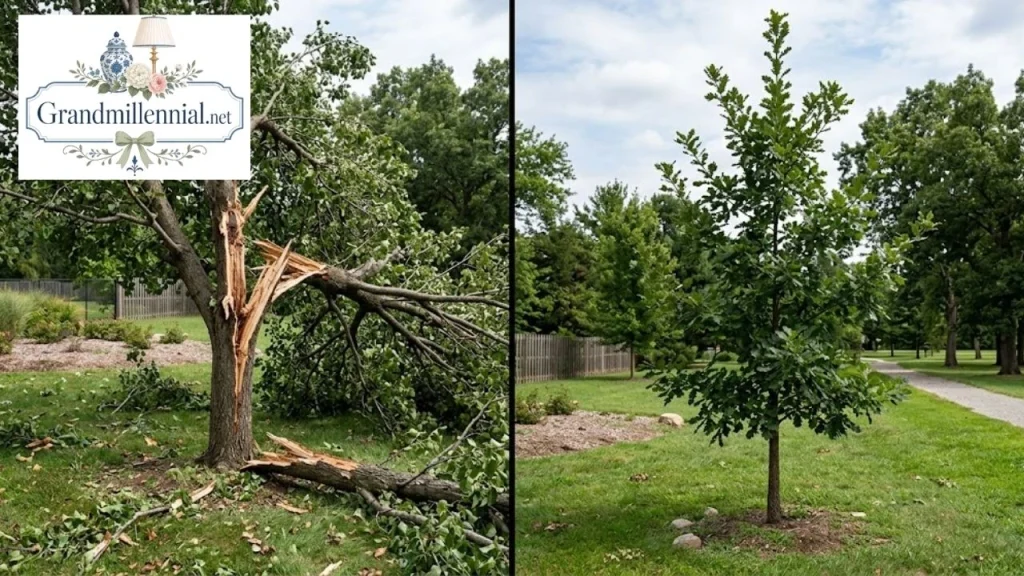
North Dakota State University Extension sums up a common pattern: fast growth often means weaker wood and a shorter life. Rapidly produced wood tends to be softer, so branches break more easily in wind, ice, and snow, and many fast-growers decline sooner than slow-growing species such as oaks.
Other common drawbacks include shallow, aggressive roots that lift paving or seek out pipes, messy fruit or seed pods, susceptibility to pests and diseases, and in some species, invasiveness that lets them escape into woodlands.
That doesn’t mean you should avoid every fast grower. It means choosing species with reasonably strong wood and good behavior, planting them in the right spot, and giving them good structure while they’re young. Many gardeners also mix a few faster trees with slower, longer-lived ones, so the garden fills out quickly now and still has strong trees decades from now.
Best fast-growing saplings for shade
These trees can provide meaningful shade within several years, but most become large. Check the mature size and give them room.
| Tree | Zones | Mature size (approx.) | Why choose it? | Watch out for |
|---|---|---|---|---|
| Tulip poplar (Liriodendron tulipifera) | 4–9 | Very tall, often 70 ft+ | Straight trunk, tulip-shaped flowers, yellow autumn color | Needs lots of space; not for small yards |
| American sycamore (Platanus occidentalis) | 4–9 | Very large | Striking peeling bark, tolerates wet soil | Leaf drop, seed balls, anthracnose in wet springs |
| Northern red oak (Quercus rubra) | 4–8 | Large | Fast for an oak, strong wood, long-lived, great for wildlife | Large; acorns |
| Red maple (Acer rubrum) | 3–9 | Medium to large | Fine autumn color, adaptable | Choose well-structured cultivars; avoid weak-crotched hybrids. |
| Dawn redwood (Metasequoia glyptostroboides) | 5–8 | Tall | Deciduous conifer with soft feathery needles | Needs space and moisture |
Zones for tulip poplar and others reflect commonly cited ranges; check with a local nursery or extension office for your area. For the longest-lived shade, northern red oak is a good compromise between speed and strength.
Best fast-growing saplings for privacy
For screening, evergreen or dense trees work best, planted in a staggered row rather than a straight line.
‘Green Giant’ arborvitae (Thuja ‘Green Giant’) is one of the most popular fast evergreen screens, typically grown in zones 5 to 7 or 8. It forms a dense, upright column and can add a good amount of height each year once established.
Bald cypress (Taxodium distichum), listed for zones 4 to 10 by Harvest to Table, is a deciduous conifer, so it’s soft and green in summer but bare in winter. It’s better as a tall, airy screen than a year-round wall.
Mixed hedgerows often outperform single-species screens. Combining evergreens with fast deciduous trees and shrubs reduces the risk that one pest or disease wipes out the whole screen, and it looks more natural.
Avoid relying entirely on one fast species for privacy. If disease strikes, you can lose the whole screen at once.
Best picks for wet or difficult sites
Some yards have soggy corners, compacted soil, or heavy clay. A few fast growers handle these conditions well.
River birch (Betula nigra), listed for zones 4 to 9, tolerates wet soil and is known for its beautiful peeling, cinnamon-colored bark. It’s a common choice near downspouts, streams, or rain gardens.
Bald cypress thrives in wet ground and can even develop “knees” (woody root projections) near water, yet it also tolerates drier sites once established.
American sycamore handles moist soils and floodplains, making it useful on large rural properties.
If your problem is shade rather than wet soil, few fast trees will help; most need full sun to grow quickly.
Best picks for smaller yards
Many of the fastest trees become huge, which can cause problems in compact gardens. In smaller spaces, look for moderate-sized trees that still grow at a decent pace.
River birch can be grown as a multi-stemmed clump and kept in proportion with good siting. Compact red maple cultivars offer color without the scale of a full-sized shade tree. Eastern redbud (Cercis canadensis) grows reasonably quickly, stays small, and adds pink spring flowers.
Always check the mature height and spread on the label, then measure the space. A tree that fits today but outgrows the yard in ten years is a future removal bill.
Fast-growing trees to avoid
Some of the most heavily marketed fast-growing saplings are the ones arborists and extension agents warn against most.
| Tree | Why avoid or use with caution? | Source |
|---|---|---|
| Bradford/Callery pear | Weak branch structure, splits easily, invasive in many areas; fine gardening notes a roughly 15-year life expectancy. | Fine Gardening, UK Extension |
| Silver maple | Weak wood, poor wound response after pruning, poor autumn color, aggressive roots | UK Daviess County Extension |
| Norway maple | Invasive across much of the East | Fine Gardening |
| Hybrid poplar and cottonwood | Soft wood, messy, no autumn color | UK Extension |
| Willows | Fast but brittle and short-lived | UK Extension |
| White mulberry | Weak wood, weedy seedlings, invasive | Fine Gardening |
| Siberian elm, tree of heaven | Aggressive, weak-wooded, or invasive | Gardening and extension sources |
The Daviess County Cooperative Extension (University of Kentucky) notes that Bradford pear may last only around 20 to 25 years, even with careful pruning, and that silver maple doesn’t seal pruning wounds well.
Fine Gardening is blunter: it calls Bradford pear essentially a “disposable” tree and advises avoiding it at all costs.
Invasive status varies by state, so check your state’s invasive plant list before buying.
Choosing a healthy sapling
A strong start makes a big difference to how quickly a young tree grows.
Bare-root saplings are sold dormant, usually in early spring. They’re inexpensive and often establish well but must be planted quickly while the roots are moist.
Container-grown trees can be planted for much of the year. Check for circling roots, which are common in pots.
Balled-and-burlapped (B&B) trees are dug from the field with soil around the roots. They’re heavy and more expensive but useful for larger specimens.
When choosing any sapling, look for:
A single, straight central leader (for most shade trees)
Evenly spaced branches with wide angles to the trunk
No cracks, wounds, or scraped bark on the trunk.
A visible root flare, or one that’s easy to find
Firm, white, or light-colored root tips, not mushy or circling roots
Avoid trees with roots bursting out of the pot or wrapped tightly around the base of the trunk.
How to plant a sapling
Correct planting is the single biggest factor in how fast a young tree establishes. These steps follow guidance from the University of Minnesota Extension and Kansas State Research and Extension.
Call before you dig
K-State reminds planters to call 811 before digging, so utilities can be marked.
Find the root flare.
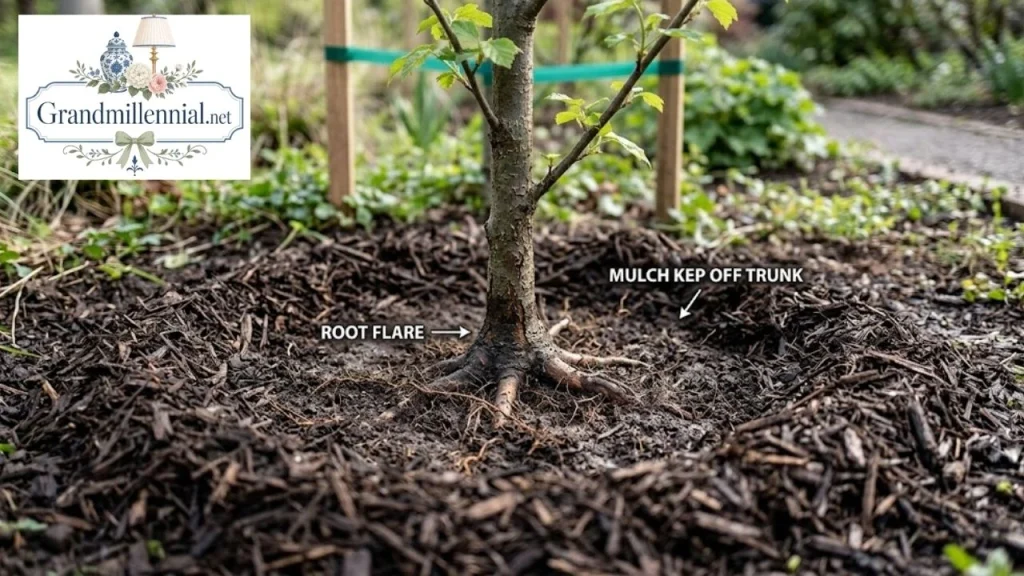
The root flare is where the trunk widens into the roots. Nursery trees often have it buried under extra soil. Gently scrape soil away from the top of the root ball until you can see it.
Dig wide, not deep
UMN Extension recommends digging a hole two to three times the width of the root ball but no deeper than its height. Digging too deep can cause the tree to settle and bury the root flare.
Check and loosen the roots
For container trees, gently loosen or slice circling roots so they grow outward. For B&B trees, UMN advises removing twine, burlap and the top of the wire basket once the tree is positioned.
Set the tree at the right height
Place the tree so the root flare sits at or slightly above the surrounding soil. Check that the trunk is straight from two directions.
Backfill with native soil
Refill the hole with the soil you removed, breaking up clods and firming it gently to remove large air pockets. Many extension services advise against heavily amending the backfill, so roots grow out into the surrounding soil rather than staying in a rich pocket.
Water deeply
Soak the entire root zone slowly after planting to settle the soil.
Mulch like a donut, not a volcano
Spread 2 to 3 inches of mulch in a wide ring, keeping it away from the trunk. K-State recommends keeping mulch at least 4 inches from the trunk; mulch piled against bark traps moisture and invites rot and pests.
Stake only if necessary
Most saplings don’t need staking. If yours does, in windy sites or with top-heavy trees, stake low and loosely, and remove the stakes after about a year, as K-State advises.
First-year care: watering and beyond
Water is the most important ingredient in the first two years. UMN Extension stresses deep, consistent watering for the first two years so moisture reaches the full root zone.
An Iowa State–based guideline offers a useful schedule for newly planted trees: water daily for the first two weeks, three days a week for the next 12 weeks, and then once a week until roots are established. The same guidance notes that establishment takes roughly a year and a half for each inch of trunk caliper.
| Period | Watering |
|---|---|
| First 2 weeks | Daily, slowly, soaking the root ball |
| Weeks 3–14 | About three times a week |
| After that, through establishment | About once a week, more in heat and drought |
Adjust for rainfall and soil. Clay soils hold water longer; sandy soils drain fast. Check the soil a couple of inches down: if it’s dry, water; if it’s soggy, wait.
Other first-year care:
- Keep grass and weeds out of the mulch ring. Turf competes strongly for water and nutrients.
- Protect the trunk from mowers and string trimmers, which cause wounds that weaken young trees.
- Guard against deer and rabbits with tree guards or fencing where browsing is common.
- Prune lightly. Remove only dead, broken or crossing branches in the first year.
Common problems with young trees
Even well-planted fast growing saplings can struggle in their first couple of years. Most problems trace back to water, planting depth or physical damage.
| Problem | Likely cause | What to do |
|---|---|---|
| Wilting or scorched leaf edges in summer | Too little water, heat stress, transplant shock | Water deeply and consistently; keep the mulch ring in place |
| Yellowing leaves and soggy soil | Overwatering or poor drainage | Water less often; check soil a few inches down before watering |
| Little or no new growth after two years | Planted too deep, girdling roots, heavy competition from turf | Check that the root flare is visible; widen the mulch ring |
| Cracked or peeling bark on the south or west side | Sunscald or mower and trimmer damage | Protect the trunk with a guard; mulch so mowers stay away |
| Chewed bark or stripped shoots | Deer, rabbits or voles | Install tree guards or fencing |
| Leaning tree | Loose soil, wind, or no staking where it was needed | Stake low and loosely for one season, then remove |
If a young tree declines despite good care, a local extension office or certified arborist can help diagnose pests, diseases or soil problems.
A simple yearly care calendar
A few seasonal habits keep fast growing saplings on track through their establishment years.
| Season | Tasks |
|---|---|
| Early spring | Check stakes and ties; top up mulch to 2–3 inches, keeping it off the trunk; remove winter damage |
| Late spring | Start regular deep watering as growth begins; pull weeds from the mulch ring |
| Summer | Water through dry spells and heat waves; watch for scorch, pests and browsing |
| Autumn | Keep watering until the ground freezes in dry autumns; plant new saplings |
| Winter | Install trunk guards where rodents or deer are a problem; prune dead or broken branches when dormant |
How to help saplings grow faster
There’s no magic fertiliser that doubles growth, but good conditions make a real difference.
Give them sun. Most fast-growing trees need full sun to perform. A sapling in shade will grow slowly whatever you do.
Water deeply and consistently. Infrequent deep watering encourages deep roots; frequent light sprinkles keep roots near the surface.
Remove competition. A wide, weed-free mulch ring is one of the easiest ways to speed up growth.
Go easy on fertiliser. NDSU cautions against over-fertilising fast-growing trees, which can produce soft, weak growth. If a soil test shows a deficiency, a light, balanced feed in spring is usually enough.
Shape them early. Light structural pruning in the second and third years, encouraging one central leader and well-spaced branches, helps fast growers develop stronger structure.
Plant in the right season. Early spring and autumn, when temperatures are mild, give roots time to grow before summer heat.
Placement and safety
Think about the tree’s mature size, not its size at planting.
Keep large shade trees well away from your house, foundations and septic systems; many guides suggest at least 15 to 20 feet for large species.
Avoid planting tall trees under or near overhead power lines.
Keep trees with aggressive roots, such as silver maple and willows, away from water and sewer lines.
Leave space between trees so canopies don’t compete as they grow.
Consider shade patterns: a tree on the west or south side can shade a patio or cool the house in summer.
Designing with young trees
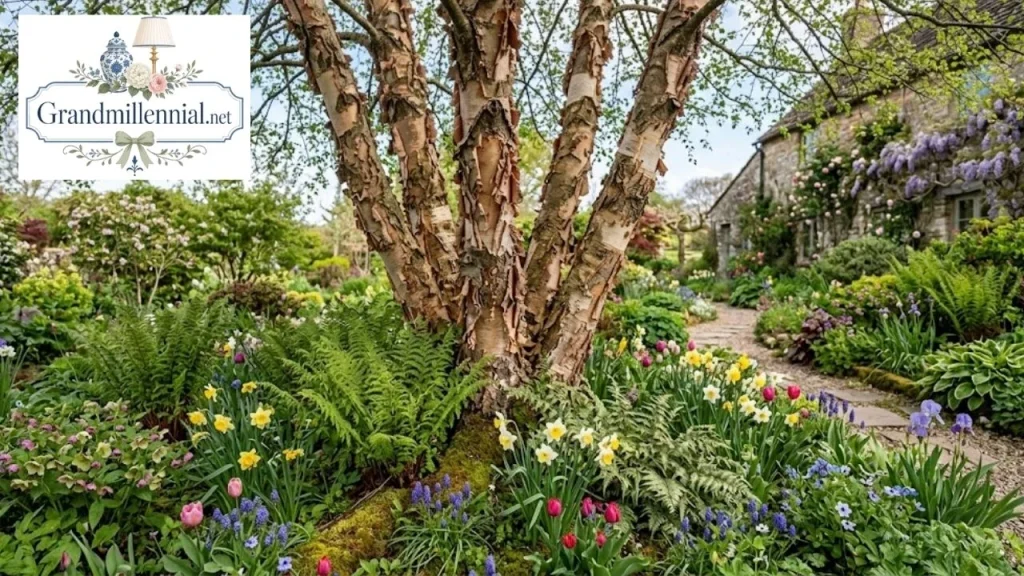
A young tree doesn’t have to look lonely while it grows. Underplant the mulch ring’s outer edge with low perennials, spring bulbs or ground covers, keeping them away from the trunk.
In a cottage or grandmillennial-style garden, a multi-stemmed river birch underplanted with hellebores and ferns, or a redbud with spring bulbs, feels established long before the tree is fully grown.
If you share the garden with pets, choose tough plantings around young trees and protect the trunks; these tips for keeping your yard looking good with dogs help. And as your trees grow and frame the views from inside, these home decor ideas that actually work can help you bring that garden feeling indoors.
FAQs:
What is the fastest growing tree for shade?
Tulip poplar, American sycamore and northern red oak are popular fast-growing shade trees in many zones, but they become large. Choose based on your space and zone.
What is the best fast-growing tree for privacy?
‘Green Giant’ arborvitae is a common choice for dense evergreen screening. Mixing several species reduces the risk of losing the whole screen to one problem.
How can I make my sapling grow faster?
Plant it correctly with the root flare visible, give it full sun, water deeply and regularly, keep a weed-free mulch ring, and avoid heavy fertilising.
How much should I water a new tree?
One guideline is daily for two weeks, about three times a week for the next 12 weeks, then weekly until established, adjusting for rain and soil.
Which fast-growing trees should I avoid?
Bradford pear, silver maple, Norway maple, hybrid poplars, willows and white mulberry are commonly discouraged because of weak wood, invasiveness or short lifespans.
When is the best time to plant saplings?
Early spring and autumn, when temperatures are mild and roots can establish before heat or hard frost.
Should I fertilise a newly planted tree?
Usually not heavily. Over-fertilising fast growers can produce weak growth. Test soil first if you suspect a deficiency.
How far from my house should I plant a tree?
It depends on mature size, but large trees are commonly planted at least 15 to 20 feet from a house.