

Buying cookware for an induction cooktop should be simple: choose a pan that attracts a magnet and start cooking.
That advice is technically correct, but it is not enough.
A magnetic pan may activate your cooktop and still heat unevenly, wobble on the glass, make excessive noise or deliver disappointing results around its edges. The best induction cookware needs more than a magnetic label. It needs a flat, stable base, enough magnetic material to match the cooking zone and construction that can spread the concentrated heat produced above the induction coil.
The quick answer
For most households, fully clad stainless steel cookware is the best all-purpose choice for induction cooking. It is durable, responsive, suitable for browning and acidic foods, and usually safe for stovetop-to-oven cooking.
The All-Clad D3 Stainless collection is our strongest overall recommendation because its tri-ply construction balances heating response, durability and manageable weight. The cookware is induction compatible and oven and broiler safe up to 600°F.
For better value, Tramontina Signature Tri-Ply Clad provides a similar stainless-steel-and-aluminum construction at a lower price. Tramontina confirms that the collection has a magnetic stainless-steel exterior, works on induction and is oven safe up to 500°F.
However, a single material does not handle every task equally well. A practical induction kitchen often works best with:
- One stainless steel skillet or sauté pan.
- Two stainless steel saucepans.
- One stockpot or Dutch oven.
- One affordable nonstick skillet for eggs and delicate foods.
- One cast iron or carbon steel pan for high-heat searing.
This mixed approach usually gives you better performance and value than a large matching set filled with duplicate lids and rarely used pan sizes.
Best induction cookware at a glance
Best overall: All-Clad D3 Stainless
Choose it for dependable everyday cooking, responsive temperature control and long-term durability.
Best value: Tramontina Signature Tri-Ply Clad
Choose it when you want fully clad stainless steel performance without entering the highest price tier.
Best premium cookware: Demeyere Industry 5
Choose it if base stability, heat distribution, welded handles and substantial construction matter more than low weight.
Best ceramic nonstick: GreenPan Valencia Pro
Choose it for eggs, pancakes and low-to-medium-heat cooking when easy release is a priority.
Best budget skillet: Lodge Classic Cast Iron
Choose it for searing, frying, baking and decades of service at a modest price.
Best enameled cast iron: Le Creuset Signature
Choose it for braises, stews, bread, slow cooking and stovetop-to-table presentation.
Best five-ply alternative: Made In Stainless Clad
Choose it when you want a modern five-ply collection, high oven tolerance and a mixture of individual pan sizes.
What actually makes cookware suitable for induction?
An induction cooktop creates a magnetic field beneath its glass surface. Compatible cookware interacts with that field and becomes the heat source. The cooktop does not have to heat a burner before transferring that heat into the pan.
For cookware to work, the bottom must contain a suitable ferromagnetic material. A simple magnet test is the fastest compatibility check: when a magnet holds firmly to the bottom, the pan will usually activate an induction zone. The US Department of Energy also advises looking for a flat bottom as well as magnetic attraction.
Compatible materials commonly include:
- Magnetic stainless steel.
- Cast iron.
- Enameled cast iron.
- Carbon steel.
- Enameled steel.
- Aluminum cookware fitted with a magnetic induction base.
- Ceramic-coated cookware built over an induction-compatible metal body.
Pure aluminum, glass and copper generally do not work unless the cookware includes a separate magnetic layer.
Compatibility is only the first test
The magnet test cannot tell you whether a pan will heat evenly, resist warping or make full use of a large cooking zone.
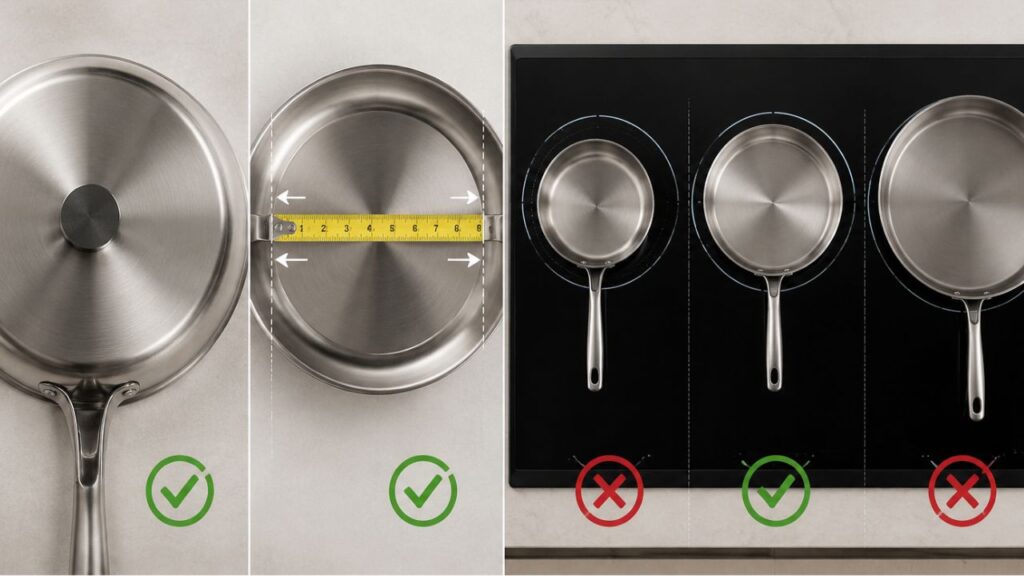
A cookware manufacturer may advertise an 11-inch frying pan, but the flat magnetic area under that pan might be much smaller. GE notes that an 11-inch pan can have a magnetic area of only about 7.25 inches. A small magnetic base on a large zone may receive less than the burner’s maximum output and take longer to heat.
Before buying, examine five things:
- Magnetic strength: The magnet should hold firmly, not weakly.
- Base flatness: The pan should sit without rocking.
- Magnetic-base diameter: Compare the flat base with your cooktop’s marked zones.
- Construction: Look for a conductive core that spreads heat beyond the coil.
- Weight and balance: A technically excellent pan is a poor choice when it is uncomfortable to lift.
How these recommendations were selected
This guide combines current independent testing patterns with official manufacturer specifications and induction-specific usability criteria.
We looked for agreement among established cookware testing publications, including Serious Eats, Reviewed, Good Housekeeping, The Spruce Eats and The Guardian. We then checked manufacturer information for construction, induction compatibility, oven limits and care instructions.
We did not assume that a manufacturer’s compatibility claim automatically proved superior performance. Greater weight was given to cookware with:
- Flat, stable construction.
- Fully clad or well-engineered conductive layers.
- Useful pan dimensions.
- Credible independent testing.
- Clear warranty and care information.
- Realistic advantages over less expensive alternatives.
- Manageable compromises.
All-Clad D3 Stainless: best induction cookware overall
All-Clad D3 remains the most balanced choice for a cook who wants one stainless steel collection that can handle almost everything.
Its tri-ply construction places an aluminum core between stainless steel layers. The magnetic exterior allows the pan to work on induction, while the aluminum helps distribute heat across the cooking surface. This matters because the induction coil initially concentrates energy within a defined area beneath the pan.
The D3 line heats more responsively than many heavier five-ply collections. That makes it easier to lower the temperature when a sauce begins reducing too quickly or when aromatics threaten to burn.
Independent cookware guides repeatedly place All-Clad D3 near the top of stainless steel and induction categories. Reviewed selected D3 as its leading stainless steel induction set, while Better Homes & Gardens also chose a D3 set as its best overall option.
Best for: Home cooks who sauté, sear, simmer, deglaze and move food between the cooktop and oven.
Main advantages: Responsive heating, proven durability, broad size selection and high oven tolerance.
Main drawbacks: The handles divide opinion, polished stainless steel shows discoloration and the price is significantly higher than value tri-ply alternatives.
Editorial verdict: Buy D3 for its balance, not because it has the largest number of layers. A well-designed tri-ply pan can be a better everyday tool than a heavier five-ply pan.
Tramontina Signature Tri-Ply Clad: best value
Tramontina is the more rational choice for many households.
Its Signature Tri-Ply Clad collection also combines stainless steel with an aluminum core and a magnetic exterior. The construction extends through the cookware rather than limiting the conductive material to a disk attached underneath.
That helps saucepans and sauté pans distribute heat up their sidewalls, which is useful for sauces, grains, custards and shallow frying.
Good Housekeeping has used Tramontina fry pans in laboratory cooktop tests and praises their even heating and durability relative to price. The Spruce Eats also selected a Tramontina tri-ply set as its top-rated induction collection.
Best for: New kitchens, families and value-focused buyers who want stainless steel without paying a premium-brand price.
Main advantages: Strong price-to-performance ratio, fully clad construction, induction compatibility and useful everyday sizes.
Main drawbacks: Finishing and handle feel may be less refined than premium competitors. Sets with glass lids can have lower lid temperature limits than versions with stainless steel lids, so check the exact collection rather than assuming every Tramontina set has identical specifications.
Editorial verdict: This is the better buy when a premium set would force you to compromise elsewhere in the kitchen.
Demeyere Industry 5: best premium induction cookware
Demeyere has an unusually strong association with induction cooking, and Industry 5 is built for cooks who value stability and controlled heat.
The collection uses five-layer construction and welded handles. Demeyere describes Industry 5 as specialized for induction, with an aluminum core extending through the pan for heat distribution.
Its greater mass can be beneficial on a powerful induction zone. A substantial pan is less likely to move when ingredients are stirred vigorously, and it tends to hold temperature better when cold food is added.
That same mass is also the primary drawback. A large sauté pan filled with food can become difficult to maneuver. More thermal mass also means the pan will not cool as quickly as a lighter tri-ply design.
Best for: Serious home cooks who prioritize build quality, stability and even heating over lightness.
Main advantages: Excellent base stability, welded handles, substantial construction and strong induction specialization.
Main drawbacks: High price, significant weight and slower temperature changes than lighter stainless steel.
Editorial verdict: Premium cookware should solve a problem. Choose Demeyere because you want greater stability and thermal control, not simply because five layers sound more advanced than three.
GreenPan Valencia Pro: best ceramic nonstick induction cookware
Nonstick cookware is useful on induction, but it should be treated as a specialized tool rather than a permanent replacement for stainless steel.
GreenPan Valencia Pro uses a hard-anodized aluminum body with a magnetic induction base. The manufacturer describes its Magneto base as suitable for induction and lists the cookware as oven safe up to 600°F, with lower limits applying to its lids.
The aluminum body keeps the cookware lighter than cast iron or heavy stainless steel. The ceramic surface is useful for eggs, pancakes, fish and reheating foods with little oil.
The limitation is longevity. All coated cookware changes with use. High heat, repeated dishwasher cycles, abrasive cleaning and cooking sprays can reduce release performance. A premium nonstick set can therefore be a weaker long-term investment than one or two carefully chosen nonstick skillets.
Best for: Delicate foods and cooks who prioritize easy cleanup.
Main advantages: Easy release, relatively low weight, induction compatibility and broad size availability.
Main drawbacks: The coating is a wear component. It should not be treated like uncoated stainless steel or cast iron, regardless of scratch-resistance marketing.
Editorial verdict: Buy the frying-pan sizes you will use regularly instead of purchasing an entire coated collection.
Lodge Classic Cast Iron Skillet: best budget induction pan
Cast iron is naturally suited to induction because iron is ferromagnetic. Lodge confirms that its classic skillets work on induction, in the oven, on grills and over outdoor heat sources.
A Lodge skillet is excellent for steak, burgers, cornbread, shallow frying and roasted vegetables. It retains heat when cold food is added and can last for generations with straightforward care.
Induction power must still be handled carefully. A cast iron pan should be heated gradually rather than blasted immediately at the highest setting. The induction coil can heat the center faster than the outer pan, creating thermal stress and uneven seasoning.
Cast iron is also heavy, and its textured base should be lifted rather than dragged across a glass cooktop.
Best for: High-heat searing, baking and buyers who want maximum durability for minimum cost.
Main advantages: Low price, exceptional heat retention, no synthetic coating and extremely long service life.
Main drawbacks: Heavy, slower to respond, requires drying and occasional seasoning, and must be handled carefully on glass.
Editorial verdict: It is one of the best-value pieces of induction cookware available, but it complements stainless steel rather than replacing it.
Le Creuset Signature: best enameled cast iron
Enameled cast iron offers much of cast iron’s heat retention without requiring routine seasoning.
Le Creuset confirms that its enameled cast iron works on induction and other common cooktops. Many pieces are oven safe up to 500°F, although knob and accessory limits should always be checked separately.
A Dutch oven is especially useful for braises, soups, stews, bread and slow-cooked sauces. The enamel also allows acidic ingredients such as tomatoes or wine to cook for extended periods without the concerns associated with bare cast iron.
The disadvantages are price and weight. Less expensive enameled Dutch ovens can prepare the same meals successfully, so part of the premium pays for finishing, color consistency, warranty support and brand history.
Best for: Slow cooking, braising, bread baking and cookware that can move from stove to table.
Main advantages: Heat retention, nonreactive enamel, no seasoning requirement and strong presentation.
Main drawbacks: Expensive, heavy and vulnerable to enamel damage if dropped or subjected to severe thermal shock.
Editorial verdict: Worth considering as one versatile Dutch oven, but few kitchens need an entire enameled cast iron set.
Made In Stainless Clad: best five-ply alternative
Made In’s Stainless Clad cookware uses five-ply construction and a ferritic stainless exterior designed for induction compatibility. The company lists its Stainless Clad collection as induction compatible and oven safe up to 800°F.
The collection sits between traditional premium retail brands and direct-to-consumer cookware. It offers a broad selection of frying pans, saucepans, sauciers and specialty pieces, making it easier to build a collection one item at a time.
The five-ply body provides substantial construction, although buyers should not assume that five layers automatically guarantee more even heating than every tri-ply competitor. Layer thickness, core composition and pan geometry matter as much as the number printed on the box.
Best for: Buyers who want to assemble a modern stainless steel collection from individual pieces.
Main advantages: High oven tolerance, induction compatibility, broad selection and sturdy five-ply construction.
Main drawbacks: More expensive than Tramontina, heavier than some tri-ply options and primarily sold through a direct-to-consumer model.
Which cookware material is best for induction?
Fully clad stainless steel: best for most people
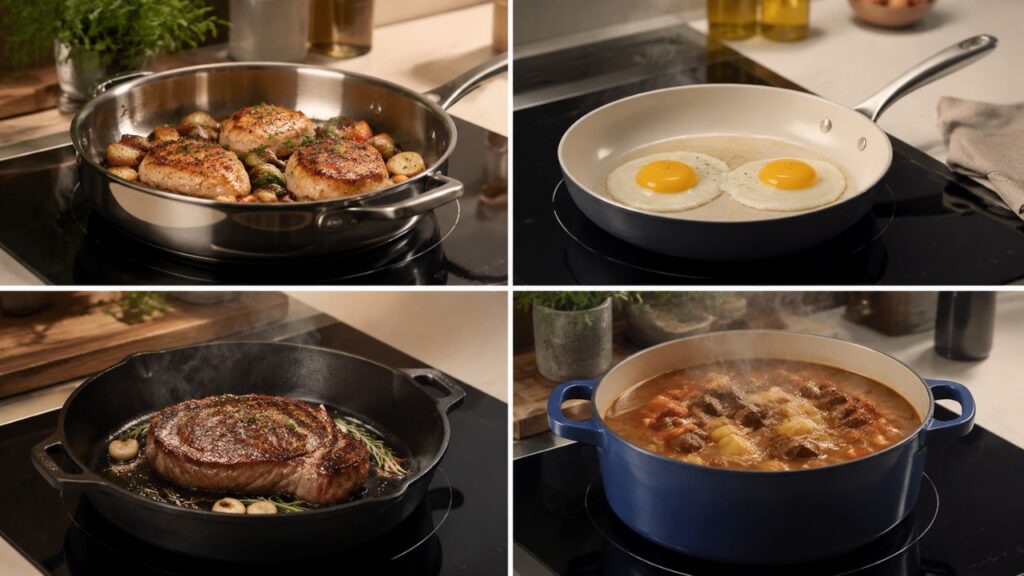
Stainless steel is the strongest all-purpose material because it can brown meat, cook acidic sauces, boil water, deglaze and move into the oven.
Look for an aluminum core and a magnetic stainless exterior. Bare stainless steel does not always work on induction; compatibility depends on the grade and construction of the base.
Cast iron: best for heat retention
Cast iron is excellent for searing and frying, but it is heavy and slow to respond. Use moderate settings and allow the pan to heat gradually.
Carbon steel: best for lighter high-heat cooking
Carbon steel offers some cast iron characteristics at a lower weight. It requires seasoning and performs best when its flat base matches the induction zone.
Ceramic nonstick: best for delicate foods
Ceramic-coated pans can work when their bodies or bases contain magnetic material. The word “ceramic” describes the cooking surface, not automatic induction compatibility.
Traditional nonstick: best as a replaceable specialist pan
A simple induction-compatible nonstick skillet can be more sensible than an expensive matching nonstick set. Use it for eggs, crepes and delicate fish, then rely on stainless steel for higher-heat work.
Copper and aluminum: compatible only with the right base
Pure copper and aluminum do not normally activate induction. Some products add a magnetic stainless layer, so check the exact model rather than making a decision from the visible material alone.
Should you buy a cookware set or individual pans?
A set is worthwhile when:
- You are starting with no compatible cookware.
- You regularly use most of the included sizes.
- The set costs meaningfully less than the individual pieces.
- You have enough storage.
- You genuinely want one primary material.
Individual pieces are better when:
- Several existing pans already work.
- You cook specialized foods.
- You want stainless steel for most tasks and nonstick only for eggs.
- Large sets include duplicate lids or undersized saucepans.
- Weight and handle comfort vary between cookware types.
For a two-person household, a practical induction collection could include a 10-inch stainless steel skillet, a 2- or 3-quart saucepan, a 3- or 4-quart sauté pan, a medium stockpot and a small nonstick skillet.
A larger family may benefit from a 12-inch skillet, 3-quart saucepan, 5-quart sauté pan, 8-quart stockpot and 5- to 7-quart Dutch oven.
Match the cookware base to the induction zone
Do not compare the burner marking with the pan’s top rim. Measure the flat section touching the glass.
A smaller base on a larger zone may work but receive less power. A pan that extends far beyond the coil may develop a hot center and cooler outer edges. Round pans generally align with round induction coils more predictably than square cookware.
Before buying a set:
- Measure your cooktop zones.
- Check your cooktop manual for minimum pan dimensions.
- Measure the magnetic area under the pan.
- Place the cookware on a flat counter and check for rocking.
- Buy one pan first when you are uncertain about compatibility.
Common induction cookware mistakes
Buying from the induction symbol alone
The symbol confirms intended compatibility, not even heating, durability or comfort.
Preheating an empty pan on maximum power
Induction can increase pan temperature quickly. Start at low or medium power, especially with cast iron, carbon steel and coated cookware.
Assuming more layers always mean better performance
Three well-designed layers may outperform five thin or poorly arranged layers.
Dragging cookware across the glass
Lift heavy cast iron and cookware with rough bases. Even compatible cookware can scratch or mark a glass surface when debris becomes trapped underneath.
Purchasing too many coated pans
Coatings are useful but have a finite service life. Spend more on uncoated cookware and treat nonstick as a replaceable specialty tool.
Ignoring weight
Check the pan’s empty weight, then imagine it filled with food and liquid. A heavy pan that stays in the cabinet provides no value.
Ignoring lid limits
A pan may tolerate a higher oven temperature than its glass lid, knob or silicone handle sleeve.
How to make induction cookware last longer
Use moderate power for routine cooking. Induction responds quickly, so maximum settings are rarely necessary outside boiling water.
Allow cold cookware to warm progressively and hot cookware to cool before washing. Severe temperature changes can stress metal, enamel and coatings.
For stainless steel, preheat at a moderate setting, add oil and wait until the food naturally releases before turning it. Sticking often reflects technique rather than defective cookware.
For cast iron and carbon steel, dry the cookware promptly and maintain the seasoning with a thin layer of suitable oil.
For ceramic and traditional nonstick, avoid prolonged empty heating, abrasive cleaners and temperatures beyond the manufacturer’s instructions.
Frequently asked questions
What is the best cookware for an induction cooktop?
Fully clad stainless steel is the best all-purpose option for most households. Add a small nonstick skillet for delicate foods and cast iron or carbon steel for high-heat searing.
How do I know if cookware will work on induction?
Place a magnet against the flat bottom. If it holds firmly, the pan will usually activate an induction burner. Also check that the base is flat and large enough for your cooking zone.
Does every stainless steel pan work on induction?
No. Stainless steel must contain a magnetic grade or be constructed with a magnetic exterior layer.
Is three-ply or five-ply cookware better for induction?
Neither is automatically better. Three-ply cookware is often lighter and more responsive. Five-ply cookware may provide greater mass and stability. Core thickness and overall design matter more than layer count alone.
Can cast iron scratch an induction cooktop?
It can scratch or mark glass when dragged, dropped or used with debris beneath it. Lift the pan and keep both surfaces clean.
Why does induction cookware make a buzzing sound?
Some sound can result from the interaction between the cooktop and layered cookware, particularly at high power. Loose components, small magnetic bases or mismatched pan sizes may make it more noticeable.
Is ceramic cookware induction compatible?
Only when it has an induction-compatible magnetic body or base. Ceramic coating alone does not interact with the magnetic field.
Are induction converter disks worth using?
A converter disk can make incompatible cookware usable, but it adds an extra heat-transfer step. Heating becomes slower and less responsive, which removes some of induction’s main advantages.
Do expensive induction pans cook better?
Not always. Premium cookware may provide better finishing, flatter bases, stronger warranties and more consistent construction, but a well-made value tri-ply pan can deliver excellent everyday results.
The most practical choice
For most cooks, the strongest purchase is not the largest set.
Start with a versatile stainless steel collection such as All-Clad D3 or Tramontina Signature Tri-Ply Clad. Add one induction-compatible nonstick skillet for eggs and one cast iron or carbon steel pan for searing.
Choose Demeyere when greater stability and premium construction justify the additional weight and cost. Choose GreenPan Valencia Pro when easy release matters more than maximum service life. Choose Lodge when durability and high-heat performance matter more than lightness.
The best induction cookware is the cookware that fits your burner, your hands and the food you actually cook.